

Products and services


During the 2022 Oscars ceremony, actor Will Smith famously walked onto the stage and slapped presenter Chris Rock across the face, in response to a joke about the former’s wife. Pictures of the slap soon went viral and entered meme lore, with people online adding textual labels onto the two main dramatis personae. One such example, for instance, placed the text “Monday” over Will Smith, and “me trying to enjoy the weekend” over Chris Rock, expressing the familiar frustration of having your weekend experience marred by the anticipation of the new work week looming ahead. In Berlin, graffiti artist Eme Freethinker quickly seized on the event, producing a piece of wall art within days of its occurrence, showing the phrases “real life” (Will Smith) and “my fantastic social media life” (Chris Rock being slapped), suggesting that real life events are continually complicating or messing up the idealised image we portray of ourselves on social media platforms.

This initial example can already teach us many things – about internet culture, the speed with which viral images can become components of internet memes, the way in which one meme can refer to another meme, and the way meme culture can seep into other aspects of life, including the fabric of a city. They also spotlight the importance of emotional meanings in meme communication: they allow us to package feelings and moods about life’s many frustrations in humorous and attractive ways. The example also illustrates one important type of meme, the ‘labelling’ meme. Note how the labels are coherent as a number of phrases relating to a specific domain (e.g. weekends and the anticipation of work, or the differences between real life and social media life), but don’t as such relate to the image they are being applied to (e.g. Will Smith slapping Chris Rock). This is different from other, not memetic, uses of labelling, as in identifying parts of a machine or device (in a user’s manual), or in vocabulary textbooks (e.g. labelling the part of a house: “the kitchen, the bathroom, the lounge,” etc.).
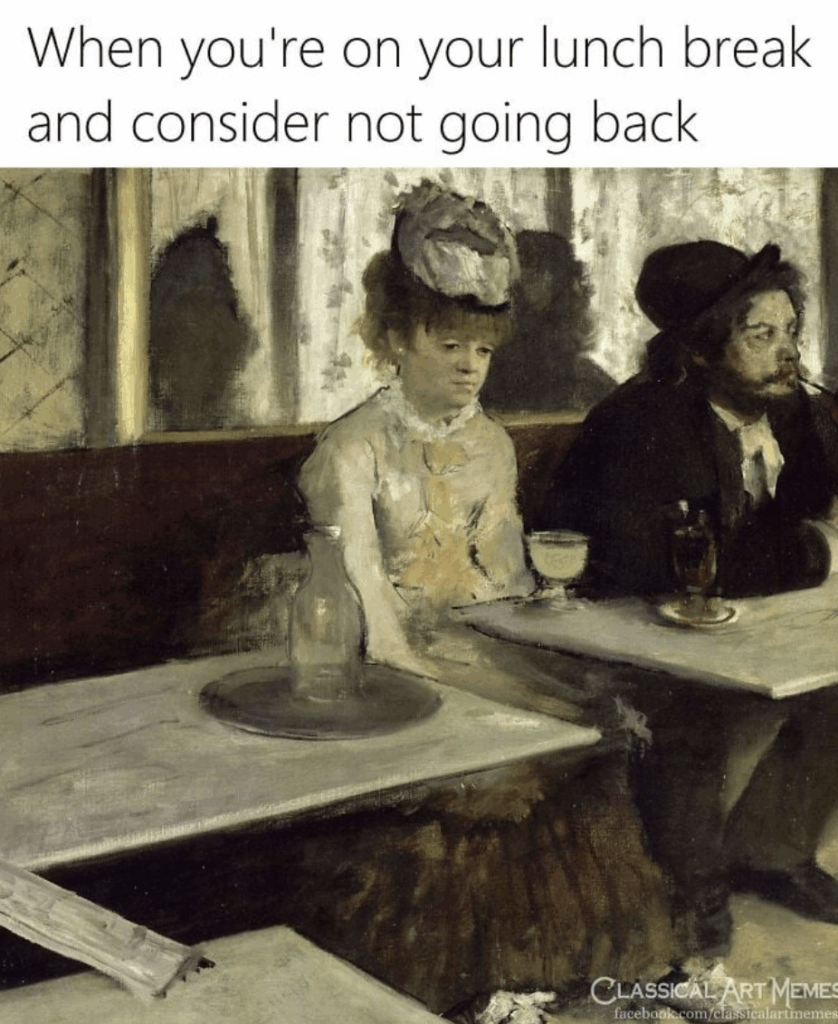
This observation in fact can be generalised: in internet memes combining image and text, the images are not there as illustrations of the text, or conversely, the text need not describe what is in the image (in the way in which captions under a newspaper photo do). Instead, images serve as structural components, with different image-text relations applying to different types of internet memes. Take the image of the painting of the Absinthe Drinker by Edgar Degas, painted in the mid-1870s, to which a line of text has been added above the image: “When you’re on your lunch break and consider not going back”. The example is one in a large collection of so-called Classical Art Memes, and the image was combined with other when-clauses in other iterations of the pattern, for instance “When the staff meeting is about to end and someone asks another question”, or “When it’s almost the New Year and you realize you’re still single”. Each of these when-clauses describes a recognizable situation involving unwelcome feelings (anticipation of an annoying return to work, impatience at being done with a boring meeting, sadness at being forever single, etc.). As a piece of text taken on its own, it is startlingly incomplete: the then-clause, which is supposed to be the main clause, completing a predictive reasoning, is missing. Instead, we get a visual completion, in this case the Degas painting. The connection between text and image is not in the specific situations involved in both, but purely in the mood, in what people feel like in both situations (e.g. the lunch break or staff meeting situation on the one hand, and the lethargic café scene on the other): when you’re in the situation described in the text, you feel like the character shown in the image. The image as a whole fills in an essential slot in the overall structure of the meme. This is a new kind of when-then construction (we can call it a ‘multimodal’ kind), sharing important aspects of the ordinary linguistic one, but adjusting it for use with images.
Apart from textual labelling, or adding a line above an image, a lot of memes use a line of top text and a line of bottom text superimposed onto the image. Some of these have partially filled in text: for instance, the “One does not simply…” meme uses a still image showing the character Boromir from The Lord of the Rings, and completes the top text line (“One does not simply”) with a bottom text line describing an action that is so difficult as to almost be impossible – as daunting and difficult, within the story of the film, as walking into the dark and dangerous realm of Mordor. One particularly sexist example, for instance, features the phrase “win an argument with a woman” in the bottom text. Other uses of top text/bottom text arrangements do not rely on signature phrases that remain fixed, but instead build on some skeletal features of linguistic predictive constructions (when P, then Q) combined with an image of a stock character, such as “Good Girl Gina” or “Scumbag Steve”. The image in these cases has come to represent a type of behaviour, such that any combination of the stock character’s image with the two lines of text now represents another example of, for instance, exemplary girl’s behaviour, or deplorable and inconsiderate male behaviour. Because of the visual presence of the stock character, the two parallel clauses in the top text and bottom text no long mention the subject, which is understood. For instance, one Scumbag Steve example has as text “Uses shopping cart / Leaves it in empty parking space”. Without the accompanying image, this would be pretty bad grammar. But in the multimodal predictive construction that is a Scumbag Steve meme, the subject argument suppression forms part of the ways in which the text has adjusted to the presence of the image.
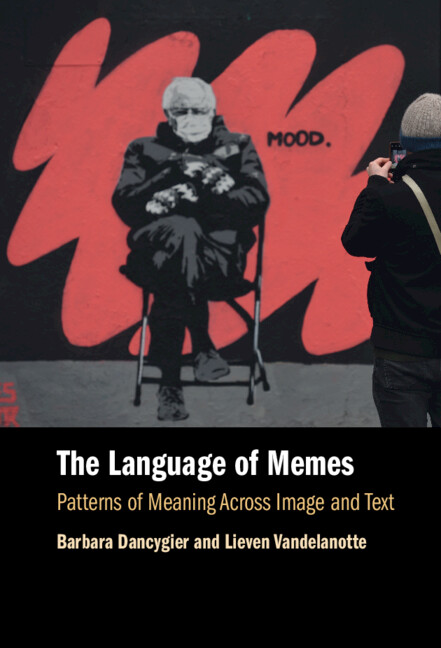
The examples we have shown or discussed here only scratch the surface of a rich and rewarding topic – the emerging grammar of internet memes, approached from a linguistic perspective. In our book The Language of Memes, we discuss these and other types in depth, in terms of their structure and their meaning-making mechanisms: so-called Image Macro memes (which re-use the same image across new iterations) vs. memes which use more one-off types of images, labelling memes, when-memes, memetic grids of various kinds (including, e.g., Anakin and Padmé memes), the curious uses of pronouns in memetic discourse and the many forms of apparent quotation in memes. We address questions of figurative language use, viewpoint mechanisms and stance expression, and memetic experimentation with both form and meaning. The final chapters zoom out to broader contexts of use, suggesting ways in which memetic grammar is affecting other forms of communication, across different social media platforms but also in new forms of advertising.
As the example of the mural with which we opened already suggested, the memetic mindset is starting to manifest itself beyond the confines of the internet. That’s one of the reasons we think it’s important to devote sufficient analytical energy to the forms of linguistic and multimodal creativity on display. We hope our book will be of interest to linguists, discourse analysts, media scholars and others interested in thinking about and working on various kinds of contemporary multimodal communication – not just internet memes.

Lieven Vandelanotte is Francqui Research Professor at the University of Namur and a Research Fellow in linguistics at KU Leuven, Belgium....
View profile >
Barbara Dancygier is Professor and Distinguished University Scholar at the University of British Columbia, Canada....
View profile >Keep up with the latest from Cambridge University Press on our social media accounts.


Latest Comments
Have your say!