

Products and services

Reading by her window, “cross-legged, like a Turk,” Jane Eyre transports herself to “Lapland, Siberia, Spitzbergen, Nova Zembla, Iceland, Greenland.” Anywhere but Gateshead, where her life has been one of continual oppression. But the book she reads bears a surprising title: “Bewick’s ‘History of British Birds.’” What is supposedly national turns out to be immediately transnational. British birds, it seems, fly around the world.
The same might be said of Jane Eyre the novel. An exemplary instance of nineteenth-century realism, Jane Eyre, nevertheless, contains within its gothic attic the sins of empire. Generations of readers have taught us to see the way the two are constitutive of one another, the construction of a white feminist subject seeming to require, as Gayatri Spivak famously argued, the destruction of her dark double: Bertha Mason as the outside of Jane Eyre. But of course what makes this element of the novel so compelling is that Bertha Mason is not outside of Jane Eyre. She is right there, in the heart of the book, even if it took a century for anyone to notice. The difficulty of reading the novel consists in trying to do justice to the doubleness of Brontë’s vision. She allows us to observe the link between domesticity and empire, but she does so with startlingly little concern for those on the imperial side of the relation. Nevertheless, read through the lens of Jean Rhy’s Wide Sargasso Sea, what Brontë paints as Bertha’s unhinged madness is transformed into justifiable rage. Rhys’s text doesn’t so much supplant Jane Eyre, then, as allow us to see it anew, showing us what Brontë herself could not.
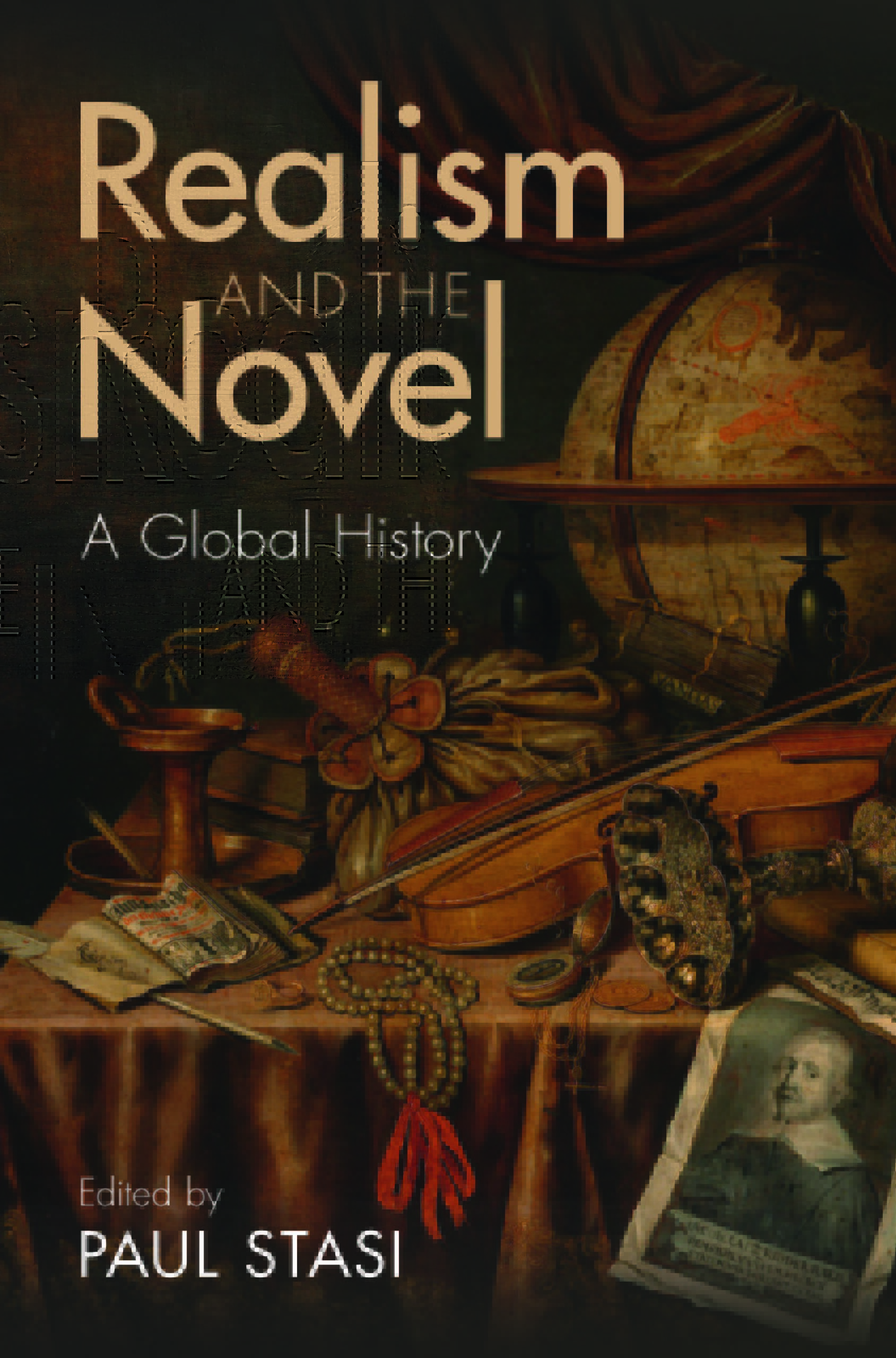
This set of relations—between travel and captivity, nation and empire, text and text—neatly summarizes the ideas governing Realism and the Novel: A Global History. If the novel form was, at least in part, a European invention, this seemingly autonomous development was, in fact, the product of Europe’s interactions with the rest of the world. The periphery, we might say, was present at the novel’s birth. Realism’s defining ideas—nation and family, sentiment and sensibility, citizen and subject—are themselves conditioned by the colonial encounter. And these concerns, along with the realist novel itself, change as they travel across the world.
Our volume, Realism and the Novel: A Global History, tries to do justice to both sides of this dialectic, combining arguments about realism’s emergence in the European eighteenth and nineteenth century with essays on its persistence throughout the world and into the twentieth and twenty-first century, focusing on the ways the relationship between center and periphery inform both realism’s origins as well as its continued relevance. At the same time, our collection takes seriously the semi-autonomy of literary form. The realist inheritance is not only an imposition; rather the realist novel has proven an exceptionally varied and multi-faceted form for representing the disparate social worlds of imperial modernity.
Sometimes empire makes itself felt directly in the novels discussed, as in Andrew Hebard’s reading of American naturalism’s grappling with an empire composed of territories “foreign in a domestic sense,” a phrase that resonates across the volume, as local traditions engage with the novel form. In Russia, for instance, the novel was, as Priscilla Meyer demonstrates, a French import, and the ability of an imported form to capture different social realities is integral to chapters on Caribbean realism by Michael Niblett, African Realism by Josh Jewell and Madhu Krishnan, and the South Asian novel by Pranav Jani. As these chapters show “the colonial origins of realism,” in Jani’s formulation, “did not overdetermine the practices of writers,” part of what allows the realist novel to incorporate ideas and places imagined to be outside its purview (sentiment, for instance, in Ulka Anjaria’s reading of two South Asian novels and Nicole Eitzen Delgado’s essay on Latinx Realism).
At other times, global developments impact the seemingly internal dynamics of a literary tradition, as in Christopher T. Fan’s account of the turn to genre in recent Asian American fiction, or Tavid Mulder’s reading of magical realism in relation to the development populism of mid-century Latin America. The novel, that is to say, is one of Roberto Schwarz’s famous “misplaced ideas,” a concept anchoring Kyle Proehl and Neil Larsen’s reading of the mediated social world present in the form of two key texts of twentieth-century Latin American literature, as well as Oded Nir’s understanding of an Israeli realism grappling with uneven development. In all these cases, as in Schwarz’s original argument, the very divergence between form and social world is what enables the revelation of the deep structures of the ideologies under discussion. This ability of realism to, in Mika Turim-Nygren’s words “reveal even those truths that its author[s] might have preferred to deny” emerges as one of its greatest strengths, as in her account of the vexed construction of an American nation out of class, cultural, and linguistic differences in Williams Dean Howells’s work, or the inadequacy of liberal solutions in colonial spaces, as in Mary Mullen’s reading of the nineteenth-century Irish novel—even as that very flexibility calls forth various attempts to rein in its truth telling, as in Martin W. Huang’s reading of the long history of the Chinese novel.
These are only some of the twenty-nine essays in the volume, all of which deserve to be referenced here, if space weren’t an issue. What unites the collection as a whole is a commitment to the vitality of realism as a form and to the varied and uncertain outcomes that emerge as it travels across time and space. What in its country of origin is read as fidelity to local circumstances becomes in a different location a world of possibility. What once seemed a story about a governess finding love becomes a tale about the imbrication of rural England with a colonial world it barely acknowledges. Much like Jane Eyre’s birds, then, books migrate and travel—but we also travel through them.

Paul Stasi teaches twentieth-century Anglophone literature at SUNY Albany. He is the author of numerous essays and, most recently, of The Persistence of Realism in Modernist Fictio...
View profile >Keep up with the latest from Cambridge University Press on our social media accounts.



Latest Comments
Have your say!