

Products and services


Before his death on the battlefields of the First World War, the young philosopher Adolf Reinach was a rising star—prime assistant to Edmund Husserl; mentor and friend to a generation from Max Scheler to Edith Stein. Since then, his influence has waned. To be sure, he developed something like speech act theory decades before John Austin—but Austin appears to have come to it on his own. Reinach’s work has, indeed, fallen into relative obscurity—his method of “realist phenomenology” alien to both sides of the contemporary analytic-Continental divide; his contributions to legal philosophy idiosyncratic among his contemporaries and largely ignored in Anglophone jurisprudence.
That is, until recently. In the past decade or so, citations to Reinach’s masterwork The Apriori Foundations of the Civil Law have begun reappearing in English law and legal philosophy. His work, as has become increasingly apparent, has much to say to contemporary private law theory, particularly of the “New Private Law” school—a push to take the linguistic structure of private law seriously in different ways, in contrast to the thorough-going conceptual nominalism of classical Law and Economics and Legal Realism. Reinach, as many of today’s theorists, rejected the rising nominalism about legal concepts of his age and offered a provocative and difficult alternative: that the basic organising concepts of private law are metaphysically real and epistemically a priori, like the basic concepts of arithmetic and logic.
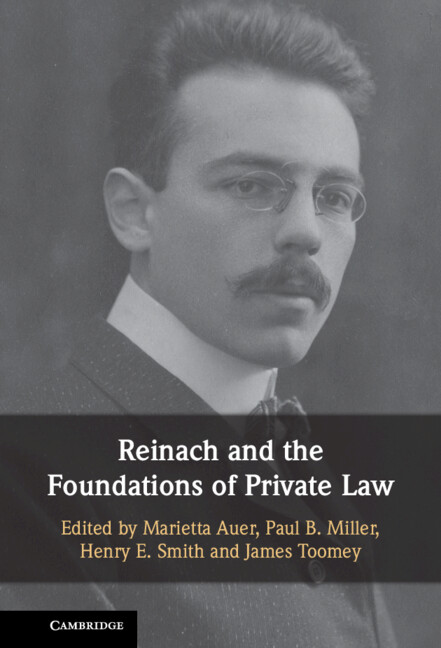
The new volume, Reinach and the Foundations of Private Law, edited by me, Marietta Auer, Paul Miller and Henry Smith, is out now with Cambridge University Press and available Open Access through Cambridge Core. It aims to rejuvenate, situate, and interrogate Reinach’s legal philosophy for a contemporary audience. Bringing together the work of both legal scholars and philosophers, the essays in the volume shed light on Reinach’s methodology, place his insights in contemporary debates about the foundational structure of private law, and engage in original, Reinachian analysis of legal concepts.
In the Foundations, Reinach argued that “the structures which one has called specifically legal have a being of their own just as much as numbers, trees, or houses,” and that the “the positive law finds the legal concepts which enters into it; in absolutely no way does it produce them.” This realisation, he suggests, provides insights into the structure of particular concepts that the law draws on and qualifies but does not create—that, say, every promise creates an obligation and a claim; obligations dissolve when they are waived, and much more. It is hard to imagine a view more strongly opposed to the nominalism about legal concepts that has dominated legal philosophy for a century since Legal Realism—the view shared by accounts as oppositional as classical Law and Economics and Critical Legal Studies that legal concepts are nominalistic placeholders for policy conclusions.
That is what makes an encounter with Reinach’s work today bracing, refreshing, and illuminating. For those sympathetic to New Private Law and its growing scepticism of pervasive nominalism, it’s a thorough account of what an alternative picture of the architecture of private law might be. For those sceptical of the recent conceptualist turn in private law theory, Reinach is an open exponent of the perhaps metaphysically dubious Platonism of which legal conceptualists have long been suspected.
The essays in the volume are organised in three parts. In the first part, Marietta Auer, Kimberly Baltzer-Jaray, Lorenz Kaehler, and I discuss issues related to Reinach’s “realist phenomenologist” method. Auer argues that, whatever Reinach says about the metaphysical reality of his legal concepts, his work can be seen as compatible with that of the later ordinary language philosophers he so resembles, offering genuine insights on the semantic structure of legal words, whatever their metaphysical correspondence. In a similar vein, I argue that Reinach’s work could be thought of as compatible with contemporary accounts that would ground the universality of legal concepts in evolutionary psychology, notwithstanding Reinach’s own insistence that his claims hold for all conceivable intelligence. Kimberly Baltzer-Jaray, one of the world’s leading experts on Reinach’s life and thought, offers insight into his controversial views that negative states of affairs have the same metaphysical standing as positive ones, which she links to his legal philosophy. And Lorenz Kaehler suggests that while Reinach’s arguments have perhaps demonstrated the existence of non-positive true legal propositions, he has not substantiated the stronger claim that they are a priori.
In the second part, Andrew Gold and Henry Smith, Sandy Steel, Paul Miller, and Olivier Massin situate Reinach’s account in contemporary private law theory. Gold and Smith suggest that understanding Reinach’s work as proposing a kind of conceptual “deep structure” of law analogous to Chomskyan “deep structure” in linguistics can help clarify the pervasive polarisations of contemporary private law theory without endorsing Reinach’s complex metaphysics. Sandy Steel situates Reinach’s account alongside that of today’s neo-Kantians—the former seeking the a priori descriptive conceptual architecture of law, the latter something like its a priori normative foundations. Paul Miller argues that, while Reinach’s analysis of representation stands among the strongest ever offered, his account of legal personhood, like that of many contemporary private law theorists, leaves us wanting. And Olivier Massin puts Reinach’s account alongside that of one of his own contemporaries, Wesley Hohfeld—and argues that by accommodating absolute rights without correlatives, Reinach’s ontology of the rights and obligations of private law is the more plausible.
Finally, in the third part of the volume, Stephan Kirste, Emma Tieffenbach, Alessandro Salice and Olivier Massin, and Crescente Molina apply Reinachian methodology to offer insights on legal concepts of their own. Stephan Kirste focuses on the legal concept of time, and compares Reinach’s scattered comments on the topic with those of the later legal phenomenologist Gerhart Husserl. Emma Tieffenbach analyses the concept of gifting, offering a novel account of the a priori structure of the social act of gift. Salice and Massin do much the same with the concept of promise, arguing that their Reinach-inspired account of the nature of promise is superior to a leading, similar account from today’s literature—that of Margaret Gilbert. And finally, Crescente Molina analyses the conceptual architecture of contract law in Reinachian spirit, arguing that the speech act of promising is the wrong place to start—and that indeed in some cases contracts can be formed without any speech act at all, as by mere internal assent.
Taken together, the essays in this volume bring to their rightful place in legal philosophy the essential but long-sidelined work of Adolf Reinach. Indeed, whether right or wrong (or, as most of the essays in the volume argue in one way or another—on-to-something, not right-about-everything) the volume argues that Reinach’s work can no longer be ignored.

Marietta Auer is Professor of Law and Director at the Max Planck Institute for Legal History and Legal Theory in Frankfurt....
View profile >Paul B. Miller is the Robert and Marion Short Professor of Law and Associate Dean for International and Graduate Programs at Notre Dame Law School, where he directs the Notre Dame ...
View profile >Henry E. Smith is the Fessenden Professor of Law at Harvard Law School, where he directs the Project on the Foundations of Private Law....
View profile >James Toomey is Associate Professor of Law at the University of Iowa. Previously, he was an Assistant Professor of Law at the Elisabeth Haub School of Law at Pace University....
View profile >Keep up with the latest from Cambridge University Press on our social media accounts.




Latest Comments
Have your say!