

Products and services


The rise of the gig economy and precarious labor has caught both academic and media attention. What happens to the largest workforce in the world? The over 200-million rural-to-urban migrant workers have been behind the engine of China’s manufacturing, making China the workshop of the world. Their hard labor and discipline have contributed to the efficient production of the consumer products that people enjoy all over the world, such as cell phones, clothing, toys, etc. However, in the last two decades, a new generation of migrant workers – born in the late 1980s and the 1990s – have emerged; this, along with China’s changing labor laws and institutions, has reshaped China’s labor landscape.
The New Generation of Migrant Workers
The new generation of Chinese migrant workers, unlike the first generation, are born and raised in a period in which migration to the cities for employment has become the norm and massive economic growth has led to better material conditions for the rural and migrant population, despite rising inequality. As children of the first generation of migrant workers, thanks to their families’ hard labor and economic gains, they grow up with better access to education, consumer products, and technologies compared to previous generations. In addition, they have less attachment to the farmland and the rural way of living, and many of them no longer perceive themselves as temporary sojourners in urban cities whose goals are to earn money, save and send remittances back home, and eventually settle down in or close to their home villages. Instead of being driven by economic goals and survival needs, the new generation of migrant workers increasingly migrate for personal development, individual freedom, and the urban consumerist lifestyle. They experience a deeper sense of anger and dissatisfaction with their migrant status and with the exploitative and hopeless factory regime.
Changing Labor Institutions
Like elsewhere in the world, the pursuit of profitability and high employment pressure along with increasing labor migration has led to the demands for flexible employment in China, and labor dispatch – where an employment relationship is established between workers and employment service agencies instead of actual user enterprises – has become a widely used mechanism for employers to mitigate labor liability, avoid labor inspection, and lower labor costs. Since the passing of the 2008 Labor Contract Law, the use of labor dispatch has expanded, as the law requires employers to make mandatory contributions to the social insurance system – healthcare, retirement, work-related injury, unemployment, and maternity – and to the housing provident fund, all of which could amount to 30-40% of employees’ total wages. Labor dispatch is also preferred by companies that cope with seasonal production changes and want to fill labor shortages in peak season, such as in the case of electronics manufacturers in need of hourly-paid workers for rush orders, but do not want to keep workers for the slower season or deal with severance pays.
Despite multiple amendments to labor laws to reduce and regulate the use of dispatch workers and protect workers’ rights, non-compliance remains rampant – often with local states’ complicity or acquiescence – and a private employment agency industry is booming. Employment service agencies and job intermediaries not only control access to all sorts of formal and informal jobs, including regular and temporary manufacturing and service jobs and day labor jobs, but also affect the terms under which workers enter their employment – workers are often faced with complex pay schemes depending on their job tenure and performance and can easily get their wages docked.
In addition to the changing labor laws and hiring institutions, although the initial factory regime was built upon the exploitation of young, single, female workers as the cheapest and most compliant labor force, a shortage of female workers along with the increasing participation of women in the service sectors has propelled factories to hire more young men, changing the demographic composition in manufacturing. Male migrant workers are therefore faced with a related but distinct gendering process from their female counterparts. While at home and in rural villages men may still hold power and privilege over women, on the shop floor female workers not only are perceived by management as better workers but often occupy higher positions as line or section leaders, putting low-skilled male workers at the bottom of the factory hierarchy. Male migrant workers are concurrently facing and constantly reminded of the competing gender expectations – female migrant workers as the ideal worker in their workplace, urban middle-class men as the ideal man in other spaces, the gender norms in their rural upbringing, and the consumerist and hypersexualized gender discourses in the media and social media that have become widely accessible to the younger generations. Depending on the circumstances, different types of masculinity may be evoked to affect how they perform and express their gender.
“The Great Gods” (dashen)
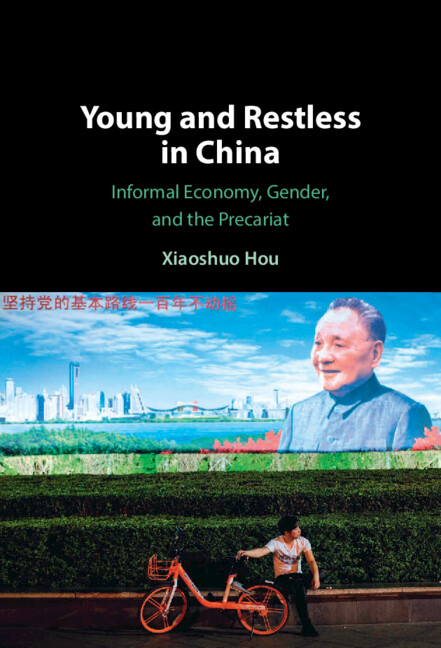
Under this context, Young and Restless in China: Informal Economy, Gender, and the Precariat explores the lives of the second-generation migrant workers who are engaged in the informal economy ranging from temporary and day labor jobs at factories, construction sites, distribution facilities, etc., to work in the “grey” and sometimes illegal sectors of the economy through an ethnographic study of two migrant communities in China. The protagonists of the study are mostly male and born in the late 1980s and the 1990s, who become disillusioned with the prospects for upward social mobility through long-term factory work and either opt for temporary and informal work or engage in illicit work or completely give up on work. They call themselves the great gods (dashen) and live a low-desire, bachelor’s life, voluntarily or involuntarily. Counterintuitive to the stereotypical view of Chinese migrant workers as hard-working, driven, and filial pious, the great gods are often described as “work for one day and play for three days” – instead of working tedious factory jobs year in and year out, they would rather look for jobs that pay them by the end of the day so that they could earn some quick cash and would then spend the next couple of days indulging in online video games, online gambling, or simply roaming around until they run out of money and have to look for jobs again.
The book reveals the processes and different levels of precarization among workers, their conundrums and everyday resistance. Essential to these processes are the diverse intermediaries who supply the great gods with jobs and livelihoods and thus both sustain and reproduce their precarious work and life, while gender is implicated in their work and life choices, aspirations, daily interactions, relationships, attitudes towards sex, as well as how the state and other authorities perceive and manage them.
More than a subculture or a counterculture, the great gods’ experiences in factories and at day labor job sites expose the concerted effort of the state, employers, and all sorts of intermediaries to engage in labor discipline and to mold specific types of workers. The great gods’ disinterest in work with high control and low wages suggests at least the partial failure of such effort, while the constant struggle over whether they should go back to or run away from the factory system indicates the difficulty of escaping and the lack of long-term viable alternatives for the many low-skilled migrant workers.
The rise of the precariat in China blurs the boundary between the working class and the underclass and challenges the stereotypical view of Chinese migrant workers as a monolithic group that shares similar aspirations and regards migration as a mechanism for upward social mobility. Informal precarious workers like the great gods are in no way disappearing, despite the local state’s efforts to regulate their presence through both enclosure and dispersal. Their very existence manifests the logic of capitalism built upon surplus and productivity and the spatial contestation in which migrant workers have long engaged, as they are only welcomed in to the cities as productive workers but not as entitled citizens and whose legitimacy and worth in the city has to be constantly proved. This book thus not only sheds light on the new generation of migrant workers in China but also has great implications for the discussion of precarious labor around the globe.

Xiaoshuo Hou is Professor of Sociology and Asian Studies at Skidmore College where she held the inaugural Frances Young Tang '61 Chair in Chinese Studies (2016-2021). She is the au...
View profile >Keep up with the latest from Cambridge University Press on our social media accounts.



Latest Comments
Have your say!