

Products and services

For anyone interested in the crucial role of money in American literature, it cannot seem anything other than eminently fitting that at the very “navel” of the vessel at the centre of the greatest of all Great American Novels sits a gold coin. Or that this totemic monetary object should speak resoundingly to questions – of nationhood, materiality, enchantment, textuality, power, and identity – that reverberate across American literary history.

Ecuadorian 8 Escudos doubloon – the “Moby Dick Coin” (minted 1840).
It is in Chapter 36 of Herman Melville’s Moby-Dick (1851) that Captain Ahab first produces a gold “sixteen dollar piece … a doubloon” and nails it to the mainmast of the Pequod, promising it to whichever member of the crew delivers the eponymous white whale’s carcass to him. Chapter 99, “The Doubloon,” consists of a series of meditations on this coin, which assumes the status of a talisman for the novel as a whole. The doubloon is stamped “REPUBLICA DEL ECUADOR: QUITO,” opening up the broad and complex question of Melville’s relation to Latin America. Equally, as the critic Susan Garbarini Fanning has suggested, Ahab’s observation that “this round gold is but the image of the rounder globe, which like a magician’s glass, to each and every man in turn but mirrors back his own mysterious self” might prompt “an American reader [to] regard the doubloon as a symbol of the American republic” – the macrocosm of the nation reflected in the microcosm of a single unit of currency. This conception of the nation as represented in and by money is a recurrent preoccupation in American literature and culture: money often appears as a phenomenon around which ideas of national identity, unity, and destiny coalesce, but may also be figured as reflecting the declining health of the body politic or the erosion of values understood to be essential to American nationhood.
In Moby-Dick, there is a suggestion that the value of this particular monetary object is a product at once of its inherent, material properties and of the symbolic meanings and associations with which it is imprinted, the narrator, Ishmael, reflecting that “the precious gold seems almost to derive an added preciousness and enhancing glories, by passing through those fancy mints, so Spanishly poetic.” Melville here gestures toward a question that has perennially vexed Americans’ thinking about money: to what extent is monetary value an intrinsic thing – an innate property of certain, peculiarly “precious,” substances, especially gold – and to what extent an effect of acts of proclamation or inscription, which symbolically bestow that value on more-or-less arbitrarily nominated objects (including materially “worthless” ones, like paper)? American authors have sometimes been drawn to quests to identify an absolutely objective and natural basis for money, but have also been inspired by affinities between money’s symbolic dimensions and their own practice of making things “real” by writing them into being. Indeed, a sense that money entails elements of trust, make believe, and even something like magic in its conjuring up of value via verbal or textual means has often appealed to producers of imaginative literature, especially those whose own literary creations tend toward the speculative, fantastical, or otherworldly. Melville points to money’s enduring links to the mystical and esoteric in observing that “arching over all” on the doubloon is “a segment of the partitioned zodiac, the signs all marked with their usual cabalistics.”
Perhaps most striking of all in this key episode of Melville’s novel is the way in which the coin’s intricate design is treated by the various characters who examine it as a cryptic text to be deciphered – an emblem, in miniature, of the interpretive enigmas posed by Moby-Dick itself. Thus in “The Doubloon” Ahab himself appears “newly attracted by the strange figures and inscriptions stamped on [the coin], as though now for the first time beginning to interpret for himself in some monomaniac way whatever significance might lurk in them.” Ahab’s intent scrutiny of the coin inspires his second mate, Stubb, to try his own “hand at raising a meaning out of these queer curvicues.” Whereas, when taking his turn to “read” the markings, Stubb beholds “signs and wonders truly,” another crewman who approaches the mast remarks, with comic bathos, that “I see nothing here, but a round thing made of gold.” Taken together, the various responses that make up the chapter suggest the curious capacity of a single “text” – whether it be a unit of currency or a work of fiction – to be made over according to multiple different interpretative schemas; in Stubb’s words, “there’s another rendering now; but still one text.”
Another highly suggestive feature of this scene is the connection it draws between money and power. Most obviously, Ahab’s authority over his crew – his ability to bind them to his fanatical purpose in pursuing Moby Dick – evidently derives in significant part from the prospect of obtaining the precious doubloon. Ahab’s possession of the coin induces others to submit to his command and subordinate themselves to his goals. “The Doubloon” also, more subtly, hints at how money might factor into power differentials that are connected to racial and ethnic difference. The procession that passes by the mast over the course of the chapter, performing its ad hoc numismatic ruminations, is initially made up of five white men, in descending order of seniority (Ahab, the chief mate Starbuck, second mate Stubb, and third mate Flask – all of whom hail from New England – before the Isle of Man-born crewman known as the Manxman). They are followed by the Pacific Islander Queequeg and Parsee Fedallah, both harpooners on the mates’ boats, and finally by the African American cabin boy Pip. In the commentary – delivered by Stubb, and reported by Ishmael – via which we observe Queequeg’s and Fedallah’s approaches to the mast, these two embodiments of racial, religious, and cultural difference are assumed to have a relation to the coin that is nothing more than an amalgam of ignorance and superstition, as if, for Stubb at least, their otherness is so pronounced as to render money, as a core institution, object, and practice of “civilization,” radically alien to them. As a young Black man whose heritage lies in two states (Connecticut and Alabama) that had long histories of slavery, Pip, by contrast would appear to have an all-too-intimate relation to money – the very phenomenon that defines the parameters of existence for so many African Americans in the antebellum US.
Money’s relation to power – and especially to racial power dynamics – is an enduring preoccupation in American literature. Writers have examined the stark and persistent disparities in wealth and property between white and Black Americans (inequities that are of course inextricable from the fact that, until the 1860s, the vast majority of African Americans were property, under the regime of chattel slavery). And they have also tapped into deeply ingrained rhetorical linkages between race and money, whereby prized monetary qualities (such as lustre, purity, authenticity, or legality) have tended to be associated with whiteness, and denigrated ones (tarnishing, debasement, devaluation, counterfeiting, and so on) with Blackness. While many white writers have taken these associations for granted, a crucial project of African American literature has been precisely to perform a transvaluation of this prevailing scheme of monetary-cum-racial values.
The coin at the centre of Moby-Dick, then, provides something of a portal into the expansive topic of money and American literature. The book devoted to this topic that I have edited for Cambridge’s Themes in American Literature and Culture series is an extended demonstration and exploration of money’s central importance in American literature. It charts how writers have made sense of changing monetary structures, systems, standards, and practices in America over the past five centuries. It reflects the fact that American literature’s engagements with money – and with directly related topics such as debt, credit, accounting, finance, and the capitalist marketplace – have been crucial preoccupations for Americanist scholars over recent years. Written by a team of leading international experts, and covering topics ranging from money in colonial America to contemporary cryptocurrencies, Money and American Literature provides the definitive mapping of this essential aspect of US literary and cultural history.
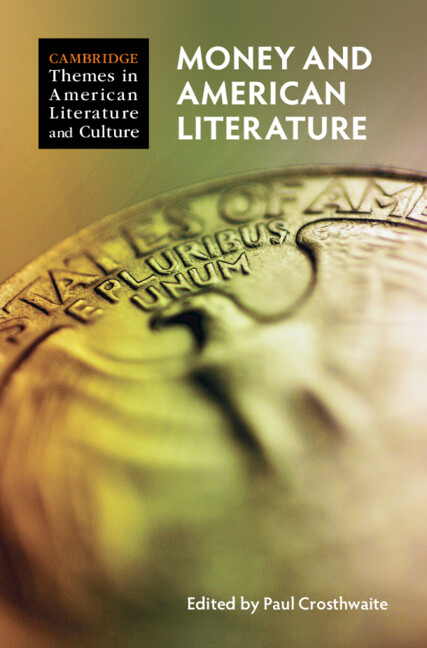
Money and American
Literature by Paul Crosthwaite

Paul Crosthwaite is Professor of Modern and Contemporary Literature at the University of Edinburgh....
View profile >Keep up with the latest from Cambridge University Press on our social media accounts.



Latest Comments
Have your say!