
Products and services


Today the international order appears to be falling apart. War in Eastern Europe is continuing to escalate, militarism is on the rise in Western Europe, and the USA seems to be increasingly disinterested in playing by the rules which helped support its global hegemony after 1945. At least in the liberal West, international disorder is more deeply felt by observers than it has been for some time. At the same time, the social organization of world politics is made up of many layers, and despite a widespread anxiety in our times, there are many things that remain unchanged. Understanding long-term historical change in international order is vital in order to put the current moment in the proper perspective.
The fundamental institution and practice of territory in world politics is a good example of this. With Russia’s recent conquests in Ukraine, the prohibition of territorial conquest which has been effective to an important degree since 1945 seems to be in doubt. But if we look deeper, the way in which the territories of states are defined through precise boundary lines has not changed. Normally, it is not expected that a state can end “thereabouts” or in a vague way, nor do states normally ask local inhabitants where their borders are. Instead, technical experts employed by states reserve the right to correctly interpret the exact locations of borders. There is no clear indication that this will change any time soon.
In my recent book, From Frontiers to Borders: How Colonial Technicians Created Modern Territoriality, I provide an original take on the way in which this system of precise, linear borders is unique to modernity, how it came into being, and how it changes international politics. The main takeaway is that beneath the many changing ways in which territory is contested, the many various meanings attributed to territory, and so on, is a quintessentially modern practice of territoriality based on delimitation (the technically precise description of geographical lines) and demarcation (the marking of lines on land). This practice, I argue, was first systematically practiced over a range of polities in the European colonies of 17th-century North America, and became global in the 19th century. It is deeply ingrained in global political practice, perhaps even more deeply than sovereignty itself, as sovereignty is not necessary for modern territoriality, which first appeared among colonies.
One of the implications of this is that experts of a certain kind, such as surveyors, who can be consulted on technical questions about the relative locations of geographical points, are built into the foundations of international order as we know it. They are not optional in the sense that states can choose whether or not to consult with them, and whether or not to take their advice. To claim a territory without doing so within the standards of precision, to some minimal degree, recognizable by geographical experts, would be to stretch the boundaries of deeply established practices. This does not make it impossible—for example, during the 2010s, China and India abandoned their attempt to delimit their border. But precise delimitation and demarcation remain the standard against which deviations are judged. There is still no recognized alternative system of claiming and marking territory, outside of delimitation and demarcation.
This is not to say that modern territoriality will never change or be replaced. In our increasingly multipolar world, it may be that international law and norms will be subject to proliferating interpretations. Standard practices historically associated with Western modernity may fragment, without any plausible attempt to come up with alternatives operating on a global level. But modern territoriality is one aspect of international order which, unlike, say, human rights, development, or the laws of war, are so taken for granted that it is difficult even to imagine what would happen in its absence. International order may be in crisis, but there is much room for the crisis to deepen.
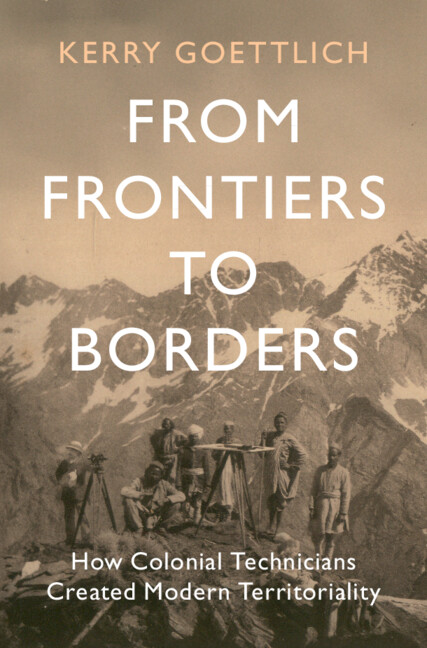

Kerry Goettlich is Lecturer in International Security at the University of Reading. His research has appeared in journals including the American Political Science Review, the Europ...
View profile >Keep up with the latest from Cambridge University Press on our social media accounts.


Latest Comments
Have your say!