Products and services

The law underwent significant developments in eighteenth-century Britain as jurists and legislators adapted older doctrines to fit the needs of an increasingly commercial, industrial, and imperial society. These developments at once shaped and were shaped by the period’s imaginative writing. In an era when disciplinary boundaries had not yet hardened, some men trained for the […]
Read More
When the idea of setting up a Modern Languages school (which was intended to include the study of English) was being debated at the University of Oxford in the late 1880s, E.A. Freeman, Regius Professor of Modern History, witheringly dismissed the study of literature as ‘mere chatter about Shelley’. Freeman was impressed with his coinage, […]
Read More
In 1885, John Ruskin resigned as Slade Professor of Art to protest the establishment a laboratory for experimental physiology at Oxford University. ‘I cannot lecture in the next room to a shrieking cat’, he announced, ‘nor address myself to the men who have been – there is no word for it.’ The word that Ruskin […]
Read More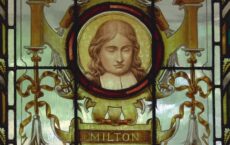
The English author John Milton, who never set foot in Ireland, has long been a consequential presence there nonetheless. Since 1890, for example, visitors to the National Library of Ireland in Dublin have entered through a semicircular lobby in which a beatific face of John Milton shone down on them as they arrived. In order […]
Read More
What do you feel when you look at something beautiful? Take this honeysuckle pattern, copied from a Greek vase. As your eyes trace its symmetrical curves, can you feel your “two lungs draw in a long breath”? Do those inhalations give you a “sense of expansion,” or a “vague feeling of harmony”? How about your […]
Read More
The English poet John Keats died in 1821, and almost immediately his friend Joseph Severn began working on the portrait of Keats that hangs in the National Portrait Gallery in London. Severn painted from memory, capturing Keats sitting among his books – one of which he is reading – in his home at Hampstead Heath. […]
Read More
What does it mean to write a novel of ideas? These are works of fiction that foreground debate and disputation-like the discussions of Zionism in George Eliot’s Daniel Deronda, the politico-religious arguments in G.K. Chesterton’s The Man Who Was Thursday, the utopian speculations of H.G. Wells’s A Modern Utopia, the debates about Communism in Doris […]
Read MoreJohn Cleland, best remembered as the author of the erotic novel Memoirs of a Woman of Pleasure (1748-49), was a tricksy and entertaining correspondent. His letters, just published by Cambridge University Press, reveal his attempts to insinuate himself with the rich and powerful at the same time as he teased them for what he perceived to be […]
Read MoreKeep up with the latest from Cambridge University Press on our social media accounts.