
Products and services


From the mid-seventeenth century onwards, Indian textiles were imported by the European East India companies and were sought after by consumers not just in England, but in most European countries. But the inroads of Indian cotton textiles into the consuming habits of Europeans also generated resistance.
Read More
Thirty years since the discovery of AIDS, and despite huge scientific advances made since its discovery, the origins of the AIDS virus continue to puzzle doctors and scientists. In The Origins of AIDS, Dr Jacques Pépin has written an immensely readable and scholarly study that finally provides an answer.
Read More
In this video, Dr. Sarah B. Snyder, author of Human Rights Activism and the End of the Cold War talks with Ambassador Richard Schifter, former Assistant Secretary of State for Human Rights and Humanitarian Affairs, and National Security Archive Research Fellow Svetlana Savranskaya about the role of human rights activism in the end of the […]
Read More
Not one, but two Toby E. Huff titles have been singled out as “fascinating” books in recent news items. Huff’s The Rise of Early Modern Science (2003) recieved the distinction in an Edward Rothstein piece on the 1001 Inventions Exhibition in the New York Times’ Critic’s Notebook, while the more recent Intellectual Curiosity and the Scientific Revolution (2010) […]
Read More
A few weeks ago, Jared Diamond, author of Collapse: How Societies Choose to Fail or Succeed, wrote a (rather negative) book review of Questioning Collapse: Human Resilience, Ecological Vulnerability, and the Aftermath of Empire - a critique of his own book - for Nature... without mentioning that Questioning Collapse was, well, questioning Collapse. StinkyJournalism.org laid out this conflict of interest, starting a good ol’ fashion media ethics debate. Today, the controversy comes to a head and the collected contributors of Questioning Collapse have formulated a response. -------- Requesting Full Disclosure and Correction of Factual Errors Patricia A. McAnany, Norman Yoffee, Joel Berglund, David Cahill, Frederick Errington, Deborah Gewertz, Terry Hunt, Timothy Murray, Kenneth Pomeranz, Christopher Taylor, Michael Wilcox, and Drexel Woodson. -------- The 18 February 2010 (Vol 463) issue of Nature contains a response to our recently published book entitled Questioning Collapse. Called “Two Views of Collapse,” it masquerades as an impartial book review in which the reviewer (Jared Diamond) alleges that the edited book contains serious errors of fact. This justifies his devaluation of our emphasis on human resilience and allows him to discount the importance of culture and history, including the facts of 18th-19th century colonialism. Throughout the “review”, Diamond fails to disclose that our book critically examines two of his publications: Guns, Germs, and Steel and Collapse: How Societies Choose to Fail or Succeed. The lack of full disclosure brings forth troubling questions. Readers of Nature expect a book review to include a description and evaluation of a book but not an author’s rebuttal to criticism of his own publications. We are disappointed that Nature would ask Jared Diamond to review our book. Nature is of course free to solicit an article by Diamond that considers the evidence presented in our book and/or to present new evidence. We are further surprised that the editorial team at Nature allowed the review to be published in its current form with unsubstantiated allegations of “errors and implausible extremes.” Here, we take pains to correct, once again, the errors perpetrated by the “reviewer” that again repeat over-determined and simplistic theses regarding both societal “collapse” and current global inequities in power and wealth. Read on as they dissect Diamond's argument, point by point. . . We emphasize that Questioning Collapse presents ample archaeological and historical data that contextualize how societies moved through periods of crisis. The goal of our book is to provide students and lay persons alike with an understanding of historical processes that is based upon up-to-date research. Questioning Collapse is more than a critical evaluation of Diamond’s scholarship: it is about how we understand change in the past, how we grapple with the legacy of colonialism and with inequalities in the present, and how we can move forward productively and resiliently into the future.
Read More
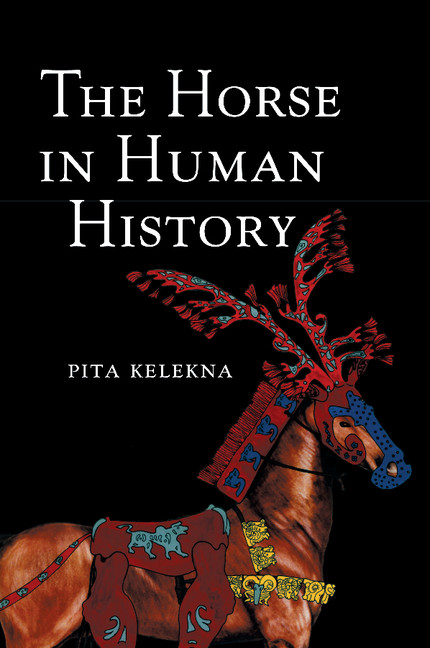
A controversial giant statue of a white horse by sculptor Max Wallinger will soon be erected at the Ebbsfleet station in southern England, the UK’s new gateway to continental Europe for Eurostar high-speed trains. Pita Kelekna tells us why this symbol is especially appropriate.
Read More
in the Far East, the Chinese achieved two significant breakthroughs during the first millennium BC, inventing first the trace harness (breast strap) and then the even more efficient contoured collar harness. While Roman chariots of minimal size, carrying two persons at most, were often drawn by four horses, contemporary Han vehicles with heavy roofs, frequently carrying six passengers, were usually drawn by a single horse.
Read MoreKeep up with the latest from Cambridge University Press on our social media accounts.






.jpg)