

Products and services


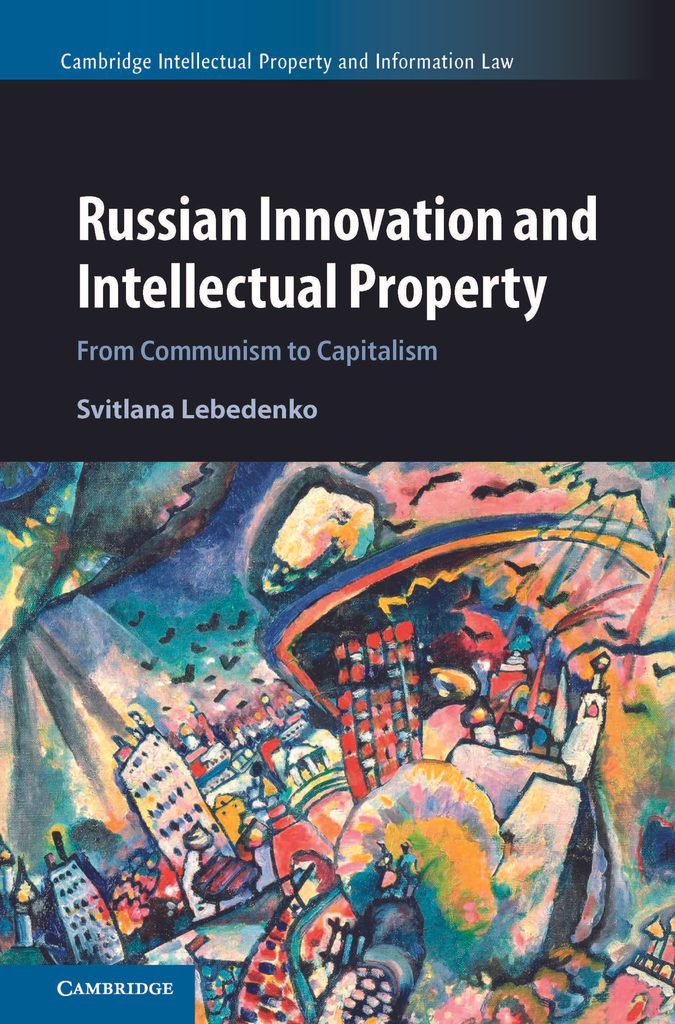
Russia is not a textbook example in the innovation studies literature – it is either ignored or considered an outlier because of its political regime. Russia’s current innovation system is largely fragmented. Yet it remains capable of making significant advancements in certain sectors of national importance. Authoritarianism alone cannot explain this pattern. The desire to understand which institutions lie behind the successes and failures of Russian innovation motivated me to write my book, Russian Innovation and Intellectual Property: From Communism to Capitalism (CUP, 2026).
This investigation took me to national archives and the offices of senior government officials in Moscow. I spoke to a former Minister of Economy and a former Minister of Higher Education and Science; specialists from the Intellectual Property Court, the Federal Antimonopoly Service, and the Patent Office; experts from the major innovation hubs, including Rusnano, the Russian Venture Company, and Skolkovo; representatives from industry associations and national champions Yandex and Kaspersky Lab; patent attorneys; intellectual property lawyers; and university technology transfer managers. What I discovered was a century-long history of institutional experiments in a turbulent and costly search for an optimal innovation system.
For almost seventy years, the Soviet Union relied on legal institutions for innovation that did not depend on commodification. One of these institutions, the inventor’s certificate (an alternative to the patent), was designed so that the inventor received compensation from the state rather than the right to stop others from using the invention. Because no one had to ask for a licence or wait for a patent to expire, others could build on it immediately rather than twenty years later. This model was not without drawbacks, but it did help the USSR make important advances in science and technology and transform itself from an agrarian into an advanced industrial society – evidence largely overlooked by those who argue that innovation depends on exclusive rights.
Post-Soviet Russia rejected this model and signed up to new intellectual property institutions based on exclusivity. It is somewhat surprising that such a monumental natural institutional experiment has attracted very little interest among intellectual property scholars. In my book, I examine the effects of this change and conclude that there is a deep mismatch between Russia’s formal intellectual property rules and the context into which they were transplanted, including a mismanaged transition to a market economy, a lack of specialist expertise, and a formalistic legal culture. The new rules became either dysfunctional or exploitable by a few, dangerously facilitating crony capitalists’ entry into high-tech sectors. The book shows that, paradoxically, Russia’s new system became more of a black box than its Soviet predecessor. Russia’s century of experiments offers lessons for today’s debates on industrial policy and on proposals to stimulate innovation without exclusivity, as well as insights into the institutional dynamics of innovation sectors in transition economies.
Keep up with the latest from Cambridge University Press on our social media accounts.




Latest Comments
Have your say!