

Products and services


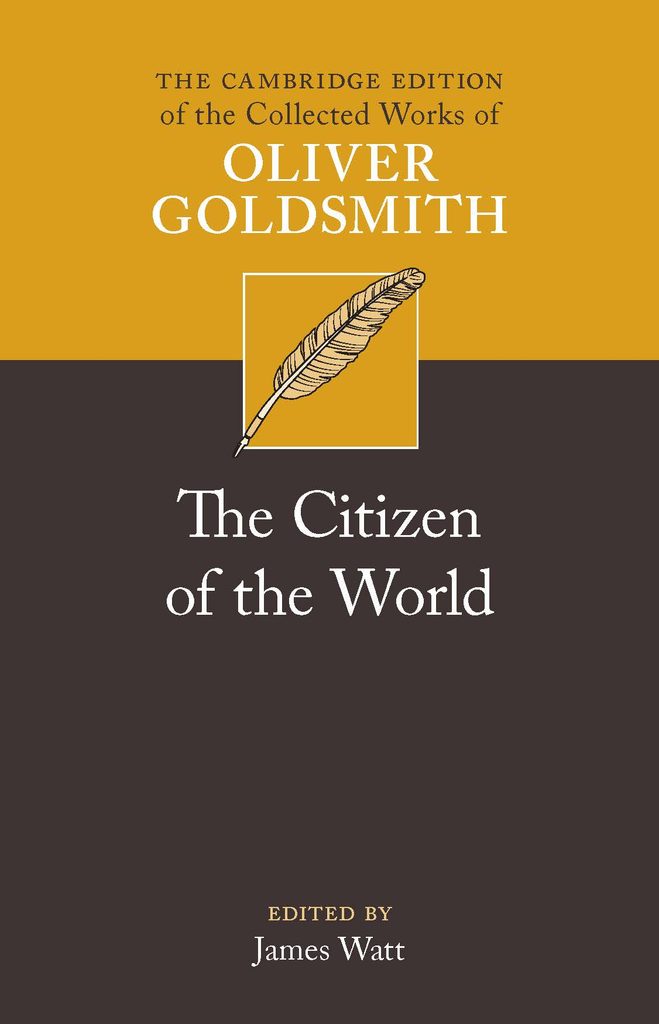
On the publication of Oliver Goldsmith’s The Citizen of the World in 1762, the British Magazine described it as ‘Light, agreeable summer reading, partly original, partly borrowed’. In his Lectures on the English Comic Writers (1819), just over fifty years later, by contrast, William Hazlitt rather differently claimed that ‘For light summer reading, it is like walking in a garden full of traps and pitfalls’.
Hazlitt’s comment captures something of the difficulty of pinning down Goldsmith’s tricksy text. Goldsmith did indeed borrow quite substantially from his mainly French sources – he wrote at speed to fulfil a contract with the Public Ledger, where nearly all The Citizen of the World’s 123 constituent letters were originally published – and by the mid-eighteenth century the tradition of informant narrative in which he worked was a familiar one. If texts such as Giovanni Marana’s Letters Writ by a Turkish Spy (1687-94) and Montesquieu’s Persian Letters (1721) helped to establish the figure of the fictional Eastern commentator on European society, however, Goldsmith engaged with these precursors in creative and distinctive ways.
Although the Marquis d’Argens’s Chinese Letters (1741) was among his sources, Goldsmith’s most significant innovation was making his main narrator, Lien Chi Altangi, a travelling Chinese philosopher. Goldsmith’s use of Altangi is complex and shifting and may help to explain Hazlitt’s perplexity on reading the work. When he arrives in London, Altangi’s first impressions are those of a naïve observer who is easily deceived, as when he gives his watch away to a solicitous ‘prostitute’ who offers to mend it. Altangi never sees his watch again, unsurprisingly, and his defamiliarizing reference to the novelties of London life – for example, ‘houses’ curiously ornamented with the signs of ‘black lions’ and ‘blue boars’ – is similarly rather predictable. In two subsequent letters (among the most cited) describing his visits to ‘ladies of distinction’ and their friends, however, Altangi also complains about being treated as an exotic by those who expect him to conform to their mistaken conceptions of Chinese customs and manners. These episodes present readers with the irony of Goldsmith’s fictional Chinese chiding his hosts for not appreciating his actual Chineseness, while at the same time protesting at being confounded with other ‘Eastern’ peoples whose manners are, he says, genuinely barbarous.
Goldsmith may have been drawn to the idea of writing the experiences of a Chinese visitor to London because his own status as an Irishman in England made him peculiarly sensitive to the predicament of the outsider in the metropolis. As in Altangi’s reference to ‘our elegant manners’ in the second of his ‘lady of distinction’ letters, The Citizen of the World also sometimes offers a positive account of Chinese civilization, drawing upon (among other things) the long history of European idealization of the moralist Confucius. Altangi declares at one point that ‘Confucius observes that it is the duty of the learned to unite society more closely, and to persuade men to become citizens of the world’, and here and elsewhere he aligns himself with a cosmopolitan credo, juxtaposing the essential human commonality which is recognized by the ‘truly great’ with the narrow patriotism of those seeking to foster national antagonism during the Seven Years’ War (1756-63), Britain’s ongoing global conflict with France.
Goldsmith’s references to the history, geography, and culture of China in The Citizen of the World derive from his reading of works by Jesuit scholars such as Jean-Baptiste Du Halde, and the quantity of this reference may be surprising to anyone reading the whole text for the first time. As well as being derivative, Goldsmith’s work is intellectually ambitious, and it makes a foray into the field of global history, anticipating the – much more substantial – project of Edward Gibbon, who would integrate the histories of Central Asia and Europe to explain the fall of Rome. Altangi’s reflections on the role of ‘migrations of men’ (‘Goths, Huns, Vandals, Saracens, Turks, Tartars’) as a driving force in world history may be inflected by Goldsmith’s Irishness and his own experience of mobility, which perhaps made him especially attentive to the determining significance of the movements of others.
As Hazlitt suggests, however, this kind of intellectual enquiry is undercut by other letters which treat the customs and manners of uncivilized ‘Tartars’ in comic terms. Altangi writes of how the ‘poorer sort’ among the Siberian ‘Tartars of Koreki’ are secondary participants in the consumption of hallucinogenic mushrooms by ‘rich Tartars’, through their collecting and drinking of the latter’s urine, and he does this by way of relativizing the less rational rituals of deference that he encounters in socially stratified Britain. Goldsmith’s work sometimes plays Chinese history for laughs, as when Altangi refers to ‘the great emperor who traces his ancestry to the moon’, a hyperbolical rendering of the sense of venerable Chinese antiquity which many European intellectuals continued to celebrate. Among the numerous interpolated tales and fragments of tales in The Citizen of the World is one told by a hack author which begins ‘Eben-ben-bolo, who was the son of Ban, was born on the foggy summits of Benderabassi’. Even as Altangi is alert to the ways in which others misrepresent his Chineseness, Goldsmith’s work includes passages of writing that demonstrate what Srinivas Aravamudan terms a ‘cultivated irresponsibility towards the cultural referent’.
At moments such as this The Citizen of the World appears to refuse seriousness. If we classify it as a comic text, however, Goldsmith’s work remains confounding, as Hazlitt identified, not least because it so often disrupts readers’ understanding of who is laughing at whom. In one of his early letters Altangi states that ‘The ladies [in London] make no scruple to laugh at the smallness of a Chinese slipper’, then adds that ‘I fancy our wives at China would have a more real cause of laughter, could they but see the immoderate length of an European train’. While Altangi here makes the reasonable point that those who laugh at others may be blind to how they themselves appear, readers might be inclined in turn to laugh at Altangi for drawing such a dubious analogy, which, through its allusion to the bound foot inside the ‘Chinese slipper’, elides different orders of – respectively permanent and temporary – disablement.
The Citizen of the World does sometimes appear to be a more conventionally comic work, and for readers such as Dickens’s friend and biographer John Forster, it was notable above all for the colourful tableau of eighteenth-century London life that it provided: ‘those actual days come vividly back to us … Merry and fashionable crowds repeople White Conduit and Vauxhall’. Altangi visits the pleasure gardens at Vauxhall together with two companions who attach themselves to him, the man in black and Beau Tibbs, and many readers including Forster have hailed these memorable comic creations. As if to underscore a point about the essential character of the work, the semi-novelistic conclusion – spoiler alert! – describes how the man in black breaks off his engagement to a wealthy widow following a farcical dispute about how to carve a turkey.
For readers progressing through The Citizen of the World from start to finish, two letters that appear just before this conclusion nonetheless continue to resonate, emphasizing again the shift between frivolity and seriousness that marks the work as a whole. In one of them, Altangi imagines the future ruins of imperial London, bringing together the nocturnal reflection of graveyard poetry and the literary tradition of contemplating the fall of Rome. In the other, he describes an encounter with a veteran of Britain’s wars who continues to celebrate English liberty and to denigrate the French, all the while disregarding his own sufferings: ‘Except the loss of my limb, and my being obliged to beg, I don’t know any reason, thank heaven, that I have to complain’.
Subsequently published as a standalone piece in Goldsmith’s Essays (1765, 1766), the latter treats the false consciousness of the disabled soldier in strikingly sympathetic terms. The Citizen of the World uses Altangi to offer an Olympian view of the politics of the Seven Years’ War, above the fray of competing national interests, and it also has him attend to the narrative of the veteran as one of the ‘many’, who, literally ‘citizens of nowhere’, ‘are obliged to wander without a friend to comfort or assist them, find enmity in every law, and are too poor to obtain even justice’. Goldsmith’s work speaks to the conflicts of our own age not only through its appeal to the cosmopolitan ideal but also through it s acknowledgement of such untold and unheard stories. Sometimes at least, The Citizen of the World seeks to reckon with the ramifications of an ongoing war and (as ‘The Deserted Village’ (1770) would do) with the history of capitalist modernization more broadly. Its distance in this respect from the more familiar works apparently reflecting the ‘good-natured’, sentimental Goldsmith may further explain why Hazlitt, among others, found it so hard to classify.
Keep up with the latest from Cambridge University Press on our social media accounts.


Latest Comments
Have your say!