

Products and services


The image was striking and traveled far, thrilling some and enraging others. As Argentina’s footballers celebrated their semifinal victory over England at the 2026 World Cup in Atlanta, they unfurled a banner proclaiming “Las Malvinas son argentinas.” The gesture, which made headlines in several world capitals, was a reminder that these “too famous islands,” as the writer Jorge Luis Borges once called them, continue to occupy a singularly charged place in our twenty-first-century global imagination.
The reaction was immediate and polarizing. A British minister called the act an “egregious violation” of FIFA rules. Argentina’s vice president deemed it “perfectly valid and legitimate.” The diplomatic machinery of Argentina and Great Britain—which has administered the islands since 1833, with the sole exception of the 74 days of the 1982 armed conflict, when they were under the command of an Argentine army general—swung into motion, and the world once again turned its gaze to the South Atlantic, a region that, despite its remoteness, often captures international attention.
But headlines tend to flatten complexity into confrontation. They present the Falklands/Malvinas only as a long-standing conflict, as if the nearly two centuries between 1833 and the present had been a monothematic and homogeneous story, frozen in the sovereignty dispute. Yet, as my new book Beyond the War: Argentines and Islanders in an Unknown Falklands argues, this is only part of the story—and certainly not the most revealing one.

Changing the Questions
What if we looked away from the familiar narrative of conflict and asked different questions? What was the relationship between the islands and the mainland like in the decades preceding the 1982 war? How were the ideas that Argentines had of the islanders and islanders had of Argentines formed, and what were they? How was the news received by both sides that the United Nations recognized the existence of a sovereignty dispute over the islands and urged Great Britain and Argentina to find a peaceful solution to the disagreement? What place did the islands occupy in the broader British map of what Roger Louis and Ronald Robinson call the “imperialism of decolonization”? What problems did the islanders face, beyond the sovereignty litigation raised by Argentina? What happened during the long decade that began in mid-1971 and closed in April 1982, when London and Buenos Aires agreed to establish unprecedented communication between the islands and the mainland? How to explain that a military dictatorship (1976-1983) seriously questioned by a large part of Argentine society managed to secure practically unanimous support for its decision to forcibly occupy the archipelago in April 1982?
Renewing the Archives, Reimagining the Story
Beyond the War answers these (and other) questions through the joint analysis of public and private archives (some of which have been little or not at all explored by other research), reconstructing and critically analyzing the impressions of Argentine travelers who visited the islands between 1936 and 1971, the perspectives of London and of the islanders themselves on the problems facing the islands in the critical decade of the 1960s, the unprecedented time of contact and coexistence between the island and Argentine communities opened by the 1971 Communications Agreement, and the influence of Argentine popular music in consolidating an “emotional community” around the idea—as valid today as it was then—that “las Malvinas son argentinas.” It also explores the present of the islands, which would surprise equally any of the islanders, British, and Argentines who were protagonists of the history the book narrates.
This is a story about nationalist claims, imperialism in the era of decolonization, colonial agency (even beyond the desires of the metropolis), and intertwined diplomacy and politics; a story that, just as its puzzle seems about to come together, falls apart—only to begin reassembling itself anew, though never quite into the same picture it had sought before.
The headlines from Atlanta—and the reactions they provoked—remind us that the Falklands/Malvinas question is not a relic of the past but continues to shape identities, politics, and international relations in the present. Looking back Beyond the war is not only of interest to those who seek, with intellectual honesty, to know the past that preceded the 1982 war. It also allows us to better understand the present of the dispute and, eventually, to imagine with greater grounding concrete possibilities for channeling the conflict into more productive avenues.
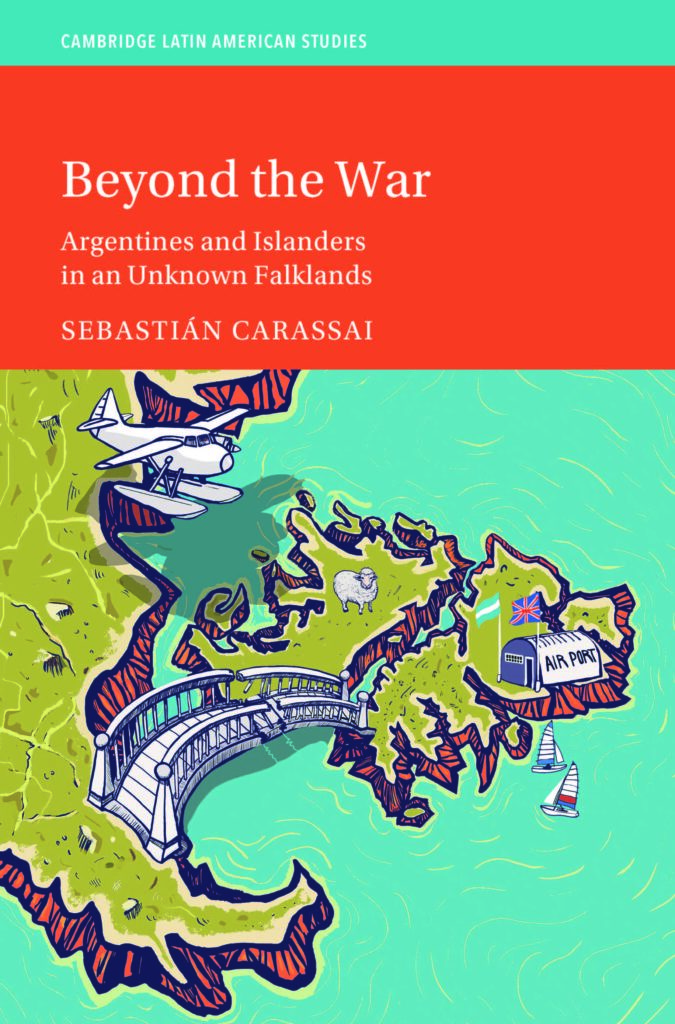
Beyond the War by Sebastián Carassai

Sebastián Carassai is a CONICET researcher, Professor of Foundations of Society and the State at the Universidad de Buenos Aires, and member of the Centre for Intellectual History...
View profile >Keep up with the latest from Cambridge University Press on our social media accounts.


Latest Comments
Have your say!