

Products and services


If students have already passed mathematics at school, why do so many still experience mathematics anxiety at university? For a significant number of learners, mathematics anxiety does not disappear with age or progression. Instead, it evolves, becoming more deeply embedded in how they think, learn, and participate in higher education.
Mathematics anxiety is often misinterpreted as a sign of low ability. In reality, it affects learners across all levels of attainment.
At its core is a negative emotional response to mathematics that interferes with cognitive abilities. Students may know how to solve a problem and yet find themselves unable to do so under pressure.
To understand this more deeply, we need to move beyond abstract definitions and consider the lived experience of the anxious learner. In my work, I begin with this perspective: what it feels like to encounter statistics and quantitative research methods lectures, assessments, or even the idea of numbers with apprehension or fear.
This human lens reveals something crucial. Mathematics anxiety is not confined to problem-solving. It extends to:
Over time, these experiences form powerful narratives about mathematics and the self.
The overlooked challenge: non-specialist students
One of the central contributions of my work is to highlight a group that has received insufficient attention: university non-specialists.
These are students studying subjects such as psychology, sociology, business, education, and health sciences, who are required to engage with statistics and quantitative research methods as part of their degree programmes.
For these learners, mathematics is often perceived as:
This matters because quantitative skills are now embedded across higher education. Statistics and quantitative research methods are no longer optional, but core components of degree programmes (Kotecha, 2023; Mehta Kotecha, 2026).
The result is a mismatch: students who did not choose mathematics are expected to engage with it at a high level, often without support that acknowledges their emotional experience.
Why traditional approaches are not enough
Universities typically respond to mathematics anxiety by offering more content: extra classes, revision sessions, or online resources.
While these are valuable, they often miss the central issue.
Mathematics anxiety is not only about what students know. It is about how they feel, how they think, and how they interpret their learning experiences.
Without addressing these dimensions, even the most carefully designed support may fail to reach those who need it most.
This is why my work moves beyond isolated strategies and proposes a theory-driven, student-informed pedagogical intervention, grounded in interdisciplinary research across psychology, sociology, neuroscience, and education (Kotecha, 2023; Mehta Kotecha, 2026).
From anxiety to resilience: a new approach
A key aim of this work is not simply to reduce anxiety, but to transform students’ relationship with mathematics.
This requires a shift in how teaching and learning experiences are designed.
Across the book, I outline practical approaches that emerged from empirical research and classroom implementation, including:
1. Connecting with students
Building trust and understanding students’ experiences is foundational. When students feel seen, heard, and supported, their willingness to engage increases.
2. Creating interest in statistics
Reframing statistics as meaningful and relevant helps shift perceptions. When students see its value within their discipline, anxiety can begin to give way to curiosity.
3. Rethinking assessment and feedback
Feedback is not simply evaluative. It is formative, relational, and emotional. Supportive feedback can play a key role in rebuilding confidence.
4. Encouraging collaboration
Group work allows students to share experiences, normalise challenges, and learn from one another in less threatening environments.
5. Ending lectures and classes
Positive closing can reshape students’ perceptions of the subject.
These approaches are not isolated techniques. Together, they form part of a broader framework designed to move students from anxiety towards confidence, engagement, and resilience (Mehta Kotecha, 2026).
Why this matters now
The importance of addressing mathematics anxiety has never been greater.
We are living in a data-driven world. Graduates are expected to interpret evidence, evaluate claims, and communicate quantitative insights across a wide range of professions.
Yet mathematics anxiety continues to generate a global pattern of avoidance, limiting both individual potential and broader societal progress. It contributes to shortages of quantitative skills and restricts engagement with data in everyday life (Kotecha, 2023; Mehta Kotecha, 2026).
If this issue remains unaddressed, existing inequalities in access to knowledge and opportunity are likely to widen further.
From teaching practice to policy change
While individual lecturers can make a meaningful difference, mathematics anxiety cannot be addressed through classroom practice alone. It is a systemic issue that requires attention at institutional and policy levels.
Universities need to move beyond viewing quantitative support as remedial provision and instead embed inclusive approaches within curriculum design, assessment frameworks, and staff development. At the same time, sector bodies and policymakers must recognise mathematics anxiety as a barrier to student participation, progression, and graduate outcomes in an increasingly data-driven world.
Efforts to widen access, improve student wellbeing, and strengthen quantitative skills will remain limited unless they explicitly acknowledge the emotional dimensions of learning. Addressing mathematics anxiety is therefore not only a pedagogical concern, but a strategic priority for higher education systems. As I argue in my recent book, sustainable change depends on aligning teaching innovation with institutional strategy and national policy agendas (Mehta Kotecha, 2026).

A call to reimagine mathematics in higher education
Mathematics anxiety is not inevitable. Addressing it requires a shift in perspective.
We need to move:
Most importantly, we need to recognise that learning is both cognitive and emotional.
Universities have a unique opportunity to lead this change. By embedding inclusive, compassionate, and evidence-based approaches into quantitative education, they can transform not only how mathematics is taught, but students’ learning experiences.
Looking ahead
When students are supported to overcome mathematics anxiety, the impact extends far beyond academic performance.
They gain confidence, expand their opportunities, and develop skills that are essential for navigating an increasingly complex world.
Transforming mathematics anxiety is therefore not just an educational goal. It is an investment in students’ futures.
These ideas are explored in my recent book, Mathematics Anxiety in University Non-Specialists: Insights and Innovation (Cambridge University Press, 2026), which presents a research-informed, student-centred framework for transforming anxiety into confidence and resilience in higher education.
References
Kotecha, Meena Mehta. (2026). Mathematics Anxiety in University Non-Specialists: Insights and Innovation. Cambridge University Press.
Kotecha, M. (2023). How can educators prevent the development of mathematics anxiety? Research for the World.
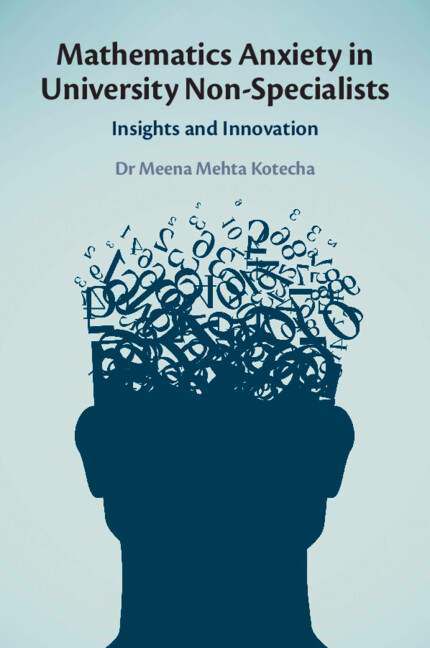
Title: Mathematics Anxiety in University Non-Specialists
Author: Meena Mehta Kotecha
ISBN: 9781009772488

Dr Meena Mehta Kotecha holds a PhD from the University of Cambridge. She is a visiting fellow at the Department of Psychological and Behavioural Science, London School of Economics...
View profile >Keep up with the latest from Cambridge University Press on our social media accounts.




Latest Comments
Have your say!