

Products and services

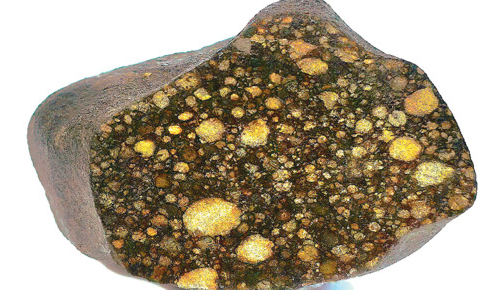
Meteorites pelt our planet at a rate of 80,000 tons per year. About 70% of this material falls into the oceans, but much of the rest is potentially recoverable. And recovery is essential – meteorites are the most important rocks on Earth. They are the number-one source of extraterrestrial material, and they come to Earth for free. Chondritic meteorites are unmelted rocks that illuminate the conditions of the early Solar System. They contain organic matter, water and phosphorus which may have seeded the ancient Earth, possibly facilitating the origin of life. Some chondrites have the same composition as the Sun (if you took away the hydrogen and helium); these meteorites provide the cosmic abundances of the elements. And it was the collision of a large meteorite – a carbonaceous-chondrite asteroid – that wiped out the dinosaurs 66 million years ago. This set the stage for the proliferation of mammals. Many chondrites also contain presolar grains (tiny oxides and carbides and silicates) that formed in the atmospheres of dying stars long before the birth of the Sun. Examination of such grains opened up a new avenue of study: microscopic astrophysics.
There are many kinds of meteorites. Iron meteorites are blocks of metallic iron and nickel. The biggest meteorites are irons; the Hoba iron meteorite from Namibia weighs 60 tons. At the other extreme, carbonaceous chondrites can be dark friable fragments resembling a lump of coal; some contain up to 11% water occurring within the crystal structures of clay minerals. Some meteorites are half metal and half silicate; these rocks formed at the core-mantle boundary deep within differentiated asteroids that melted 4½ billion years ago.
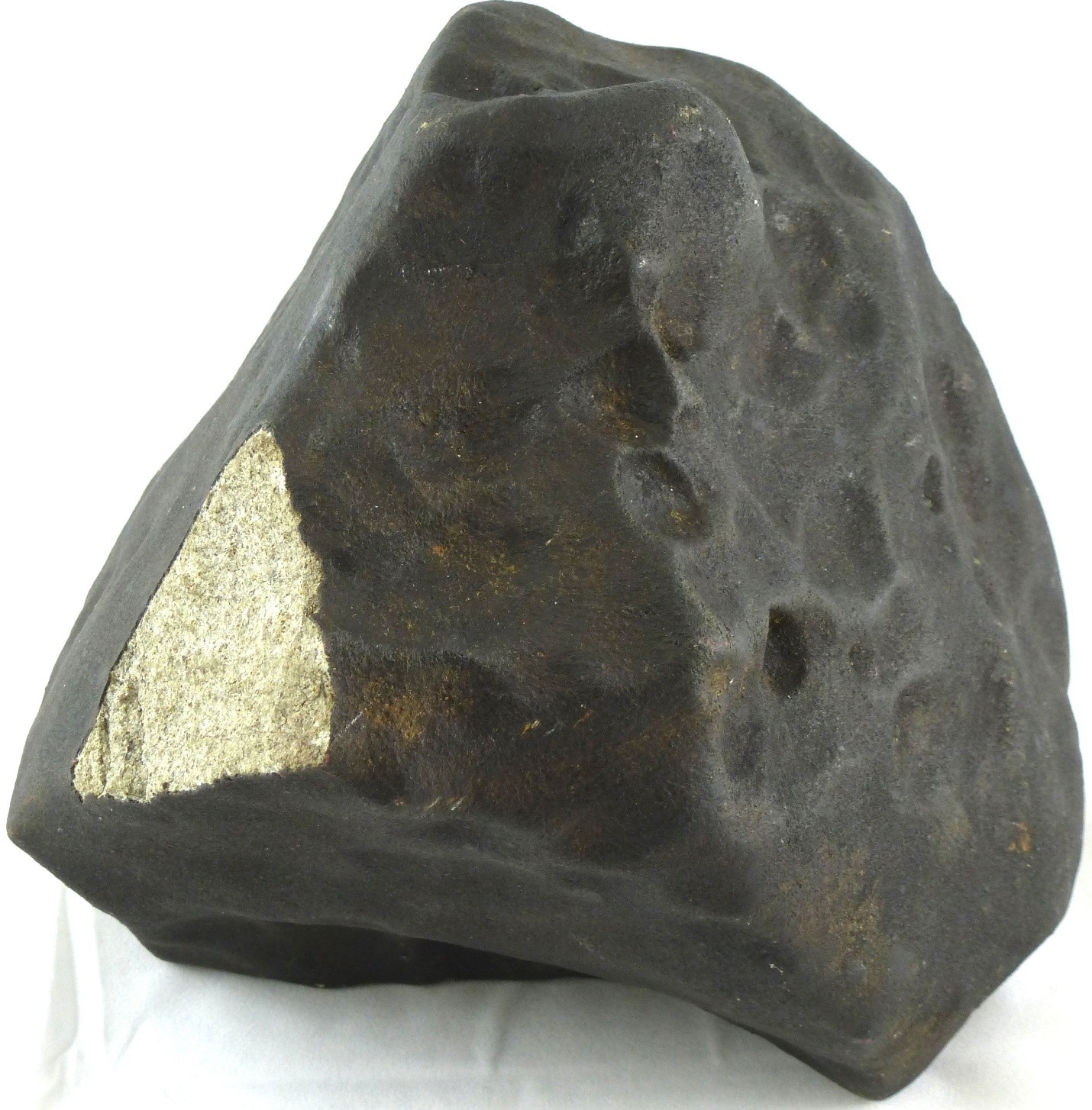
The diversity of meteorites has yielded an abundance of new minerals, otherwise unknown on Earth. There are high-pressure phases formed by energetic impact events. Also occurring in chondrites are refractory phases that condensed from the nebular gas as it cooled from high temperatures. A few new minerals are unstable under terrestrial conditions where free oxygen is readily available. They degrade when exposed to water.
The most abundant meteorites, naturally enough, are ordinary chondrites. They comprise about 80% of all known meteorite samples. Fossil chondrites exhumed from ancient sedimentary rocks show that ordinary chondrites have been falling for at least half a billion years.
There are three groups of ordinary chondrites, dubbed H, L and LL, for “high total iron”, “low total iron” and “low total iron, low metallic iron”. They were derived from three separate asteroids. Their main constituents are chondrules – submillimeter-size igneous spherules that formed from molten droplets early in Solar System history. Other ordinary-chondrite components include millimeter-to-centimeter-size calcium-aluminum-rich inclusions. These are the oldest rocks formed in the Solar System – 4.5673 billion years ago.
Ordinary chondrites contain pristine material from the beginnings of the Solar System. But this material is masked by the modification processes these meteorites have been subjected to. These meteorites suffered significant thermal metamorphism – heating caused by the decay of a short-lived radioactive isotope of aluminum (26Al). Metamorphism caused extensive recrystallization and homogenized the mineral compositions. Many ordinary chondrites were shocked and battered by collisions; the impact events caused brittle fracturing, mineral deformation, sample melting, and localized vaporization. Another process that modified the ordinary chondrites is aqueous alteration – alteration by water. Seeping water transformed glass and fine-grained minerals into clays and carbonates; it also changed iron metal and iron sulfide into iron oxide.
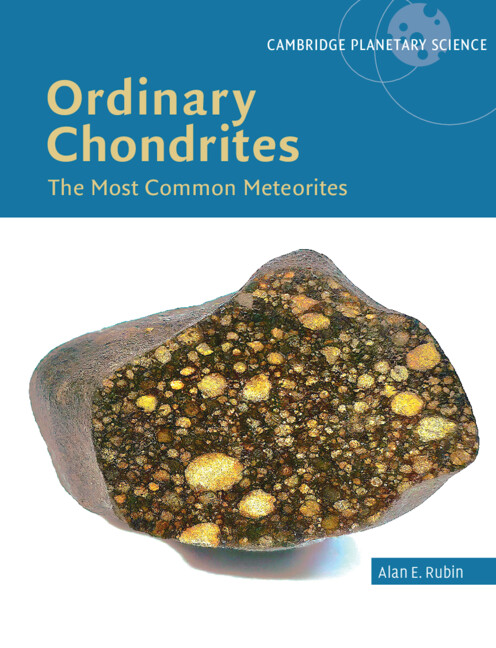
Much can be gleaned through the study of mineral grains in meteorites. Take nickel-rich metallic iron grains (the mineral taenite). Many taenite grains within iron meteorites or ordinary chondrites cooled slowly from high temperatures, typically at rates of a few degrees per million years. The compositions and sizes of these metal grains can be matched to theoretically calculated cooling-rate curves. Some ordinary chondrites, called regolith breccias, formed at the surfaces of their parent asteroids. Their mineral grains were damaged by solar flares. Gases from the solar wind are adsorbed on the surfaces of silicate grains. Studies of the taenite grains in these ordinary chondrites show that different individual grains cooled at vastly different rates, ranging from 0.1 degree per million years to 1000 degrees per million years. These grains, now all in one sample, were derived from near the center and near the surface of the asteroid. The asteroid must have been shattered by an enormously energetic collision before most of the pieces fell back together to form a loose heap of debris – an asteroidal rubble pile. The asteroids Ryugu and Bennu, recently visited by spacecraft, are also rubble piles. The new book, Ordinary Chondrites: The Most Common Meteorites, discusses all these topics and more. It is comprehensive and up to date, written by one of the world’s foremost authorities on these rocks. An understanding of ordinary chondrites grounds the studies of cosmochemistry and planetary science. There is no better treatment of the subject.

Alan E. Rubin is a world-leading expert on meteorites. He is now semi-retired but previously served as an adjunct professor and research geochemist in the Department of Earth, Plan...
View profile >Keep up with the latest from Cambridge University Press on our social media accounts.




Latest Comments
Have your say!