

Products and services

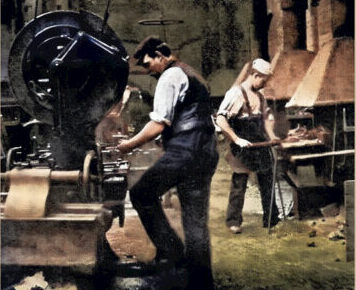
Economic growth transformed human society, freeing us from a world where nearly everyone was mired in poverty and half of all kids died before adulthood. Life before growth remained tough even for the survivors of childhood disease. The only exception were the select few rich enough to employ servants. Everyone else had to haul water from nearby wells, since indoor plumbing was virtually unknown. Women usually bore that burden, fetching water perhaps ten times a day for cooking and washing. Men’s work was brutal too. In an era before tractors, machinery, and scientific breeding allowed a single farmer to nourish a hundred people, most men toiled on farms, producing only enough to feed people a dismal diet of the cheapest calories available: in Europe, groats, or a porridge of vegetables, salted meat, barley, and stale bread. And everyday things that we take for granted, such as simple clothing, was a major expense.
That grim world has disappeared in countries blessed by economic growth and by the sustained technological change that made it possible. Economic growth is, in fact, unrelenting technological change. Technical change brings to mind new machines and ideas, but for the economy, it usually means that prices plunge for goods and service. The ideas and better machines simply make lower prices possible by reducing the cost of production. In Britain, where economic growth was already underway in the 1700s, newly invented spinning machines pushed the price of cotton yarn down 93 percent between 1785 and 1825.4 To take a more recent example, by 2006, computers had cut the cost of doing calculations by a factor of seven trillion relative to working the same problems out by hand.
These benefits, however, have not been felt everywhere or by everyone. In my new account of the divergence between east and west, I uncover the ultimate causes of economic growth and I explain why it originated in eighteenth-century northwestern Western Europe and why it took much longer to reach much of the rest of the world.
The answer comes with a big spoiler alert: the explanation is not slavery, not colonialism, and not capitalism either. Rather, it lies with advantages shared by much of northwestern Europe: institutions that secured property rights with benefits beyond a narrow elite; states that could rearrange property rights with credible compensation to improve transportation and agricultural productivity; cities made possible by productive agriculture that spawned clusters of innovation like those at work today in Silicon Valley; skilled workers who could implement new ideas; and access to the ideas themselves from the Scientific Revolution and the Enlightenment. Northwestern Europe had these advantages for four reasons: its history, its religion, its intellectual heritage, and its distance from Eurasia’s steppes. Those four reasons are the ultimate causes for the onset of economic growth in Britain in the 1700s and for its spread to much of northwestern Europe.
In the nineteenth and early twentieth centuries, much of the rest of northwestern Europe joined Britain on the path of sustained economic growth. Several other economies began to grow as well, among them the United States and Japan. Yet many others lagged behind. My book explains these divergent outcomes. It does so by examining telling examples of rapid economic progress, of stagnation, and even of impoverishment: France and Russia, the United States and Mexico, Japan and China, and – last but not least – Africa. These examples lead to important conclusions about economic growth in general and about how widely its rewards are shared. Political institutions will matter, and so will religion. But inequality makes a big difference too. It may keep people from using their talents or create perverse political incentives that stifle education and the accumulation of human capital. The resulting differences in economic performance can persist for decades.
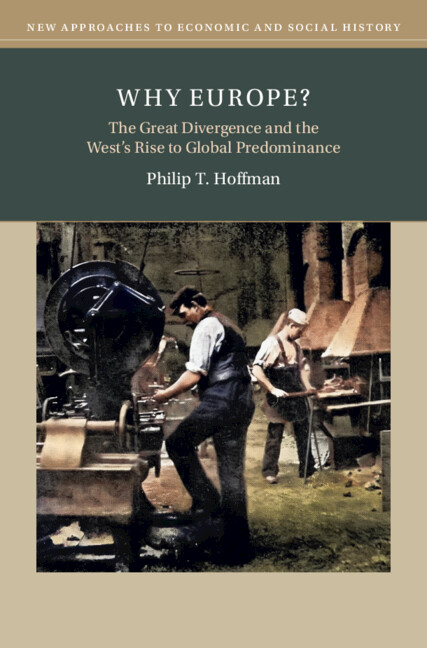
Why Europe? by Philip T. Hoffman

Philip T. Hoffman is Emeritus Professor of Business Economics and History at the California Institute of Technology. A Guggenheim Fellow and former president of the Economic Histor...
View profile >Keep up with the latest from Cambridge University Press on our social media accounts.


Latest Comments
Have your say!