

Products and services


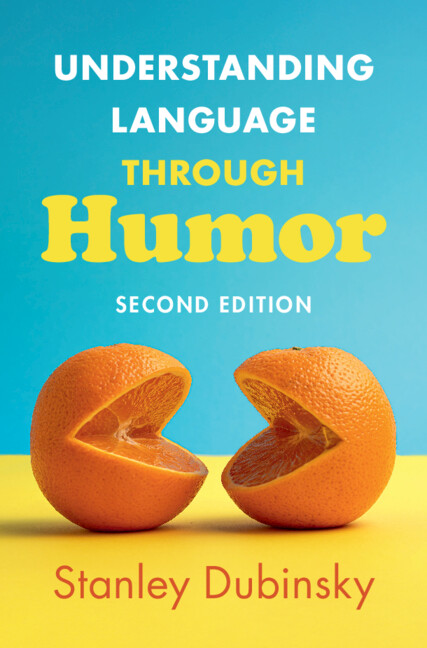
Like many books, this one has a biography worth telling. The first edition of Understanding Language through Humor (ULTH) emerged out of a conversation with Cambridge University Press (CUP) Linguistics Publisher Helen Barton. It is fair to say that ULTH would never have come to be – not the first edition nor this one – without her inspiration, guidance, and encouragement. If ULTH were a motion picture, Helen would be its producer.
On her first excursion as a linguistics editor, Helen found me in my university office and inquired whether I might have a book project of interest. I had not. I then said that I had “an idea” that wasn’t yet a “project,” and proceeded to bring out half a file drawer of folders full of linguistically-oriented cartoons.
I had for many years been collecting these for use in classes, as they greatly facilitated teaching complex material. I would present students with a cartoon that leveraged a linguistic concept. If they laughed at the joke, it was then easier to explain WHY they had laughed.
Helen suggested this could be a worthwhile book project and so began the work of turning a sheaf of cartoons into a book. It was daunting. And rather than be daunted, I turned to a department colleague, Chris Holcomb, whose expertise was complementary to my own. Chris took the lead on chapters I was not prepared to write, expanding the range of topics in that first edition. The final product, published in 2011, was an entertaining survey of linguistics for a general reader.
Fast forward eight years. At the 2020 LSA Meeting, Helen (The Producer) asked whether I might undertake a second edition. CUP was interested in it being more textbook-like and having more complete linguistics coverage. The proposal was intriguing and hard to decline, and I had little sense of how challenging it would be. So, I jumped headlong into it.
If the first edition was a challenge (it was), the second edition was doubly so. First, Chris Holcomb was busy with other projects and could not work on it. Secondly, I realized that revising the book would be inadequate. I needed to REWRITE it.
Coverage had to be more thorough, more organized, and more connected to a standard survey. Explanations needed to be more complete, technical, and useful. Finally, it needed elements that would provide better engagement – discussion questions, analytical problems, exploratory exercises, and further readings.
If the first edition was a caterpillar, the second edition is a butterfly. To make it a text, chapters (on word meaning, onomastics, writing systems, and language in the digital world) were added. Other chapters were reorganized, rewritten, and expanded. Unfortunately, to add new material, some first edition chapters (on discourse, prescriptivism, and standardization) were dropped, and this edition is the poorer for that. But books and life both have length limits.
This edition is a product of its age. Much of the content – insights, examples, jokes, stories, history, and biography – was discoverable and accessible only through the internet. Proof of this is had from the proliferation of internet sources, found in endnotes and references. If this book could even have been written ten years ago (and I think it could not), it would have taken twice the time and four times the effort.
As the fortunate beneficiary of good mentorship (Barton), good collaboration (Holcomb), and good times (internet), I am merely a messenger.
(This has been adapted from the preface of Understanding Language through Humor, 2nd ed.)

Stanley Dubinsky has taught Linguistics at the University of South Carolina since 1991. He has lived 'a life in language,' with a BA in Spanish & Latin American Literature and ...
View profile >Keep up with the latest from Cambridge University Press on our social media accounts.




Latest Comments
Have your say!