

Products and services


In the 1950s, research on language learning was dominated by behaviourism, which viewed language as a system of linguistic rules and patterns. Learners were encouraged to imitate and memorise words and sentences heard or read, and received reinforcement from their environment—rewards for correct responses and punishment for errors. Language acquisition was thus explained as a process of developing appropriate linguistic habits through stimulus and response. This explanatory framework appeared scientific because it relied on observable behaviour while reproducing positivist experimental research models in vogue at the time.
Noam Chomsky challenged this view with a simple question: If language is merely learned behaviour, how can children produce sentences they have never heard before? This was not just a technical objection; it was a philosophical challenge to dominant assumptions about the ontology of language, or what language fundamentally is. It prompted questions such as Is language simply behaviour, or a cognitive system governed by internal rules? How can we explain the differences and relationship between language as found in dictionaries and encyclopaedias, and language as used by people in everyday life? Whether or not one agrees with Chomsky’s conclusions, or his notion of Universal Grammar, his crucial intervention illustrates why ontological questions—and the philosophy of science more broadly—matter in applied linguistics, as they do in all other academic fields.
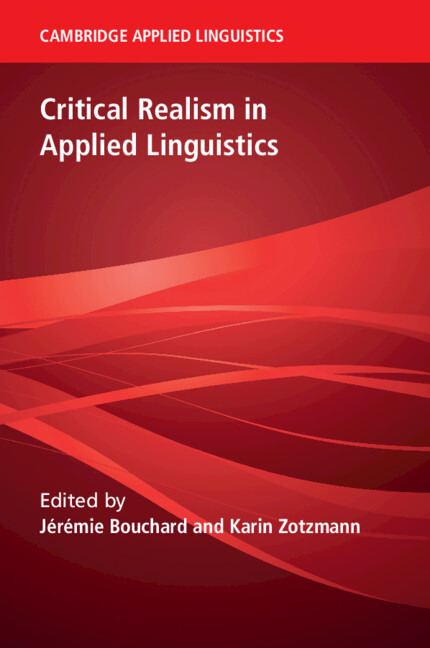
Critical Realism in Applied Linguistics similarly raises philosophical questions about research on language learning and other core topics in applied linguistics and sociolinguistics. Our perspective is informed by Critical Realism, a philosophy of science largely guided by three principles: ontological realism—the world exists independently of our knowledge or perceptions of it, and is ontologically layered—epistemic relativism—while the world is real, our knowledge of it is always mediated through theories, concepts, research instruments, and language itself, making it socially produced and fallible—and judgmental rationality—despite our fallible knowledge of the world, we can use logic, evidence, and improved explanatory models to develop increasingly better, more accurate, and more useful understandings of the world. Recognition of these three philosophical principles allows us to perform much needed ‘philosophical under-labouring’—that is, clarifying scientific and philosophical assumptions in order to facilitate the production of more sophisticated explanatory accounts of real-world phenomena. It also invites us to reflect on our respective theoretical commitments and methodological choices and consider alternative perspectives.
Each chapter in this edited volume is characterised by critical examination of core assumptions underlying conceptual and methodological choices. Because methodology follows from philosophical commitments, we are cautious in our interpretation of data, while remaining open to alternative explanations. We agree on the point that commitment to research reflexivity is of particular importance to current applied linguistics research, given its two increasingly radicalising tendencies: successionism—marked by the dominance of experimental and statistical methods (randomised controlled trials, effect sizes, pre-test/post-test differentials, null hypothesis significance testing and other quantitative metrics) to produce causal explanation—and interpretivism—the prioritisation of relativist, qualitative accounts of perceptions, meanings, and discourses said to ‘construct’ lived experiences. For us, these two radicalising tendencies arguably fail to capture the full complexity of social reality, thus constraining conceptual, methodological, and analytical developments in the field.
Although the shortcomings of Chomsky’s intervention have rightfully been identified over the years, his critical exploration of many conceptual assumptions grounding applied linguistics research remains a valuable point of reference for future developments in the field. Applied linguistics today needs similar reflexive depth, so as to improve upon ongoing debates on a broad range of language-related issues including the use of AI in language education, multilingualism, linguicism, racism, assessment fairness, educational equity, and of course language—the phenomenon at the heart of all applied linguistics research projects. In light of this, the chapters in this edited volume offer different ways in which Critical Realism can assist applied linguists in their commitment to greater research reflexivity and social scientific rigour.

Jérémie Bouchard is Professor in the Faculty of Humanities, Hokkai-Gakuen University, Sapporo, Japan. He is a sociolinguist who, for the past twelve years, has been both teaching...
View profile >Karin Zotzmann is Associate Professor in Applied Linguistics at the University of Southampton. All her research is informed by critical realism....
View profile >Keep up with the latest from Cambridge University Press on our social media accounts.




Latest Comments
Have your say!