

Products and services

Tankers and pipelines spill their toxic contents into oceans and wetlands, the AI industry guzzles massive amounts of water, and imperialist warmongers decimate animals, species, and biosystems across our planet. And yet, through it all, my community’s Facebook group has remained focused, instead, on excoriating a thoughtless litterbug and a band of noisy ATVers who tore up our public beach. Why is that? Amitav Ghosh argues that, while the global climate crisis is a “collective predicament,” any effective response to large-scale environmentalist concerns is hindered by modern society’s privileging of the individual conscience.[i] Is there an utter disconnect between our middle-class, local concerns and the collectivist reaction that the climate crisis requires, between our circumscribed imaginations and a devastating global reality? If the Victorian past is anything to go by, perhaps not.
I recently completed editing the Cambridge Companion to Victorian Literature and the Environment. The contributors discuss works by writers and artists from Australia, Canada, New Zealand, South Africa, the UK, and elsewhere. What becomes clear is that, even in the nineteenth century, various people recognized individualist, local actions and global systems as part of the same ecological network. The term “ecology,” coined in 1867, comes from the Greek oikos, meaning household, suggesting the local focus. It refers to the study of the relation of an individual organism to the other animate and inanimate elements of its surroundings, but it also recognizes the bionetwork extending beyond any one organism’s full comprehension.
This interest in how the “household” impacts larger systems maps insightfully onto another Victorian concept – “the house beautiful,” the middle-class vogue for fashioning one’s private home with the admiration of friends and neighbours in mind. The practice arose in tandem with neighbourhood beautification schemes aimed at improving not just one’s private space but that of one’s community, often extending to address the quality of life for the working class in general.
For example, in 1877 Octavia and Miranda Hill launched the Kyrle Society (named after 18th-century philanthropist John Kyrle) under the motto “Bring Beauty Home to the Poor.” Their organization encouraged individuals to plant window boxes but also to contribute to the development of public gardens. The Hills saw an even greater potential: introducing everybody to “the life-enhancing virtues of pure earth, clean air and blue sky.”[ii]
A few decades later, John St Loe Strachey advocated for replacing brush, wetlands, and creatures deemed pests with homes for agricultural workers, nestled in manicured green spaces.[iii] His aim, however, was to enhance large-scale agricultural practices that benefitted wealthy landlords. The neo-liberal rhetoric people such as Strachey integrated into their eco-visions helps us recognize the middle-class privileges safeguarded by some of today’s popular environmentalist principles, such as land management, sustainability, and carbon neutrality.
My community’s Facebook concerns regarding local beautification are conceptually distant from the perspective needed to take on the climate crisis. But both the Hills and Strachey saw that tending to one’s home or community has larger conceptual and physical implications. And the contributors to the Cambridge Companion to Victorian Literature and the Environment amply demonstrate that the repercussions are felt around the world, including by people, species, and communities who historically have had little, if any, voice in the matter.
[i] Ghosh, Amitav, The Great Derangement: Climate Change and the Unthinkable. University of Chicago Press, 2016, 80.
[ii] “Conservation.” Octavia Hill Society. https://octaviahill.org/conservation/.
[iii] Strachey, John St Loe, “In Search of a £150 Cottage.” 1904. The Book of the Cheap Cottages Exhibition. London: no publisher, 1905. Pp. 7-10.
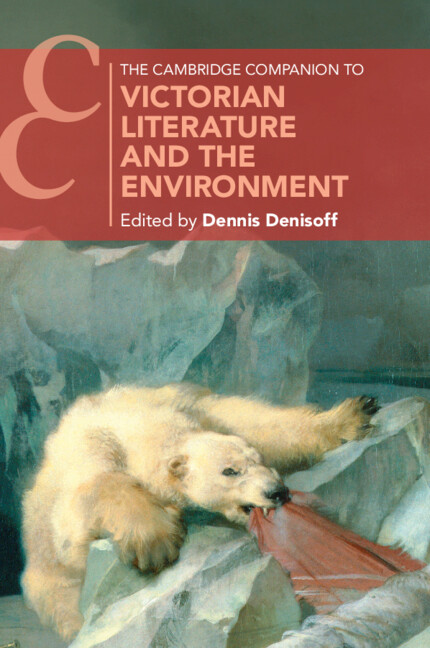
The Cambridge Companion to
Victorian Literature and the
Environment By Dennis Denisoff

Dennis Denisoff is McFarlin Professor of English in the College of Arts and Sciences at The University of Tulsa. His awards and recognitions include the President's Award from both...
View profile >Keep up with the latest from Cambridge University Press on our social media accounts.




Latest Comments
Have your say!