

Products and services


Moral imagination is a well-developed concept in business ethics, and one that is closely associated with Patricia Werhane, whose much-cited 1999 textbook argued that ethical failures often arise not from ill intent but from a failure to re-perceive situations, stakeholders, and systems beyond taken-for-granted mental models.
What role should Moral Imagination play in managerial and corporate decision-making? It should expand perception beyond existing mental models and corporate norms. Managers often default to the familiar schemas of industry norms, KPIs, and “the way things are done.” Moral Imagination pushes decision-makers to reframe a problem from multiple stakeholder viewpoints, to recognize hidden systemic risks and to consider the multiple and ethically relevant features normally screened out by routine practices. This aligns with Werhane’s foundational work in moral imagination (Werhane, 1999).
Why ordinary and decent managers engage in questionable behavior, is often explained by reference to group norming and groupthink combined with narrow, task-oriented framing preconceptions and organizational pressures that reward compliance over personal reflection. Moral Imagination disturbs this potentially uninterrupted dynamic by legitimizing challenges, encouraging reframing, and bringing to the foreground long-term and moral consequences.
The book description mentions process philosophy and systems insights. Moral imagination supports systems-level thinking by helping managers see interdependencies across supply chains, the long-term socio-ecological consequences of the activities of the firm and the unintended effects of efficiency-driven decisions. It extensively presents contemporary cases which reflect on firms that take costly ethical stands, such as McDonald’s closing its Russian operations. It shows how moral imagination can be at work enabling leaders to see themselves as the stewards of global norms, recognizing symbolic moral leadership, and considering long-term legitimacy rather than short-term profits.
Moral imagination does not simply assist and guide managers to avoid wrongdoing, it guides each of them to invent new options beyond the standard economic and strategic binary. Examples include developing humane supply chain innovations, designing technology governance structures, and creating safer production systems (as in the Boeing case).
Organizations are shown as by that division of Google described in this book, that institutionalize a moral imagination and will train employees to recognize moral issues early. They will appreciate how to normalize reflective pauses in decision processes. and this will encourage narrative and relevant scenario-based deliberation. The outcome then develops as a culture where ethical concerns are not “extras” but integral to strategic reasoning. Chapter 9 of our text was prepared and authored by two Google employees, and it illustrates a version of our methodology in practice.
Moral imagination is not only an abstract philosophical ideal; it is a practical managerial capability that helps individuals and organizations to expand perception, disrupt and rebuild narrow decision frames. It can anticipate systemic effects if not all of them. It innovates ethically responsible solutions and contributes to maintaining legitimacy in complex geopolitical and social environments. Its absence often explains why “good” managers end up making ethically questionable decisions, as shown in the spectacular twenty years long and still running Fujitsu and British Post Office scandal. In this newly issued revised version “Moral Imagination for 21st Century Individuals and Organizations” we have updated the cases and extended the scope of the book for a twenty-first century view.
Patricia Werhane’s work positions moral imagination as the capacity to re-envision a problematic situation by stepping outside entrenched mental models. For Werhane, ethical failures often stem not from malicious intent but from habitual and rigid cognitive paradigms or mind-sets, from a failure to understand the perspective of un-noticed stakeholders and from an over-reliance on normative corporate scripts. Werhane argues that moral imagination lets managers see alternatives beyond the conventional constraints of business-as-usual.
David Bevan extends and complements Werhane’s ideas by emphasizing that ethics are an inherently dialogical engagement process. Ethics emerges through confronting the other in some encounter, respecting the context and not through individual reasoning alone. Moral imagination is relational and decisions occur in lived, relational processes. Above which our individual critical reflexivity allows us to be aware of power, social narratives, and organizational discourses.
Where Werhane stresses cognitive reframing, Bevan foregrounds the relational and processual dimensions of moral imagination, how stories, dialogues, and language shape ethical possibilities. Notable themes in Bevan’s work include, the ethical significance of narrative plurality, the role of organizational storytelling in enabling or suppressing moral imagination and the contribution of moral imagination to a process of responsible leadership in responsible organizations
Working together on this text, Werhane and Bevan help explain not only why ethical failures occur but how managers can actively cultivate better decision-making:
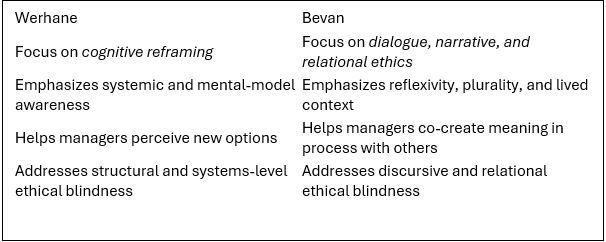
Together, they present moral imagination as both a mental capacity and a relational practice. Incorporating this revised work suggests managers should: re-examine existing mental models; engage in the process of ethical dialogue and reflexivity; recognize systemic and relational interdependencies; craft alternative narratives for action; and, elevate ethical and stakeholder considerations in strategic process.
This dual framework can be applied to help understand explain why and how good managers manage to commit questionable acts, how firms overlook ethical dimensions of their operations and how companies sometimes act on principles over profits. Werhane’s and Bevan’s insights in this updated and fully revised volume offer a holistic foundation for continuing ethical imagination, responsible leadership, and a more processual and systems-based organizational awareness.
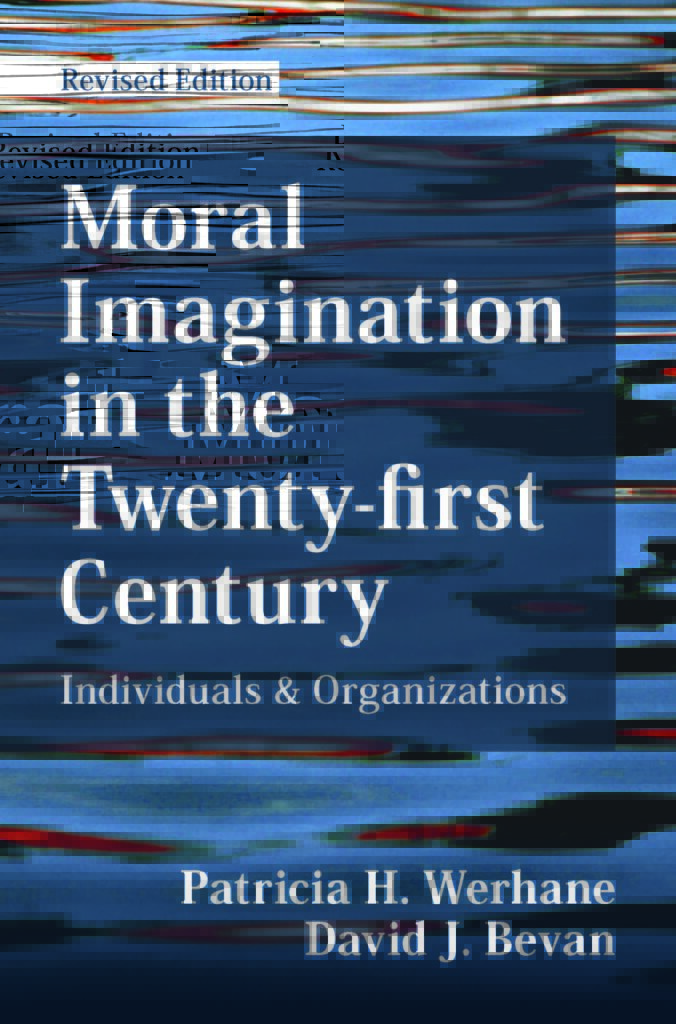

Patricia H. Werhane is Professor Emeritae in the Darden School of Business at the University of Virginia and DePaul University, and the author or editor of 36 books and 150 article...
View profile >David J. Bevan directs Postgraduate Courses in Action Learning at St Martin's Institute of Higher Education, Malta, and is author of over 50 articles in critical management and bus...
View profile >Keep up with the latest from Cambridge University Press on our social media accounts.




Latest Comments
Have your say!