

Products and services

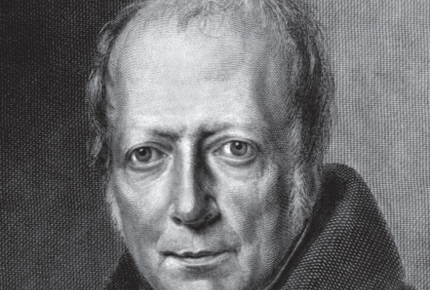
My book, Wilhelm von Humboldt and Early American Linguistics, addresses an audience of interested scholars and potential readers with the following concentrations:
My book may also be of interest to a broader audience wishing to learn about the intricacies of nineteenth-century comparative studies in linguistics, the social sciences, and other disciplines, foremost natural history.
In writing the current study, I have drawn major inspiration from the recent edition of Humboldt’s empirical writings in Americanist linguistics: a grammar of Nahuatl (“Mexicanisch”, Uto-Aztecan; Humboldt 1994a) and an accompanying vocabulary of 1000 pages edited by his protégé J.C. Eduard Buschmann (Buschmann and Humboldt 2000); various grammatical studies of indigenous languages of Middle, South, and North America (Humboldt 2009, 2011, and 2013); introductory and comparative Americanist studies (Humboldt 2016); plus typological studies of American languages (Humboldt 2017). During his lifetime, Humboldt drew on what then was perhaps the most comprehensive data base of not only a hemispheric American scale, but also a global range, including languages of Europe (together with his first-hand sociolinguistic field research on Basque, an ergative-absolutive non-Indo-European isolate in the Pyrenees of Spain), Asia, and the Pacific for structural contrast. Diverse documents on American languages made Humboldt one of the principal Americanist linguists in the early nineteenth century, as already recognized by contemporaries such as the American linguists Peter S. Duponceau and John Pickering; but his writings have primarily been in German with the exception of single essay in French (for a listing of Humboldt’s recent reeditions, see https://brill.com/display/serial/HSS17).
Wilhelm von Humboldt and Early American Linguistics offers a summary review of fundamental linguistic notions by the elder Humboldt, which were still familiar in their full intricacy to Franz Boas (1858-1942) and his early students, foremost Alfred L. Kroeber (1876-1960) and Edward Sapir (1884-1939), a century ago. Accessible to English speakers in only a few short and select translations, Humboldt’s linguistic writings have since remained largely elusive in their full complexity – unlike English translations for many writings by his younger brother Alexander. After World War I, any broader Anglophone audience gradually lost many of Humboldt’s insights without easy access to systematic English translations of his original writings or a thorough understanding of the German language for the interpretation of demanding passages. My book then does not focus so much on Humboldt in his role as language philosopher; but it presents an inclusive discussion of Wilhelm von Humboldt’s understanding of language in its structural diversity and common expressions, together with a review of his influences as an empirical Americanist linguist on U.S. American linguistics of the nineteenth century from Duponceau to Boasians of the early twentieth century.
For interpretation, I have relied on an interdisciplinary approach consisting of biography, ethnohistory (i.e. a socioculturally sensitive history based on modern anthropological principles), and historical linguistics, especially philology, for mutual enhancements. In particular, this study describes:
For historical context, I have incorporated numerous quotes in English as well as in original German and French (with concurrent English translations). I have also added a chapter on how Humboldt’s notions of Americanist linguistics eventually came to serve as a conceptual-methodological model for the study of Malayo-Polynesian languages of the greater Pacific, although he diligently refrained from proposing any historical relationships or typological parallels between the structurally diverse indigenous languages of the Americas and Austronesian languages.
In the end, Humboldt appears no longer so much as either an ardent linguistic relativist or an early transformational grammarian (as sometimes suggested in the anthropological and linguistic literature), although he did occasionally advocate relativist and generativist notions. Rather, he emerges as an early structuralist linguist drawing on a broadly defined comparative approach with diverse ideas and conceptions, focusing on sociolinguistic fieldwork (as with Basque), philological reconstructions, linguistic cartography, and an attention to typological-linguistic and sociohistorical factors of language change, when desirable historical-linguistic records were not available as in the case of many American languages. By focusing on grammatical analysis as a means of historical and typological classifications, Humboldt already demonstrated the use of diverse linguistic concepts such as linguistic and cultural alterity, the phoneme, the zero morpheme, noun incorporation, the underlying form (“innere Form”) of languages, and a processual perspective, extending to language contact and mixed languages (as in the case of Old Javanese (“Kawi”), an Austronesian language of central and eastern Java, Indonesia). In their diversity and richness, Humboldt’s ideas on language have made him a primary advocate for modern empirical and theoretical linguistics until today.
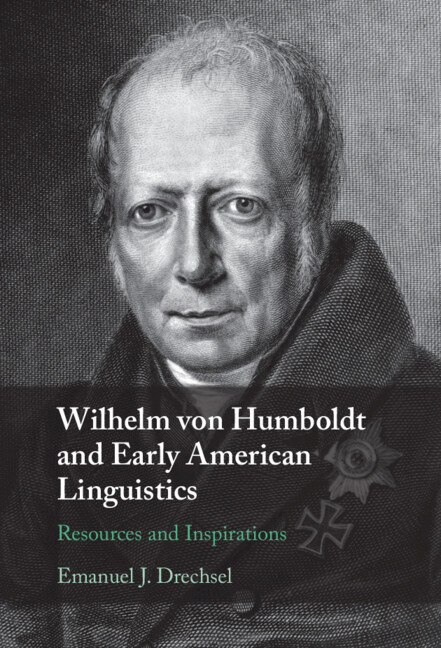

Emanuel J. Drechsel is Adjunct Professor in the Department of Linguistics at the University of Hawai'i at Mānoa. Notable publications include Mobilian Jargon (Clarendon Press, 199...
View profile >Keep up with the latest from Cambridge University Press on our social media accounts.




Latest Comments
Have your say!