

Products and services

November 5, 2017, marked a century since the U.S. Supreme Court decided the famous Buchanan v. Warley case, striking down racial zoning in the United States. With more than 100 years of land use practices and legal and policy institutions to achieve racial justice, is land use racially just in the U.S.? And if not, what are the prospects for making it so?
As scholars in law, urban planning, and social history in Louisville, Kentucky, where the Buchanan case arose, we assembled a national, interdisciplinary team of distinguished scholars to assess these questions through the lenses of social movement history, legal theory, and public policy. For example, chapter authors in the book Racial Justice in American Land Use include legal scholars Audrey McFarlane and Michael Alan Wolf, as well as planning scholars Michael Lens, Kelly Kinahan, and Emmanuel Frimpong Boamah, among others.
The answer to our question is that land use in the U.S. remains persistently, even intransigently, unjust for Black Americans and other people of colour. Racial residential segregation still characterises our urban landscapes, despite modest improvements. Many conditions – housing affordability, home ownership rates, property values, industrial zoning and exposure to pollution, neighbourhood infrastructure and conditions, climate vulnerability, neighbourhood effects (e.g., education, crime, economic opportunity), eviction rates, gentrification and displacement, and homelessness, among many others – are worse for Blacks and Latines than for other Americans.
More importantly, racial injustice is deeply and structurally embedded in the American land use system. We see it in the cultural norms and socio-political power of white supremacy that persistently shape land use practices and resist or hijack racial-justice reforms. We see it in legal theories and doctrines that allow the racial subjugation and marginalisation of people of colour to persist so long as government policies and private actions appear superficially neutral with respect to race. And we see it in an ever-evolving set of public policies and planning practices that are used as tools to perpetuate racial inequities.
All these elements exist alongside judicial opinions like Buchanan and Shelley v. Kraemer (which held that courts cannot enforce racial covenants), the abolition of redlining, the passage of the federal Fair Housing Act, and other important institutional changes. Patterns of racial inequity have been maintained through exclusionary zoning, exclusionary local permitting processes, and exclusionary covenants and deed restrictions. They have been maintained through industrial zoning, the creation of environmental-justice frontline/fenceline communities, and disparate investments in neighbourhood infrastructure. They have been maintained through discriminatory practices in real-estate lending, housing development, real-estate transactions, and rental housing (e.g., rents, evictions, conditions), which easily evade legal enforcement. And they have been maintained through local government structures that have facilitated white flight from cities to suburbs and now facilitate gentrifying displacement in both cities and suburbs. Moreover, the U.S. Supreme Court practically encourages this apartheid with its post-racial constitutionalism and rhetorical neutrality – upholding policies and actions that are racially neutral on their face but racially oppressive in practice, yet striking down race-conscious polices and actions that are aimed at remedying the present-day effects of racial oppression.
Even efforts in some states and cities to abolish single-family zoning have had minimal impacts on housing supply and affordability, because they don’t change underlying deed restrictions, community infrastructure, real-estate finance practices, or the behaviours of developers and housing consumers. One theme raised by some of the chapters is racial capitalism. In the land use economy, profits are to be made and property values are to be captured from disparate treatment of different racial groups. Thus, racial power disparities are political, legal, but also economic, and social.
Despite our book’s assessment that racial inequity is a systemic feature of land use in the U.S., we have noted several reasons to be hopeful for a more racially just future.
First, there is a powerful conceptual legal theory of anti-subjugation that strongly counters the current doctrinal direction of the Roberts Court; the intellectual dishonesty and socially oppressive effects of the Roberts Court’s post-racialism are becoming more visible. The current direction of U.S. law cannot sustain itself.
Second, rigorous analyses of social facts and data support many worthwhile policy reform proposals to improve racial justice in land use practices. However, policy reforms must be multifaceted and systemic, not mere tinkering with just one problem dimension (e.g., single-family residential zoning). This is because racially unjust land use practices are multifaceted and systemic.
Finally, grassroots social movements for land use justice give us hope. They are the reason why racial zoning didn’t persist, and instead, fair housing laws were enacted; the landscape of racial injustice would have been much worse without those key victories. Land use justice movements have expanded, as Blacks have formed coalitions with other people of colour and low-income people. The fight for housing justice has expanded to include fights for justice in environmental conditions and community resilience. History teaches us that young people are ever-moving racial-justice thinking and activism forward. Hope is a key strategy, because hope is a radically anti-racist, anti-oppressive expression of resistance. Hope is needed to motivate a multitude of actions to seek systemic social and institutional change. As our studies of the past 100+ years show, movements for land use justice are built on hope.
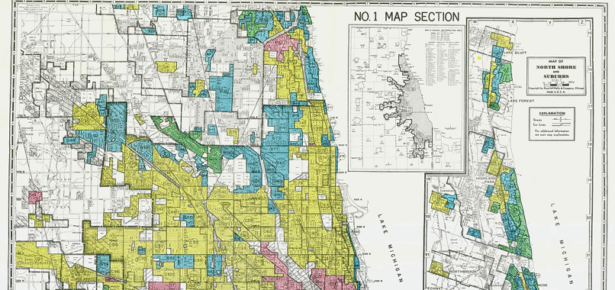
Image: HOLC Redlining Map of Chicago
Description of the Image: This is a redlining map of Chicago, as created by the Home Owners’ Loan Corporation.
Source: Kara Zelasko.

Craig Anthony (Tony) Arnold is an internationally renowned transdisciplinary scholar, receiving numerous honors for his pioneering ideas and research in land use, environmental jus...
View profile >Catherine Fosl is an interdisciplinary scholar of twentieth-century US social justice movements, especially the history of race, gender, and grassroots-level activism in the US Sou...
View profile >Laura Rothstein is a renowned leader in US legal education and elected member of the American Law Institute. By using her scholarship to 'advocate through education,' she has worke...
View profile >Cedric Merlin Powell is a prominent Constitutional Law scholar and structural inequality theorist on neutrality and post-racial constitutionalism. He is the author of two other boo...
View profile >Keep up with the latest from Cambridge University Press on our social media accounts.




Latest Comments
Have your say!