

Products and services

In this summer’s blockbuster film The Odyssey, directed by Christopher Nolan, Agamemnon, leader of the Greek expedition against Troy, appears only briefly on screen. Nevertheless, the legendary king’s costume, helmet, and demeanor have already generated considerable debate among viewers. In one scene, Odysseus bows his head to Agamemnon in a gesture of respect and deference. This portrayal, together with Agamemnon’s mythical association with Mycenae, raises a much broader historical question: How extensive was the power of any of Mycenae’s rulers at the height of Mycenaean palatial society in the late 14th and 13th centuries BCE?
Nolan’s Odyssey implies that a Mycenae autocrat enjoyed a position of considerable authority. The political reality of Late Bronze Age Greece, however, is far less certain, largely because of the scarcity of written evidence from that time. Although Linear B archives survive from several Mycenaean palatial centers, these administrative tablets (written in an early form of Greek) primarily record inventories rather than historical events or political relationships. Moreover, the corpus of Linear B tablets from Mycenae itself is relatively limited.
The uncertainty of the Mycenaean political configuration is especially acute in the Argolid region, where several major citadels (e.g., Mycenae, Tiryns, Midea, etc.) appear within a remarkably small area. How should we understand this cluster and their inter-site relationships in the Late Bronze Age? Were they independent, perhaps even rival, polities? Or were some or all of them components of one kingdom dominated by Mycenae? Scholars and travelers to the Argolid have wrestled with this issue for centuries.
In Architecture and Politics in Mycenaean Greece, I approach the political dynamics of the Late Bronze Age by examining technological and architectural similarities across various sites on mainland Greece. Focusing on palace-sponsored building projects, I argue that Mycenaean labor and specialized craftwork are integral to understanding the period’s geopolitics. The stoneworking details of certain architectural and sculptural endeavors implies the movement of artisans and specialists and reveals connections among Mycenaean citadels that are otherwise difficult to detect.
A systematic examination of construction tools (e.g., axes, chisels, saws, and other implements) with particular attention to their availability and distribution lays the foundation for the study. Consumption patterns of Mycenaean tools raise broader questions pursued throughout the book: What was the status of the artisans who used them? How mobile were these craftspeople? And to what extent did palatial administrations oversee and organize stonework?
Moving from tools to architecture and sculpture, I examine stoneworking techniques and the implications of substantial construction efforts in the Argolid and Boeotia. My analysis highlights a more nuanced relative chronology for Mycenae’s palatial development and suggests that its rulers used monumental construction and display to evoke memory, inspire awe, and advance political agendas. The equally formidable citadel at Tiryns employed stoneworking techniques closely comparable to those found at Mycenae, pointing to strong construction and political links between the sites. Such craft practices are also evident in northern Boeotia. The renowned tholos tomb at Orchomenos, known as the Treasury of Minyas, and the unique L-shaped complex called the Melathron on the citadel of Gla are elite building projects with discernible connections to the Argolid. Mycenae and Tiryns apparently cultivated significant craft and likely political relationships with this part of Greece in the 13th century BCE, seemingly at the expense of Thebes.
Architecture and Politics in Mycenaean Greece shows how the physical traces left by builders can illuminate political relationships that the contemporary Linear B records cannot. Similarities in stoneworking techniques and technological practices across the Greek mainland illuminate networks of knowledge, labor, and authority in the Late Bronze Age, offering a more nuanced picture of Mycenaean politics than that suggested by later Greek legend.
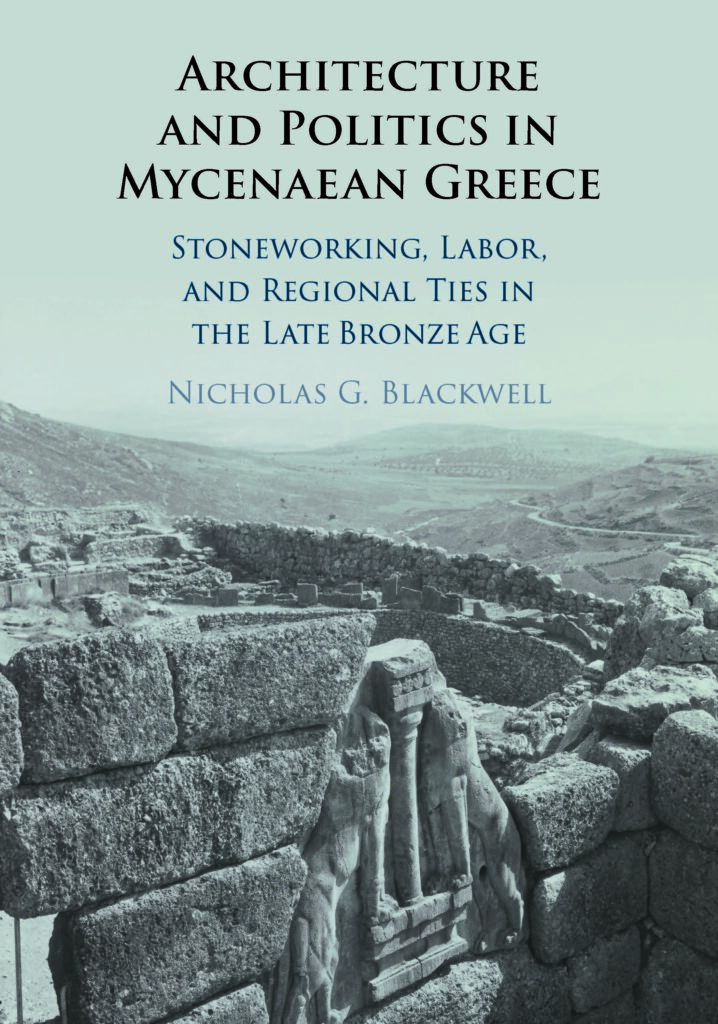
Architecture and Politics in Mycenaean
Greece by Nicholas G. Blackwell

Nicholas G. Blackwell is Assistant Professor of Classical Studies at Indiana University, Bloomington and previously served as Assistant Director of the American School of Classical...
View profile >Keep up with the latest from Cambridge University Press on our social media accounts.




Latest Comments
Have your say!