

Products and services


Have the courage of your convictions. Be a person of conviction. Carry conviction. Stand tall in your conviction. As these idioms attest, we have a strong cultural conviction that conviction is a virtue and that anything less betrays weakness—or as W. B. Yeats put it more dramatically, that civilization itself is at stake when “[t]he best lack all conviction.” Yet the origins of the term might give us pause. “Conviction,” after all, derives from the Latin convincĕre, meaning to conquer, to overcome. Eighteenth-century lexicographer Samuel Johnson captured this domineering tendency when he recorded in his Dictionary that “to convince” can mean “to force any one to acknowledge a contested position.”
The Oxford English Dictionary treats Johnson’s definition as an outlier, noting that it lacks the “fully developed current sense” of conviction as belief that is “well proved or established; … firm or settled,” or else the process of achieving it. For a swathe of Johnson’s contemporaries and successors, however, the association of conviction with force was at once philosophically and practically significant, whether in David Hume’s controversial argument that our convictions typically involve the imposition of meaning (e.g., about causality) or political satirist Charles Pigott’s blunter remark, in his Political Dictionary of 1795, that “the only argument of conviction to despots” is a cannon. In the contexts of political polarization and epistemic crisis, it became a matter of personal and collective urgency to ask: What alternatives might there be to holding or affecting beliefs without conquest, in others or oneself?
Reimagining Persuasion in British Romantic Literature is the first study of how a range of late eighteenth- and early nineteenth-century British writers theorized and practiced the alternative they often called “persuasion”: a uniquely malleable mode of belief that could accommodate doubt, dissent, and changes of mind. At a moment when firm convictions no longer seemed philosophically possible, ethically advisable, or politically efficacious, writers wrestled creatively and intellectually with the possibility of decoupling persuasion from conviction, allowing for flexibility in one’s beliefs without giving up the possibility of belief altogether or reducing it to private enthusiasm. In so doing, I argue, they broke with classical and Enlightenment precedents to treat persuasion not merely as conviction’s synonym, supplement, or dubious proxy, but as a uniquely flexible and reflective mindset worth the often-considerable effort involved in achieving and sustaining it.
Spanning the periodical essays of Thomas De Quincey and William Hazlitt, the legal fictions of William Godwin and William Wordsworth, the novels of Jane Austen, and the poetry and prose of Percy Shelley, Reimagining Persuasion tracks the emergence of a new epistemology and literature of persuasion compatible with the partiality of human beliefs, in the double sense of bias and limitation, and the writerly resources suited to articulating it. While oral dialogues and debates are central to the works I address, so too are the rearrangements of belief distinctly enabled by print and reading. Through close readings of familiar and lesser-known works—from Austen’s Persuasion, Godwin’s Things As They Are, and De Quincey’s “On Murder” to Wordsworth’s The Borderers, Shelley’s “Satire upon Satire,” and Hazlitt’s late essays on truth and controversy—I show how techniques including divergent narrative and argumentative perspectives, lexical hedges, suggestive polysemy, and rhetorical and rhythmical pauses could stage the difference between a rigid conviction and a malleable persuasion, and in so doing make the latter a live possibility. Reimagining Persuasion ultimately seeks to make this reimagined persuasion a live possibility today, as a feature of our political and professional lives in a time of newly polarized convictions and partisan divides.
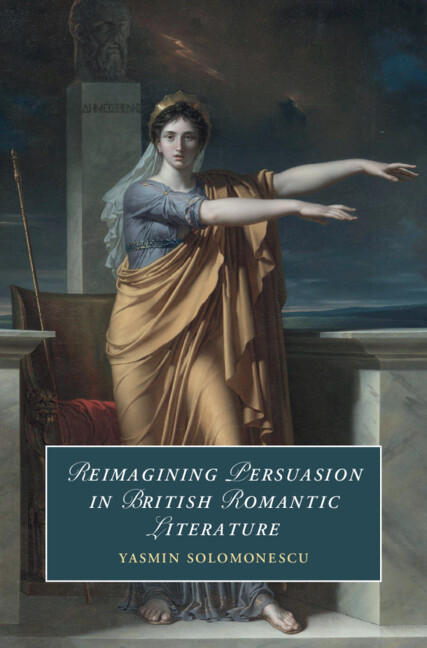
Reimagining Persuasion in British
Romantic Literature by Yasmin Solomonescu

Yasmin Solomonescu is an Associate Professor in the Department of English at the University of Notre Dame. She the author of a previous monograph, John Thelwall and the Materialist...
View profile >Keep up with the latest from Cambridge University Press on our social media accounts.




Latest Comments
Have your say!