

Products and services


The cover of The Anthropocene and Literature features a photo from an abandoned house in the ghost town of Kolmanskop in Namibia. The former mining town was established in the early twentieth century when Namibia was still a German colony, and it was abandoned only fifty years later, when the diamond mines were depleted. With its drifting desert sands percolating through a former colonial site of extraction, the striking image encapsulates a number of features of the critical concept around which this book revolves, namely the Anthropocene.
The concept was proposed in 2000 by Paul J. Crutzen and Eugene F. Stoermer in a brief note in the Global Change Newsletter, where they argued that the activities of humankind during the Holocene Era had left such an indelible impact on the planet that humans had turned into a “significant geological, morphological force.” Crutzen and Stoermer accordingly suggested that we have entered a new geological epoch that they proposed to label the Anthropocene: the era of Man.
The Anthropocene proposal was a fitting inauguration of a new millennium, where climate change and other human-made impacts on the planet are rapidly escalating beyond our control. Since Crutzen’s and Stoermer’s original note, the proposal has been hotly debated by scientists who disagree on both the dating of the era and the general validity of the term. The debates culminated in a much-publicized vote in 2024, where a panel of international geologists decided to reject ratifying the Anthropocene as an official term for a new geological era.
It could therefore be argued that there is no Anthropocene, but on the other hand, the notion has torn loose from the sphere of geology and moved into a much broader context. In an age of rampant capitalism and extractivism, anthropogenic climate change, still-felt legacies of colonialism, desertification, and pervasive extinction of nonhuman species, the Anthropocene is clearly everywhere, and it is hard to think of other recent critical concepts that have had a similar impact across a wide range of disciplines. This is not least the case in literary studies. Literature has always been concerned with the fraught relation between humans and nature, and the concept of the Anthropocene allows literary scholars to analyze and discuss this long literary tradition in new ways.
The Anthropocene and Literature explores how literature has anticipated and responded to the Anthropocene, and it traces how the stories we tell about our relation to the planet both affect and are affected by our cultural habits. The author Amitav Ghosh has famously argued that our dominant literary genres are not adequate to the task of describing and comprehending the enormous challenges of the current environmental crisis. Nevertheless, the contributions in this volume clearly show that both literature and literary criticism are well-suited to let us understand the incomprehensible and interconnected crises that we have caused and are embedded in, or at the very least to let us understand their incomprehensibility.
They do so in very different ways, however. The concept of the Anthropocene remains highly politicized and contested, and many of the rifts and faultlines in the originally geological term are evident in this volume. As such, each chapter in the volume offers a different doorway into understanding the relations between literature and one of the most important concepts of our time.
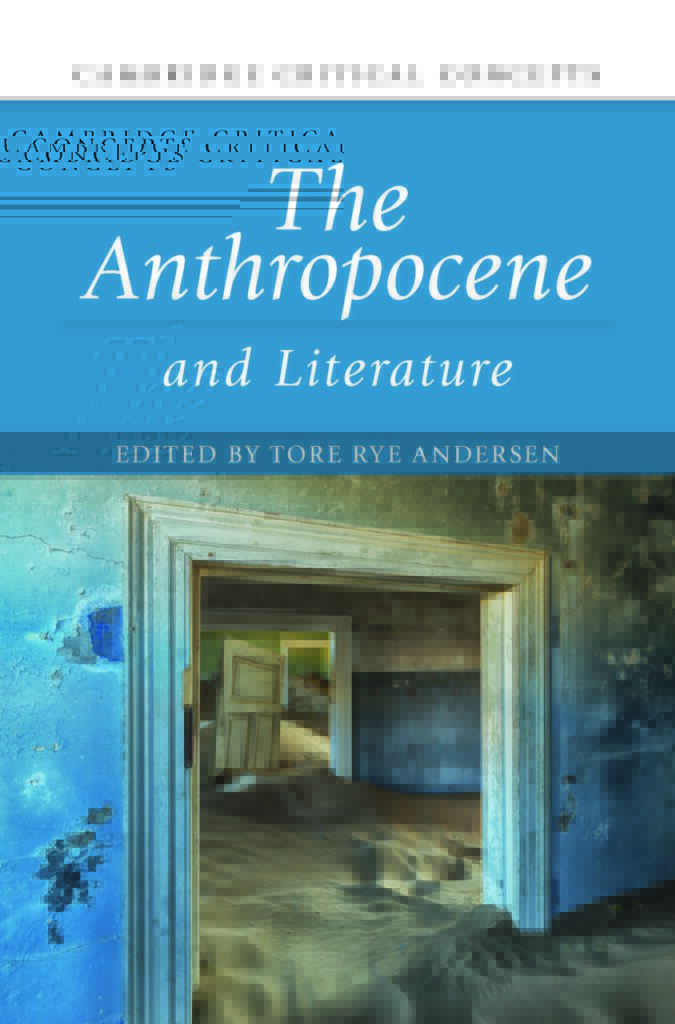
The Anthropocene and Literature
by Tore Rye Andersen

Tore Rye Andersen is Associate Professor of Comparative Literature at Aarhus University. He has published numerous essays on literary fiction in journals such as Critique, Narrativ...
View profile >Keep up with the latest from Cambridge University Press on our social media accounts.



Latest Comments
Have your say!