

Products and services


The soul of modern complexity science lies in understanding, training, and controlling the interactions among millions of elementary degrees of freedom to generate emergent dynamics; in other words, to shape the effective physical laws that govern the behavior we observe. This goal has so far been achieved primarily in computer simulations and in models that we describe as intelligent. Yet there is one field in which researchers can directly engineer large-scale interactions at the physical level: photonics.
Complex photonics may be defined as the art of tailoring the propagation of light through strongly disordered and nonlinear media. Its applications span a broad range of disciplines, including advanced microscopy, quantum information processing, artificial intelligence, and novel classes of high-dimensional laser sources, among many others.
Over the past forty years, the development of complex photonics has been driven by two compelling motivations. The first is speed: light provides an unparalleled platform for information processing at the fastest speed permitted by nature. The second is efficiency: during free-space propagation, light dissipates essentially no heat and, unlike many competing technologies, does not require cryogenic operation; except in cases involving advanced quantum detectors. Beyond these fundamental advantages, recent technological progress has demonstrated our ability to control millions of degrees of freedom within a single optical field. These include the local phase and amplitude of speckled beams, the superposition of numerous optical frequencies, and even the quantum fluctuations across different spatial modes.
The book, Complex Photonics, introduces these concepts and their applications while highlighting the deep intellectual heritage. In particular, it emphasizes profound connections with the central ideas of complexity science, especially those in statistical mechanics, nonlinear physics, and spin-glass theory.
As discussed throughout the book, statistical mechanics and the science of light developed side by side as complementary expressions of the same physical principles: photons and entropy represent two faces of the same coin. In recent years, the remarkable correspondence between spin-glass systems and light propagation has emerged in a variety of contexts, laying the foundations for a new era of optical computing that extends from classical to quantum regimes.
A central theme is the transition from simple optical systems to complex nonlinear dynamics through the progressive increase of the dimensionality of light. Once this transition is understood, the powerful theoretical framework of spin-glass physics, and its applications, including combinatorial optimization, are employed for novel devices such as random lasers, coherent optical networks, and Ising machines.
At the dawn of photonics, the primary objectives were new light sources such as pulsed lasers, or parametric oscillators. Today, the challenge has evolved: photonics has become a platform for harnessing and engineering complexity itself. This book describes that transformation from first principles, combining rigorous mathematical models with detailed experimental demonstrations. Ultimately, complex photonics exemplifies the power of interdisciplinary science. It brings together optics, statistical physics, nonlinear dynamics, information theory, and computation into a unified framework. In an era in which interdisciplinarity is often regarded as either an aspiration or a challenge, complex photonics demonstrates that it can instead become a powerful scientific reality.
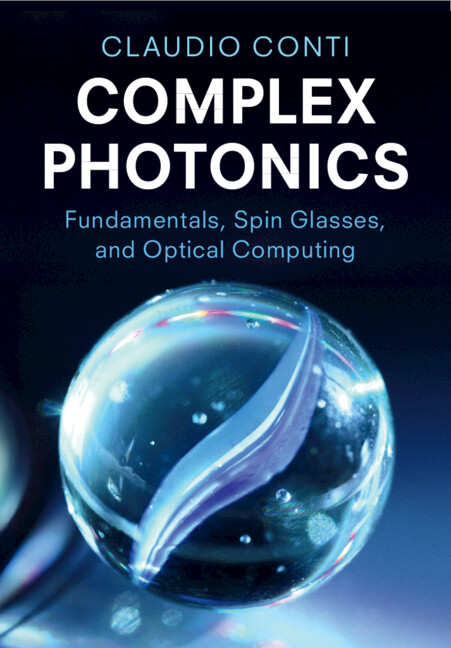
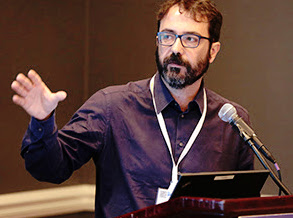
Claudio Conti is Professor of Physics at the Sapienza University of Rome and has published over 250 research articles on topics including complexity, photonic systems, and machine ...
View profile >Keep up with the latest from Cambridge University Press on our social media accounts.




Latest Comments
Have your say!