

Products and services

My first week of doctoral coursework at Johns Hopkins in 2017 came with four hundred pages of reading. The second week came with five hundred. I had been reading science for a living for a decade — as a journalist, a teacher, a writer — and by the middle of the term it was an avalanche of reading scientific articles.
My classmates who had arrived with less reading preparation were buried faster. Some had already begun to quit. One of them had run corporate training at Amazon before he came back to graduate school. He was the best adult educator in our cohort, by any honest measure. He left after the second semester. One by one, chairs around the seminar table emptied. I looked around the room and realized the ones going under were not the ones who couldn’t think; they were the ones nobody had ever explicitly taught how to critically read a research article under load.
So I started writing myself a protocol—a scaffold in education speak. I created a method to move through a dense paper quickly without skimming, or faking it. I asked the same five questions of every article I opened:
These questions replaced my reflex to read the abstract, skim the figures and tables, and guess about the rest, which is how most of us learned to fake reading research long before we got to graduate school.
Eventually this scaffold acquired a name, CERIC, and I stopped working on it alone. An early collaborator, the late Dr. Laura Quaynor, helped me apply the method in the Ed.D. program Writing Center. My co-author Prof. Adam Burgasser scaled it with me across natural science disciplines and into the book I am publishing this year. We tested it with hundreds of doctoral students and adapted it to a variety of formats and fields.
The results were clearer than I ever expected. Students who were already strategic readers still benefited, while students who had been struggling began to stop struggling. One participant in my 2022 dissertation study named what had been wrong before:
“Nobody really teaches you this stuff. The underlying assumption is that here’s a paper, go read it, and if you recognize words, you can read it well enough […], which is so sad because that’s so not true.”
Once you finally know what you are looking for, a scientific article stops feeling like a mountain and becomes a map.
What I keep thinking about, though, is the students who were not in our studies, like the ones who left my own doctoral program before I knew what to do. Or the ones who come into doctoral training from backgrounds — first-generation, working-class, and multilingual — where no one ever explicitly taught them how to read a scientific article. Not because they couldn’t. Because nobody ever showed them how to find the elements of arguing from evidence. These missing people represent many scientific contributions that the world will never get and a lot of perspectives that will be missing from the rooms where the next generation of science is argued into shape.
The book I am publishing this year is the one I wish had been on my desk that first week at Hopkins. It is also, honestly, the one I wish had been on the my classmate’s. He was better than most at almost everything else teaching asks of a person. I still think about the semester he quit.
If you teach doctoral students — or you are one — I would like to know which of the five questions is hardest for you or for the people you work with, and whether it’s differs. I have a working hypothesis, but I am still collecting evidence. Tell me in the comments.
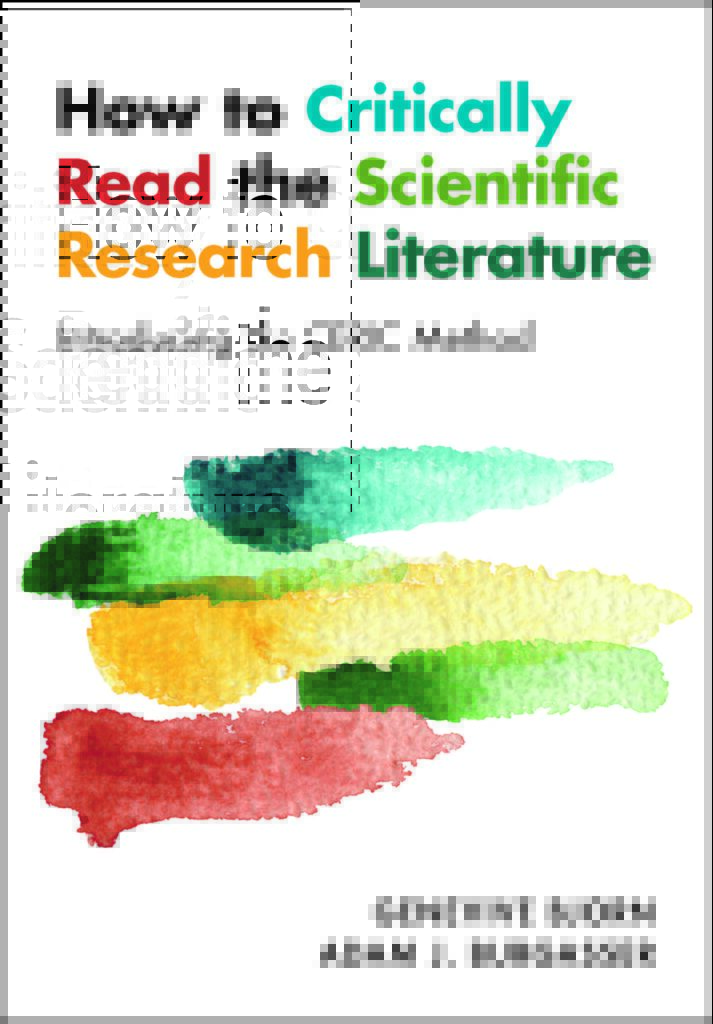
Title: How to Critically Read the Scientific Research Literature
Author: Genevive Bjorn and Adam J. Burgasser
Genevive Bjorn, Ed.D. is Director of the Higher Learning Lab. Her book on the CERIC method is forthcoming from Cambridge University Press in June 2026.
ISBN: 9781009631273

Genevive Bjorn, Ed.D., directs the nonprofit Higher Learning Lab Co. and is the founder of ScienceWriting.net. Holding a doctorate from the Johns Hopkins School of Education, her s...
View profile >Keep up with the latest from Cambridge University Press on our social media accounts.



Latest Comments
Have your say!