

Products and services


A society’s true measure of success is its capacity to deal with failure. In the mid–seventeenth century, this is just what we can observe in the city of Amsterdam, at the time one of the world’s prime commercial hubs. In the early modern Dutch Republic, a set of legal, cultural, and institutional innovations resulted in a new and economically more efficient way of dealing with the problem of insolvency. Individual citizens and entrepreneurs whose businesses failed were not, as in other times and places, confronted with shameful sanctions and debt imprisonment. Instead, the creation of a specialized court for insolvency cases in 1643 – the Desolate Boedelskamer or ‘Chamber of Insolvent and Abandoned Estates’ – together with several legal innovations over the next decades, allowed many insolvents to regain credit and restore their businesses.
We can only appreciate the revolutionary nature of this new and pragmatic approach to insolvency if we compare it to contemporary insolvency regimes. Even if from the later Middle Ages onwards, insolvents who had not committed fraud in Italy, the German lands, or France could try and free themselves from the debtor’s prison by applying for cessio bonorum, those who could not repay their debts continued to be regarded as sinners and thieves. In Rouen, for instance, former insolvents had to wear the shameful bonnet vert (‘green cap’) for a stipulated period, intended to protect others against the danger of engaging in transactions with those who had not paid their debts. In the French–speaking part of Switzerland, even more gruesome procedures dictated that insolvents be led around the city naked, sitting on a donkey, accompanied by a blaring trumpet player to ensure public attention. Having arrived at the central market, the unfortunate debtor had to hit a special pillar with their naked backside three times, crying out ‘cedo bonis!’, before being allowed to cede their possessions to the collective creditors. Similar shaming rituals, often including forms of public nudity and a humiliating display in the city’s prime civic or commercial spaces, were widespread throughout Europe at the brink of the early modern period. Even if in early modern England, those classified as ‘traders’, owing a minimum of £100 to a single individual, could enter a formal bankruptcy procedure, this left the vast majority of insolvents vulnerable to a harsh regime of imprisonment on mesne process. As many as 1 in 4 middling men in eighteenth–century London could expect to be incarcerated for debt at some point during their lifetime. In France, large–scale debt imprisonment could likewise be observed, only slowly decreasing towards the end of the ancien régime.
The seventeenth–century Dutch Republic witnessed an important shift in mentalities towards debt and insolvency that constitutes a sharp contrast with procedures in earlier times and other places. This came together with active urban authorities, who were not content to sit back and leave the problem of insolvency to be fixed by the market. Instead, Amsterdam’s legislators and judges actively intervened in private property rights for the common good. From 1647, it became possible to force a dissenting minority of the creditors to accept a composition that restructured the repayment of (part of) an insolvent’s debts in several instalments. This allowed the insolvent to revive their business, resulting in larger potential repayments than a simple execution of their estate. While intervening in the rights of the dissenting creditors, the Amsterdam court both served the interests of the majority of creditors and the urban economy. The creditors were no longer held back by ‘one or a few ill–affected people’, the insolvents regained their credit and could once more contribute to society. Similarly, the Desolate Boedelskamer ensured that applicants for cessio bonorum were non–fraudulent and could therefore grant this legal solution without shaming sanctions. Evidence from the archives shows that for these insolvents, too, a legal solution secured by the impartial and professional procedure of Amsterdam’ urban court allowed to regain credit and revive their businesses.
In early modern Amsterdam, insolvency did not result in widespread imprisonment for debt. At the peak of the Dutch Republic’s golden age, urban authorities coupled good governance with a healthy pragmatism. As a result, capital investments were preserved to a greater extent than would have been possible without the systemic trust generated by Amsterdam’s legal authorities, compensating for the deficient information position of individual creditors. Amsterdam’s court allowed industrious but unfortunate citizens to receive a second chance to contribute to both urban economy and civic community rather than facing humiliating public punishment. Would you like to read more about this revolutionary shift in mentalities in the Dutch Republic, as well as what we can learn from a successful institution like Amsterdam’s Desolate Boedelskamer? Read all about this and more in Court, Credit, and Capital!
Maurits den Hollander is assistant professor of legal history at Tilburg University, the Netherlands. This is his first book, for which he was awarded the Human Solvency Prize 2024-2026 by the “F. Datini” International Institute of Economic History.
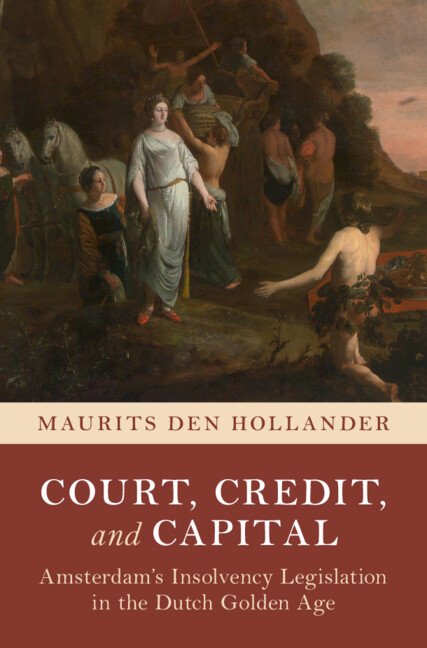
Court, Credit, and Capital by Maurits den Hollander

Maurits den Hollander is Assistant Professor of Legal History at Tilburg University. He specializes in legal and institutional developments across the late medieval and early moder...
View profile >Keep up with the latest from Cambridge University Press on our social media accounts.




Latest Comments
Have your say!