

Products and services

For many years I tried, without success, to crack the code of a literary critical puzzle concerning D. H. Lawrence. The tradition of post-World War II Lawrence criticism, remarkable though it was in remaking successive Lawrences sensitive to the discourses of the day (existentialism, feminism, postcolonialism, eco-criticism), hadn’t got me there. But then, amidst the norm-reversals and the topsy-turvy stresses of the COVID period, I realised that what the critics had taken for granted as the natural object of study-the works as published-was itself the fundamental error. What would become How D. H. Lawrence Wrote: Performance on the Page suddenly came into focus for me.
Rather than treating Lawrence’s oeuvre as consisting of a series of stopping points (works) along the road of a literary career, with each one successively interpreted in light of the others under the arc of the prevailing literary theory of the day, it was the road itself, I came to see, that we should be studying.
But how to reveal its exhilarating contours, its appalling potholes: how to map it? The first move, I already knew, was to bring front and centre in the literary critical endeavour the archive of documents, manuscript and printed, produced by Lawrence or in his name. Big scholarly projects of the last forty-odd years-nearly 50 full-scale critical editions, very substantial bibliographies and biographies-had gradually revealed and made these resources available. Opening up communicating corridors between them would be essential if the question of how Lawrence wrote (not just what he wrote) was to be approached critically.
Studying the successive versions revealed in the archive of documents-and not just the published works themselves-would get us closer to where the action was really taking place: in a sort-of personal workshop, where, on a regular basis, those versions must have overlapped in his mind with versions of other works whenever his multiple writing projects were proceeding more or less in tandem-which was, for Lawrence, most of the time.
That was the starting point, the opening gambit, for How D. H. Lawrence Wrote. What then needed to be characterised and accounted for was the peculiar energy that propelled Lawrence’s verbal explorations. The book’s proposal lies in the concept of performance: Lawrence’s extraordinary, yet always provisional, textual performances on the page, the freshness of nearly every one of them, and his highly charged, deliberately polarising devil’s advocacy. This commitment to staged self-performance led him into unsettlingly radical positions that generations of critics have struggled to defend as a wise philosophy but that the biographical man himself didn’t consciously endorse as a credo-or, if so, not for very long. His drive to create that next piece of writing, only just around the corner, pushed him to vary and adapt and refresh. His daily writing became for him a site of-a stage for-ongoing intellectual-imaginative experiment.
This book, accordingly, is more interested in the saying than in the said. But there is so much material to handle that three significant moments in Lawrence’s writing career are chosen for extended special attention so that all the writings circulating through and around those moments may be treated interconnectedly: 1915–16, 1920 and 1927. All the genres are covered, with the major novels getting extra attention. Women in Love, in particular, gets reconfigured when its two versions are put side by side.
How D. H. Lawrence Wrote finds an unapologetic way of putting before us Lawrence’s fresh and unembarrassed intellectual risk-taking, his confronting intensities, and his forceful conclusions that balloon to fill the narrative space. Watching the versions develop, and work unfold into work as Lawrence’s oeuvre evolved, becomes both chastening and invigorating. You are not the same afterwards; you see differently.
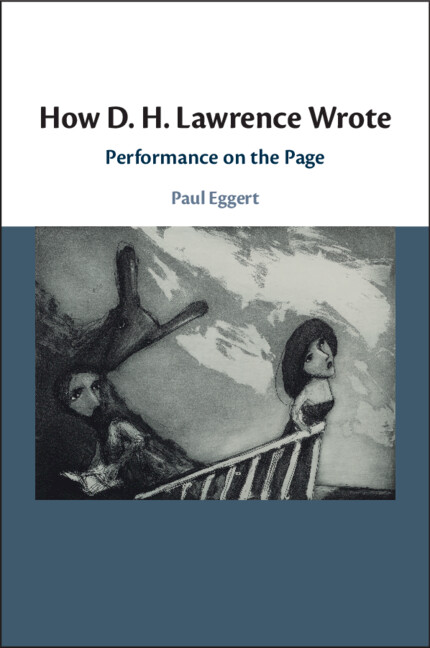
How D. H. Lawrence Wrote by Paul Eggert

Paul Eggert FAHA is an editorial theorist and literary critic. His writings include The Work and the Reader in Literary Studies (2019), Biography of a Book (2013) and Securing the ...
View profile >Keep up with the latest from Cambridge University Press on our social media accounts.



Latest Comments
Have your say!