
Products and services

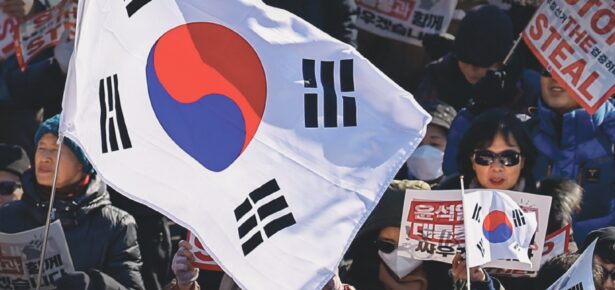
On December 3, 2024, then–President Yoon Suk Yeol of South Korea stunned the world by declaring martial law out of the blue. In a televised address, he emphasized the inevitability of martial law by identifying the current situation as a state of emergency, in which the opposition Democratic Party—what he described as a “pro–North Korea, anti-state force”—was engaged in “legislative dictatorship” and attempting to overthrow the social order. He ordered the prohibition of political activities and suspended the free press. It had been more than forty years since martial law was last declared, by the military dictator Chun Doo Hwan in 1980. As we now know, Yoon’s farcical self-coup was quickly averted, and he was sentenced to life in prison on February 19, 2026. Yet the political forces that enabled it remain firmly in place. The broad political alliance that supported his martial law—consisting of the main right-wing People Power Party and its members, right-wing media, far-right influencers, and ordinary citizens—still exists and continues to chant “Yoon Again!” while staking out its position as staunchly anticommunist.
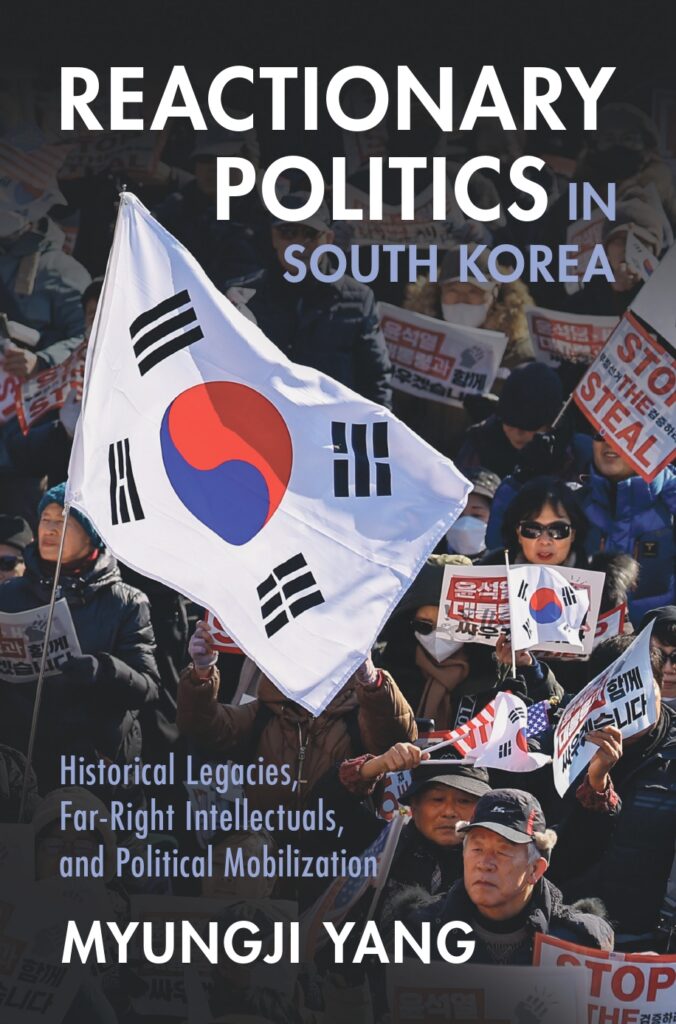
Reactionary Politics in South Korea digs into the question of the formation of the far right, which is rooted in Cold War geopolitics and authoritarian legacies in South Korea, as well as in its organizational and popular bases. In South Korea, where the Korean War between North and South Korea, which broke out in 1950, has not technically ended, far-right elites and politicians have long engaged in war-mongering tactics. By engineering fear about North Korea and amplifying the danger of the “enemy”—namely, North Korea and the so-called pro–North Korea forces within South Korea—these far-right elites suppressed critical voices and insurgent activities and maintained authoritarian regimes from the 1960s through the 1980s.
Even after the country transitioned to democracy, this political practice did not change much, as we witnessed in the martial law debacle caused by Yoon. National security and “liberal democracy” (which, in the South Korean context, often means anticommunism and opposition to North Korea) are the usual rhetorical themes used to justify political control and mobilize supporters. They also openly celebrate former autocratic leaders, such as Syngman Rhee and Park Chung Hee, for establishing the Republic of Korea and achieving economic success. Support for authoritarianism, the demonization of political opposition, and antagonism toward minority groups—which are generally considered far-right positions—are embraced as ordinary “conservatism” in South Korea. By normalizing authoritarian nostalgia and extremist rhetoric under the banner of conservatism, the far right has successfully pushed antidemocratic politics into the political mainstream.
While anticommunism remains at the heart of the far right, the availability and affordability of digital platforms—such as YouTube channels and group chatrooms—allow the far right to disseminate conspiracy theories more easily and widely. This new tactic of knowledge dissemination through emerging forms of communication is, ironically, something that the far right has shrewdly learned from its political counterparts.
The lesson from South Korea’s far right is clear: by dividing society into “us” and “the enemy” for their own political ends, the far right has constantly manufactured a state of emergency and vilified political opposition as an anti-state force (or as “commies”). This war-mongering tactic, of course, is not unique to a country like South Korea. As we can see in the war involving the United States, Israel, and Iran, aggressive far-right leaders do not hesitate to wage war at the cost of countless lives. By invoking national security against Israel’s “sworn enemy,” Benjamin Netanyahu has attempted to overcome a political crisis and maintain his hold on power.
Currently, global norms and the international order as we know them are eroding rapidly, while the far right’s transnational connections are growing stronger, thereby threatening liberal democracy. History shows that the heaviest burdens of political violence fall disproportionately on those with the least political power and influence. Countering far-right movements requires a clear understanding of how they operate in contemporary contexts. It also requires educating citizens about democracy and constructing a counter-hegemony against an authoritarian far right.

Myungji Yang is Associate Professor of Sociology at the University of Hawai'i at Mānoa. As a political sociologist, her research interests include state-society relations, authori...
View profile >Keep up with the latest from Cambridge University Press on our social media accounts.




Latest Comments
Have your say!