
Products and services


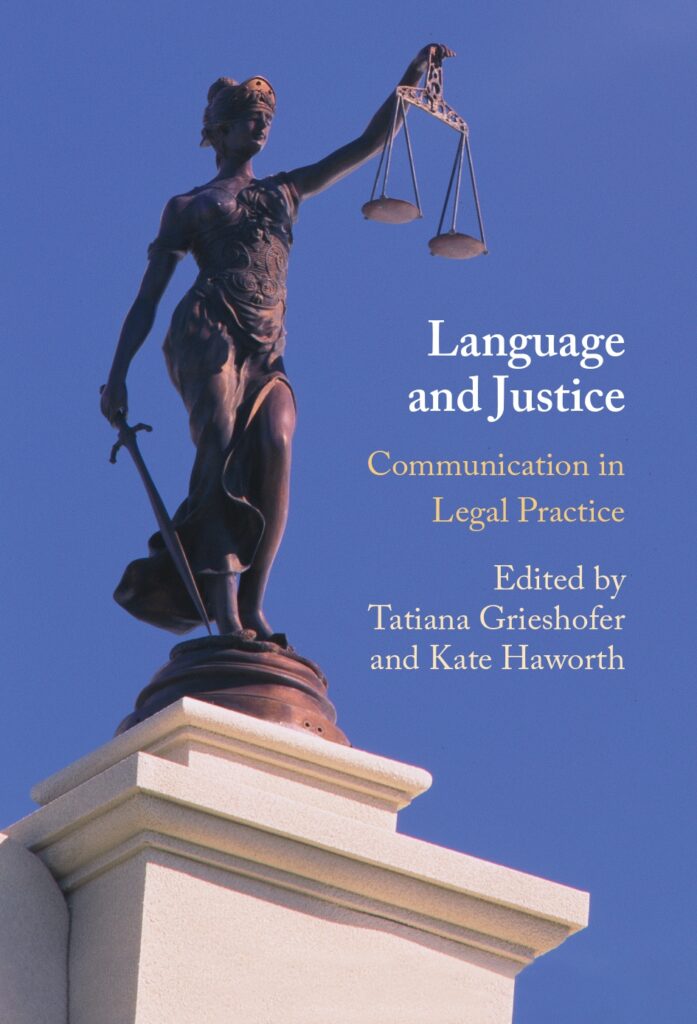
This week we are celebrating the release of our brand new edited collection, ‘Language and Justice’. You may already have heard of the academic areas of ‘language and law’ and ‘forensic linguistics’, but we are capturing something a little different, reflecting new and exciting directions in the research. So let’s start by explaining what we mean by ‘language and justice’. It’s already well established that language is a fundamental part of law, from the wording of legislation to verbal exchanges in interviews and courtrooms. But ‘justice’ is a broader concept than ‘law’: it includes the system; the process; the institutions; the legal professionals and administrative support who keep the whole thing running. This procedural dimension tends to get much less attention, yet it is fundamentally what ‘justice’ is on a day-to-day basis. And language and communication studies are uniquely well-suited to capturing and critiquing this messy reality of how justice is actually delivered. This new collection includes analysis of language in action across a wide range of fascinating contexts, including legal advisor-client consultations; judges’ assessments of language proficiency; lawyers’ strategies for cross-examining vulnerable witnesses; debates around the provision of interpreters for jurors in bilingual jurisdictions; and the administrative creation of official records of recorded talk such as covert surveillance, to name but a few. The chapters all use data from real-life cases and legal contexts, providing new insight into the multiple communication-related challenges which the justice system and those who work in it have to navigate every day.
The motivation for this book came about during a run of international conferences which we both attended one summer, where we noticed a new development emerging. Although research on the interface between language and law has advanced considerably over the last decade or more, the legal context has still tended to be no more than a backdrop for many linguistic studies. What we observed at these conferences, however, was a move towards greater integration of legal process into linguistic analysis or methodology, which makes the research more directly relevant and useful to the justice system itself. At the same time, topics which had previously seemed of interest only to linguists were beginning to be engaged with by legal scholars and others across related disciplines. We were so encouraged by this that we decided – in the middle of a conference dinner in Finland – to create this volume, not just to capture this progression, but also to create a platform to develop this flourishing of new ideas and synergies further.
The collection will be of use to academics and to legal professionals and analysts seeking to add to their understanding of the everyday working practices of law and justice. It will also be valuable for the many degree programmes and modules on law and language / language and law / forensic linguistics which are on the rise internationally. Above all, we hope it shows the huge potential for incorporating linguistic insights into the judicial process, and the benefits this can bring on both sides. This can mean finding solutions to areas which are known to need reform, but also identifying problems which are not yet fully recognised within the legal system. The collection highlights how these often stem from common misunderstandings about how language and communication work in (legal) practice; it also makes a strong case for the potential for us to work together to find workable, evidence-based solutions. If this new book can be part of making that happen, it will have been a conference dinner very well spent.

Kate Haworth is a visiting senior research fellow at the Aston Institute for Forensic Linguistics, of which she is a founding member. Prior to her academic career she was a practis...
View profile >Tatiana Grieshofer is Professor in Language and Law with an interdisciplinary research profile across socio-legal studies, administrative law and applied linguistics. Drawing on mi...
View profile >Keep up with the latest from Cambridge University Press on our social media accounts.




Latest Comments
Have your say!