

Products and services


A Non-International Armed Conflict (NIAC) is a limited manifestation of the broader concept of armed violence. The factual and legal criteria for determining when a situation of armed violence reaches the of NIAC threshold remain complex and contested. The absence of a definition of NIAC in international law, coupled with the lack of any formal mechanism for determining its existence, has long afforded states broad discretion in classifying situations of armed violence. Whereas states once routinely denied the existence of NIACs, contemporary practice increasingly reflects the opposite: states now frequently assert the existence of a NIAC and the applicability of international humanitarian law (IHL), even when the prevailing facts suggest otherwise. With the progressive development of International Human Rights Law (IHRL), states no longer perceive IHL as restricting their ability to suppress rebellions within their territories but rather as easing the more stringent restrictions imposed by IHRL. Put simply, the existence of a NIAC activates IHL, which permits (or at least tolerates) conduct otherwise prohibited by IHRL. The result is a persistent conflation of armed violence with armed conflict, leaving the applicable legal framework open to dispute.
This conflation is particularly visible in the context of the so‑called “global war on terror,” but it is far from unique. Ongoing debates regarding whether military operations by the G5 Sahel Joint Force are regulated by IHRL or IHL, or a combination of the two illustrate the continued uncertainty. Similar questions have arisen concerning whether confrontations between security forces and criminal organizations in Rio de Janeiro, or between competing drug cartels in Mexico, satisfy the NIAC threshold. Increasingly robust UN peacekeeping mandates have prompted further discussion about whether UN forces may themselves become parties to a NIAC. Most recently, President Donald Trump asserted that U.S. strikes against “drug cartels” in the Caribbean were lawful under international law on the basis that the United States was engaged in a NIAC with these groups.
Even where the existence of a NIAC is uncontested, significant ambiguities persist regarding the personal, geographic, and temporal scope of the applicable law – issues that carry profound consequences for determining who may be detained without charge or targeted without warning. In the absence of any central authority to resolve these matters in real time, states continue to exercise wide discretion – and controversial practice is expanding.
Clearly identifying the existence of a NIAC entails profound and reverberating legal significance. This is demonstrated by the impressive range of international actors engaged in conflict identification. For example, both national and international criminal tribunals must determine the existence of a NIAC to prosecute war crimes. The UN Human Rights Council engages in conflict identification to assess whether violations of IHL or IHRL have occurred, while human rights courts and UN treaty bodies undertake similar assessments when interpreting and applying IHRL. At the same time, national courts and tribunals engage in conflict identification to assess asylum or subsidiary protection claims, while insurance firms determine the existence of a ‘war’ to activate war exclusion clauses.
The motives that drive each of these actors to identify armed conflict inevitably influence their respective determinations. This can be seen with respect to not only the existence of a NIAC, but also the geographical and temporal scope of NIAC. Indeed, it is not uncommon for multiple actors to reach different conclusions as to the existence of a NIAC based on the same factual circumstances. These conflicting interpretations are not only the result of the motives that drive them, but equally the result of a broad spectrum of uncertainties surrounding the legal concept and contours of NIAC.
Image credit: fabrikasim / Freepik
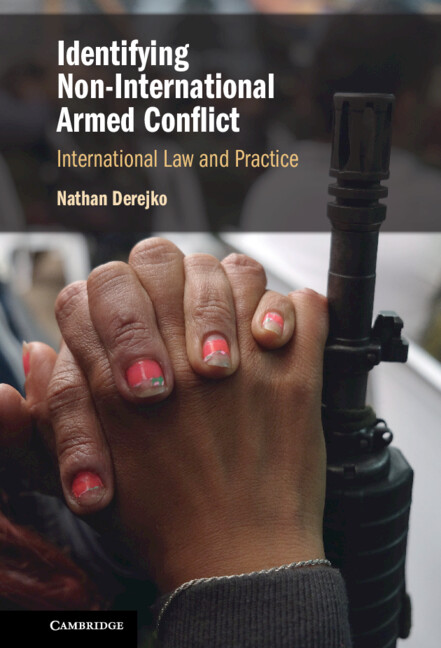
Nathan Derejko is the Mauro Chair in Human Rights and Social Justice and Assistant Professor of Law in the Faculty of Law at the University of Manitoba. He has previously held posi...
View profile >Keep up with the latest from Cambridge University Press on our social media accounts.


Latest Comments
Have your say!