

Products and services


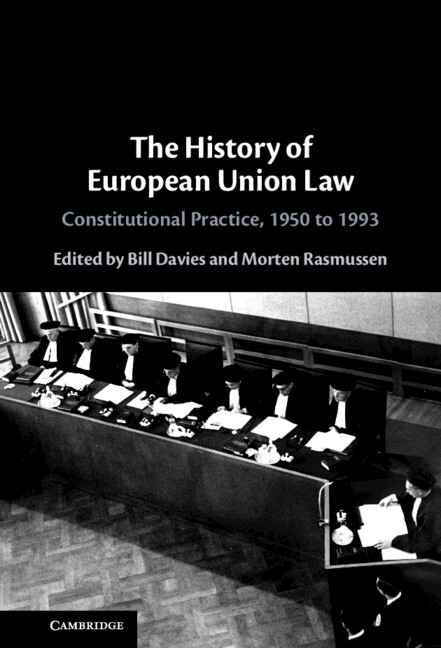
It is a sure bet that almost every study ever written on EU law has, at some point, referenced Eric Stein’s aphorism that the Court of Justice of the EU has been able to fashion a constitutional, federal-type framework of EU law “tucked away in the fairyland Duchy of Luxembourg…blessed…with benign neglect.” This view that the early history of EU law has been forgotten, ignored or simply hidden away in the haze of time past is a tempting target of study for historians. Driven by this enticement, this book once and for all blows away those ephemeral mists and casts a bright light through the clouds of the past revealing a contentious, fragmented and often times rousing course of evolution in the history of EU law.
To do this, the book showcases a methodology of sustained engagement with archival sources. Our contributors draw on court records, government memoranda, institutional archives, and private papers to reconstruct how EU law was argued, implemented, and contested across both the Member States and the European institutions. Going beyond simply trying to explain canonical judgments in isolation or the development of specific doctrines, the chapters situate key decisions within broader legal, political, and administrative contexts. This archival approach reveals the contingencies, deliberate choices, and institutional constraints that shaped the development of EU law.
Debates about EU law are typically framed in the language of doctrine: supremacy, direct effect, competence, proportionality. These terms are, with good reason, the bread and butter of EU law textbooks and academic discourse. But our study reveals that they evolved gradually, only partially formed and were very deeply contested. They were developed over time by judges, lawyers, civil servants, and national courts operating within specific historical contexts. Awareness of this historical context can improve and sometimes even transform our understanding of contemporary legal doctrine. A field of EU law that fails to incorporate this historical consciousness is left impoverished. Doctrinal analyses remain indispensable, but they cannot explain how legal authority was established, why resistance emerged, or how national responses to EU law varied so markedly.
The History of European Union Law makes the clear statement that EU law should also be learned and taught as a historical product and not only as a settled body of doctrine. In many teaching contexts, EU law appears as a fait accompli, a fully-fledged constitutional order whose formative decades are condensed into a handful of cases and principles. Instead, our view is that EU law is something that had to be envisioned, interpreted, defended, and, in many cases, then cautiously accepted (or even flat out rejected) by national legal and political systems. The feedback received from national orders then in turn helped reshape the EU system. This is a tableau of competing forces all pushing to find an acceptable equilibrium that allowed EU law to bring desired benefits at bearable costs.
Through introducing historical texture to EU law, the book encourages students and scholars to ask not only what the law came to be, but how and why it developed in particular ways. It also helps to explain why EU law and the constitutional practice it has developed – has never been uniformly received or uncontested, how that contestation actually helped shape and mould the legal system, and why present tensions between courts or governments should be understood as part of a much longer history rather than as exclusively recent developments.

Morten Rasmussen is Associate Professor at the SAXO Institute, University of Copenhagen and a leading expert on the legal histories of European integration and the League of Nation...
View profile >Bill Davies is Associate Professor at the Department of Justice, Law & Criminology, American University and a leading expert on the legal history of European integration. He is...
View profile >Keep up with the latest from Cambridge University Press on our social media accounts.




Latest Comments
Have your say!