
Products and services


In the summer of 2020, corporate America found its voice on race.
Across every sector, from finance to retail to tech, corporations and their executives issued public statements proclaiming solidarity with Black communities and pledging to confront racial inequality. I watched this unfold like many others—partly inspired by the apparent shift. After all, the Business Roundtable (a consortium of Chief Executive Officers), had declared that the purpose of the corporation also included consideration of the interests of stakeholders like employees and consumers. The language felt sweeping, confident, and moral.
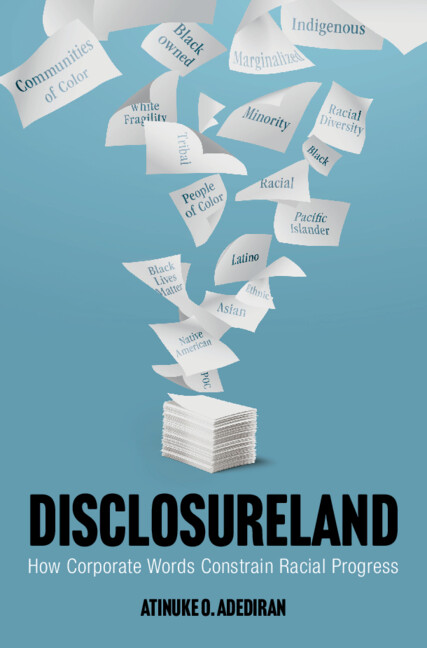
Five years later, many of those pledges have faded, softened, or disappeared altogether. In my book, Disclosureland: How Corporate Words Constrain Racial Progress, I explore how and why that happened—and what it reveals about the deeper relationship between corporate power, language, and racial justice in America.
To write Disclosureland, I studied more than 2,000 companies. What emerged was a pattern: corporations issue public commitments about racial justice not primarily as moral or social acts, but as strategic disclosures designed to shape reputation, reduce legal exposure, and manage shareholder and consumer expectations.
These words are powerful tools. They can move markets, quiet critics, and bolster public trust. But they are also fragile. When the political climate shifts as it has under the new administration, those same statements can become liabilities. The result is a rhetorical whiplash: one year, companies declare that Black lives matter; the next, those same companies quietly remove the word “race” from their websites or annual reports.
The Problem with Opportunistic Language
Corporate pledges to equity often sound visionary. But what they too often lack is historical grounding. Few acknowledge the long histories of exclusion, wage inequality, and racialized labor practices within their own walls. Without that acknowledgment, today’s language of racial equity floats free from the past, serving less as a commitment to change and more as a kind of marketing performance.
That disconnect allows companies to gain from the moral capital of equity language without taking the risks real change demands. In other words, they can profit from progress without practicing it.
Reputation Management
Over and over, I found examples of how language becomes a shield. Public statements about diversity and inclusion can deflect criticism and delay regulation. When questioned about lack of progress, companies point back to their statements as proof of commitment.
This pattern is especially visible in moments of scrutiny. Consider how some firms responded after being accused of racial discrimination or inequality: rather than address structural issues, they expanded their “equity” sections online or hired new diversity officers. These actions are meant to appear responsive while maintaining the status quo.
Intensified Retreat
Under the Trump administration, this dynamic has only intensified. Some companies have chosen to soften their diversity language—substituting “belonging” or “inclusion” for “race” and “equity.” Others have erased references to race or DEI altogether.
The logic is the same: protect brand value, anticipate political backlash, and avoid drawing attention from regulators or shareholders skeptical of “woke capitalism.” Behind each rhetorical shift lies a calculation about what matters most—profit, not principle.
But these shifts are not without consequence. They send a powerful signal to employees and customers that racial justice was conditional, contingent on convenience. When corporations can pivot so easily, the credibility of all such commitments is undermined.
Should Words Have Consequences?
That question lies at the heart of Disclosureland. Should corporations be allowed to benefit financially from their public commitments to racial justice and then walk them back with impunity? What does it mean for our collective pursuit of equality when the marketplace rewards symbolic virtue but punishes sustained reform?
I argue that these actions have moral and legal implications. Public statements are not just words; they are market instruments that shape investor behavior, employee trust, and consumer perception. When those statements are misleading or opportunistic, they distort how we value corporations in both economic and ethical terms.
A government truly committed to addressing racial inequality could treat such disclosures as part of a broader framework of accountability. That might mean regulatory oversight of diversity reporting or legal standards for consistency between corporate speech and corporate practice. In short: if corporations choose to speak on racial justice, their words should bind them to something real.
What Comes Next
As citizens, employees, investors, and consumers, we all have a stake in how corporations talk about race. We can demand greater transparency, insist on measurable commitments, and challenge the idea that words alone are progress.
But my book is not simply about corporate hypocrisy. It’s about the systems that make that hypocrisy profitable and how, through policy and law, we might begin to change them.
I invite readers to look closely at the world of corporate communication, to see beyond the polished statements and into the systems that produce them. Because only when we understand the consequences of corporate words can we fully appreciate the importance of accountability.

Atinuke O. Adediran studies the relationship between business, law, and society. A legal scholar and sociologist, her research has won national awards, including recognition from t...
View profile >Keep up with the latest from Cambridge University Press on our social media accounts.




Latest Comments
Have your say!