

Products and services

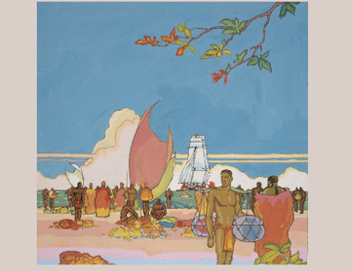
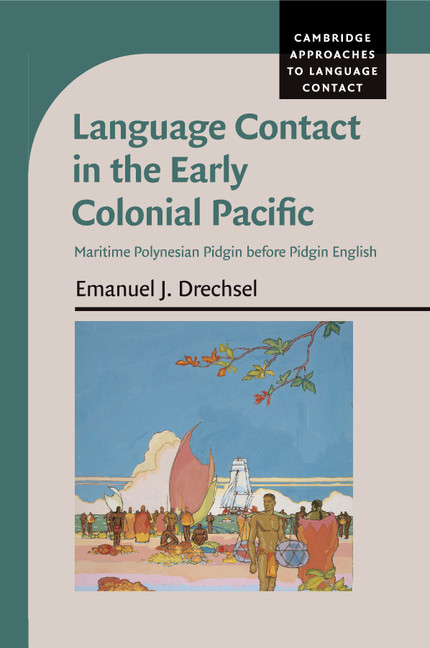
How did Polynesians and other Pacific Islanders interact verbally with Europeans during early colonial times? In turn, how did Cook and those who followed in his footsteps talk with Islanders on their explorations of the eastern Pacific? Answers to these questions emerge from my book Language Contact in the Colonial Pacific (2014) for an interdisciplinary audience with a special interest in:
In addressing a broader audience with an interest in the indigenous peoples’ historical roles, my book has purposely avoided the use of excessive technical terminology for easier interdisciplinary discussions, without however compromising on linguistic standards. As a broad historical-sociolinguistic model served my earlier research on unrelated, Muskogean-based Mobilian Jargon of the lower Mississippi River valley (see Drechsel, Mobilian Jargon: Linguistic and Sociohistorical Aspects of a Native American Pidgin. Oxford: Clarendon Press, 1997). It follows others’ research tradition on non-European pidgins, foremost Chinook Jargon of northwestern North America and Algonquian-based Delaware Jargon.
Language Contact in the Colonial Pacific appeared as part of the interdisciplinary series “Cambridge Approaches to Language Contact,” including a vocabulary of some 60 pages accessible at its website (see “Resources”). Colonial documents have regularly presented reduced or pidginized forms of Tahitian, Māori, and Hawaiian with distinctly Polynesian grammatical patterns and lexica. By all indications, these varieties were closely related and mutually intelligible by their common linguistic patterns so as to lend underpinnings for Maritime Polynesian Pidgin (MPP), a regional medium. In post-contact times, Europeans adopted and employed this reduced Polynesian avenue in contact with Islanders of the eastern Pacific without initially attempting to impose English or some other European language on the Islanders. A telling case in point is the historical record by the British fur trader James Colnett, who in Mexico (sic!) addressed his Tahitian servant-sailor Matatore through the Spanish naval officer Esteban José Martínez and Franciscan priests during the Nootka Sound Controversy between Great Britain and Spain of 1789: “Oe No Ho No ho haree Tenenony or Capitain?” ‘Will you stay at the house of Tenenony the captain?’, reconstructed as ‘Oe nohonoho hale teni/tini noni o kapitan? ‘You live/reside [at the] house [of the] chief [who-is-]small or [the] captain?’ or ‘Do you live at the house of the small chief or captain?’
Intriguingly, MPP served as major interlingual medium during European explorations of the Pacific in the late 1800s, when the unsolicited visitors required new resources. Explorers wanted fresh food and water, navigational assistance by native pilots, repairs to damaged ships, or even indigenous seamen as replacements for crew members who had jumped ship. The pidgin also served as a major contact medium in the maritime fur and hide trade and subsequent traffickings of sandalwood and pearls, whaling and sealing, plus beachcombing. MPP came into use in still other exchanges between Eastern Polynesians and European or American explorers as with the first European missionaries’ attempts at converting Islanders to Christianity, the establishment of early military rules by European nations or the United States in the Pacific, and the emergence of the first colonial plantations in the area. The Pidgin continued as a full-fledged contact medium until about the mid-nineteenthcentury before gradually merging with Pidgin English, but survived in a few Pacific Islanders’ memories in the early twentieth century and reportedly as Parau Tinitō ‘Chinese speech’ in Tahiti as late as the 1970s.
While reflecting sociolinguistic and sociopolitical realities of the colonial Pacific, the history unfolding MPP’s origin, structure, and uses offers a perspective different from conventional linguistic or historical analyses by giving greater recognition to Pacific Islanders until the overthrow of their local governments in the nineteenth century. Language Contact in the Early Colonial Pacific indeed redefines our understanding of how Europeans and eventually Americans interacted with Pacific Islanders of eastern Polynesia in their first encounters, and offers an alternative, differentiated model of language contact. The search for documentation on how Pacific Islanders and Europeans interacted verbally with each other stipulates a systematic, careful review of diverse original historical and linguistic texts for the period. Once identified, such historical attestations are not acceptable at their face value because of hazards for Europhile hypercorrections and lexical replacements misrepresenting colonial records. To meet standards of modern linguistic transcriptions as closely as possible, early testimonies instead require a careful rewriting by triangulation with contemporary or modern comparative data from mostly Eastern Polynesian languages. Known as reconstitutions, these reconstructed transcriptions have frequently differed from standard Polynesian vernaculars by displaying grammatical reductions characteristic of pidgins, evident also in Colnett’s recordings. As documented by still other examples, most reconstituted forms of MPP exhibited other differences from Polynesian languages such as by the dominant word order of subject-verb-object (SVO) instead of VSO, as characteristic of Polynesian languages.
My analysis follows an established tradition of philology as first developed for Indo-European languages, but also applied successfully to non-European cases, foremost Algonquian languages of northeastern North America, Nahuatl (Uto-Aztecan) and other indigenous instances of Mesoamerica, as well as Austronesian languages of the Pacific, including Polynesian. In distinction from conventional historical-linguistic research promoting a tree model of language diversification, my analysis has paid greater attention to language contact, particularly pidginization and creolization. My book has not only demonstrated the feasibility of philological research and – with it – the existence of systematic, Polynesian-based language contact, while drawing on European historical records as primary sources and integrating modern comparative data from Polynesian languages. Additionally, Language Contact in the Colonial Pacific exemplifies a broader, ethnological approach to the sociohistorical description and analysis of primary linguistic and non-linguistic records by incorporating diagnostic principles of the ethnography of speaking. As modern attestations of MPP have not been available to my knowledge, the actual analysis of its broader sociohistorical context could not depend on modern linguistic or ethnographic data. For historical analysis, I have instead incorporated ethnohistory in an ethnohistory of speaking (in analogy to the ethnography of speaking) to help resolve various linguistic problems comparable to modern social-science issues in sociolinguistics. In the end, my book presents extensive historical-sociolinguistic attestations of a regional Maritime Polynesian Pidgin for corroboration, and lends support for the notion of its role in the historical emergence of subsequent European varieties as linguistic replacements with the rising dominance by European and their American powers in the eastern Pacific.
Emanuel J. Drechsel, Ph.D., Emeritus Professor, University of Hawai‘i at Mānoa, Honolulu, USA
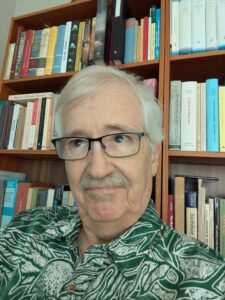
Emanuel J. Drechsel is Adjunct Professor in the Department of Linguistics at the University of Hawai'i at Mānoa. Notable publications include Mobilian Jargon (Clarendon Press, 199...
View profile >Keep up with the latest from Cambridge University Press on our social media accounts.




Latest Comments
Have your say!