
Products and services


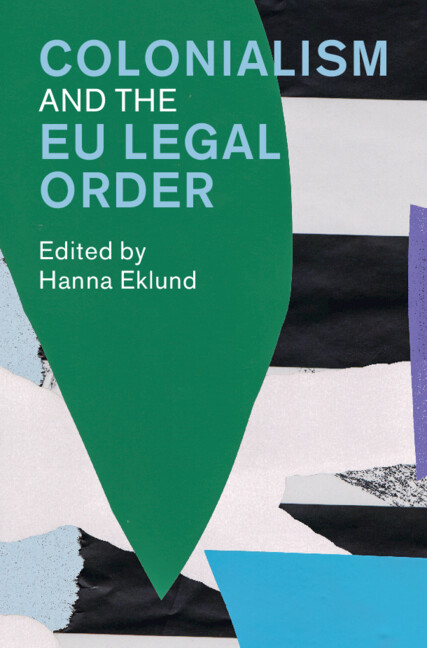
How has Europe’s century-spanning history of colonialism shaped the development of the European Union (EU) legal order? The book Colonialism and the EU Legal Order edited by Hanna Eklund explore this question across 16 chapters and analyses how colonialism has had an impact on the drafting and application of EU law, on the methods of actors and the workings of institutions, and on the changes in EU membership over time.
The origin of the European Union and EU law is traditionally taught and studied as an embodiment of the peace process for the European continent after the Second World War. A growing multi-disciplinary field, however, has shown that while the proposition that inter-European peace animated the idea of a united Europe is unmistakable, colonialism and decolonisation also shaped the outlook and methods that characterised the early days of European integration. The book Colonialism and the EU Legal Order builds on that scholarship.
Colonialism is a capacious and contested term. It is commonly, including in the book, taken to stand for both a form of rule and a historical period of European territorial expansion. All chapters of the book reference the European colonial enterprise, which accelerated in the fifteenth century in North and South America, and culminated in the late nineteenth century in Asia and Africa. It is with the repercussions of the latter period in particular that the chapters of this book predominantly grapple.
The book is divided into four parts reflecting the different case studies used by the authors to analyse the relationship between colonialism and the EU legal order. First, the book opens with eight chapters that concern colonialism and different areas of substantive EU law. Marise Cremona writes about trade; Daniela Caruso about agriculture; Karim Fertikh about social security; Lionel Zevounou about discrimination; Diamond Ashiagbor about labour law; Kako Nubukpo about currency; Veronica Corcodel about migration; and Janine Silga about development policy. The second part comprises two chapters that examine the connections between colonialism and actors within EU institutions. Véronique Dimier writes about actors in the EU Commission and Michel Erpelding about actors in the Court of Justice of the EU. The third part contains three chapters that analyse exits from the EU and how the history and aftermath of these exits relate to colonialism. Amel Benrejdal Boudjemaa writes about Algeria; Ulla Neergaard about Greenland, and Stephen Coutts about Northern Ireland’s exit from the EU with Brexit. The fourth and last part contains chapters by Antoine Vauchez and Iyiola Solanke that look towards the future and address the question of how we build on the knowledge and scholarship concerning the interconnections between EU law and colonialism. Taken together, the chapters of this book make the case that understanding more about colonialism and the EU legal order is not merely, although it is also importantly, a historical exercise. It has the potential to constitute a starting point for examinations of current EU law, and dialogue with people interested in acknowledging and moving away from Europe’s colonial history.

Hanna Eklund is Assistant Professor of Constitutional Law at the University of Copenhagen. She was previously a postdoctoral fellow at Sciences Po Law School and holds a Ph.D. from...
View profile >Keep up with the latest from Cambridge University Press on our social media accounts.




Latest Comments
Have your say!