
Products and services

During the 1960s and 1970s, most Latin American republics saw their democratic systems ousted by ruthless military dictatorships. Whether in Brazil, Argentina, Chile, or Uruguay, these regimes alleged to purge society from communism – thus averting an imminent “civil war” – only thereafter to enact profound neo-liberal reforms in their economies. “Bureaucratic Authoritarianism” is how political scientists have characterized this sinister state model throughout the years. But were they fascist? Until recently, most historians have refused to call them that, let alone to agree on a genealogy linking them to 1930s fascist Europe. After all, fascism came to its conclusive end in May 1945, they would pose.
Still, the question of how fascism continued to inform right-wing quarters worldwide after 1945 cannot be shrugged off that easily, especially not in Latin America, where leaders such as Juan Perón avowedly revised Mussolini’s state model into a novel “Third Position” between capitalism and communism. Perón was neither a fascist nor a neo-fascist; he was the world’s first post-fascist populist.
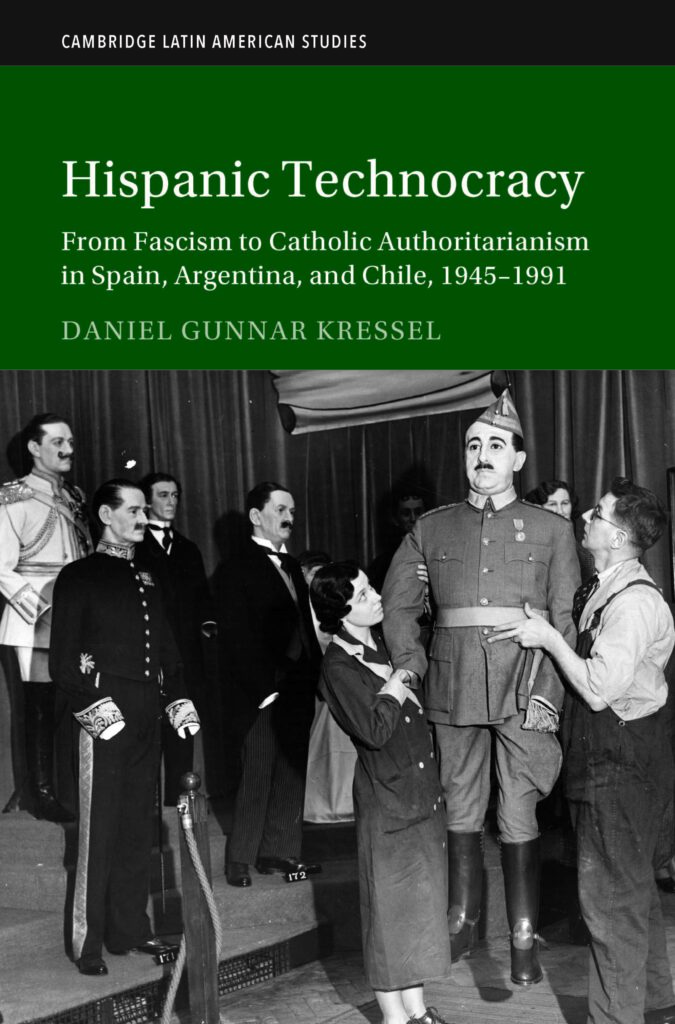
What my book Hispanic Technocracy: From Fascism to Catholic Authoritarianism in Spain, Argentina, and Chile does is tell a story of the rise and fall of yet another post-fascist ideology; one that, unlike revolutionary populism, was attuned to the power structures of the Cold War and the stipulations of the global financial order after Bretton Woods. Indeed, this book is, essentially, about the moment when fascism overlapped with neo-liberalism. Strikingly, Franco’s Spain was the place where this intersection took place for the first time.
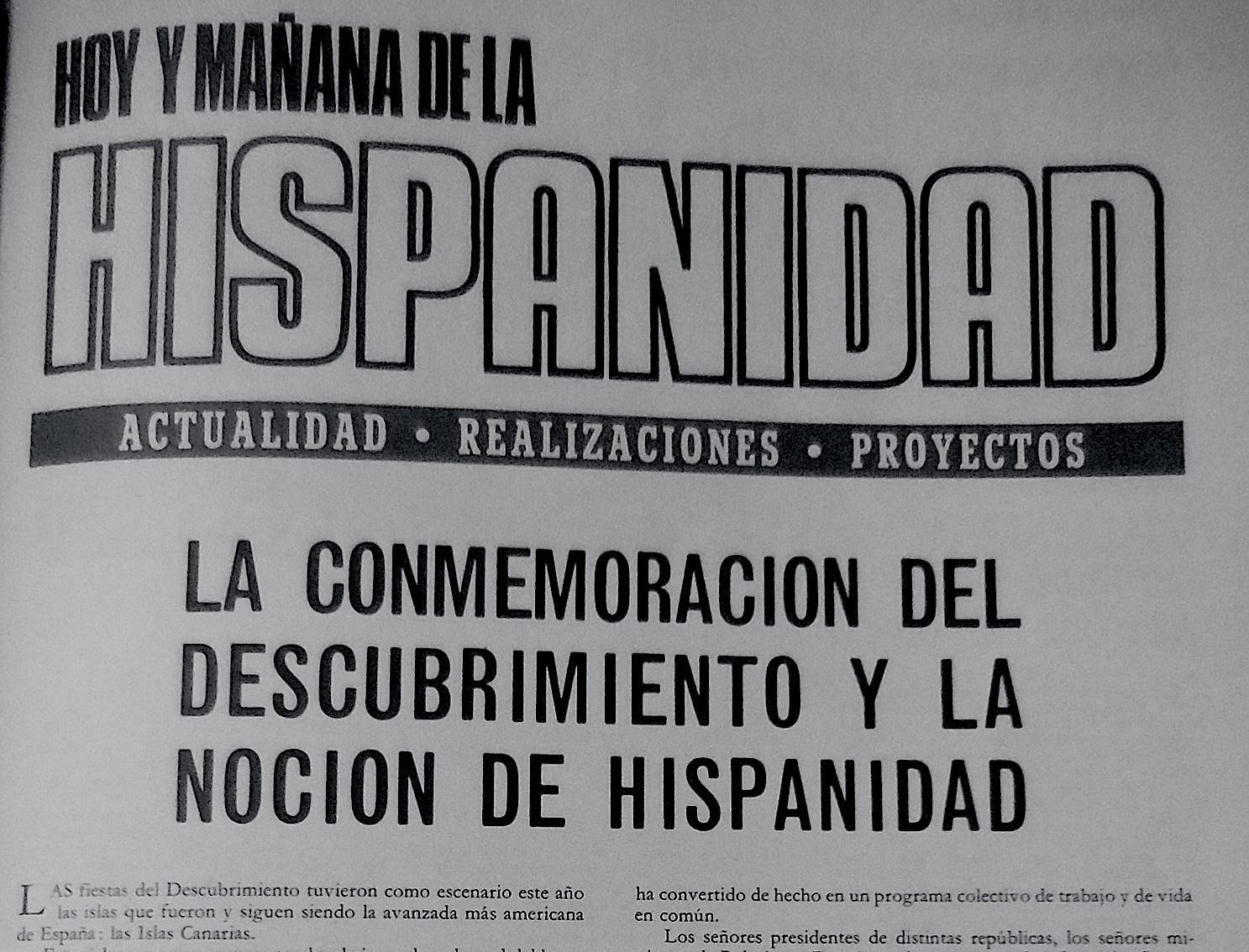
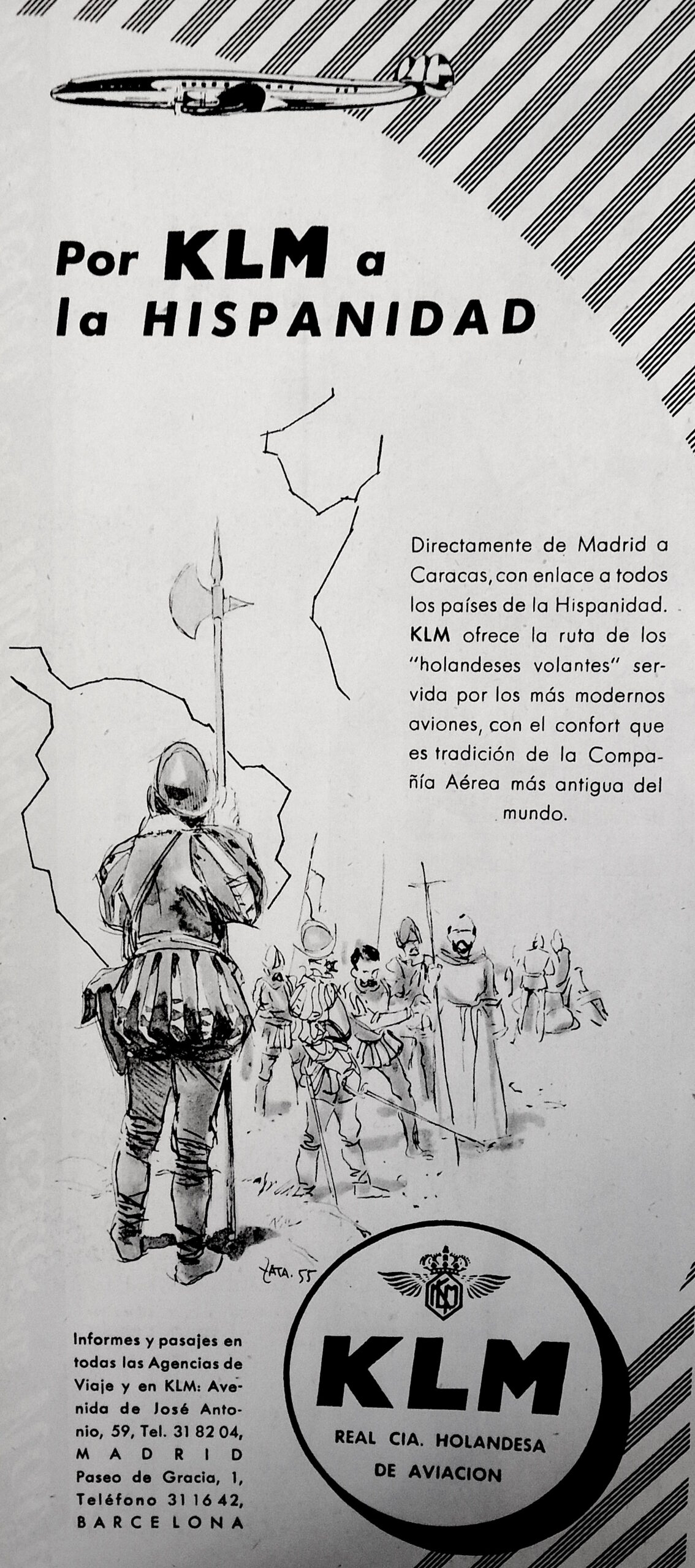
I know, Spain is not in Latin America. But this is not how Franco and his men saw it. For them, “America began at the Pyrenees.” Indeed, ever since the turn of the century, right-wing Spanish traditionalist intellectuals have been linking with Latin American conservatives to craft an anti-modern and neo-imperial vision for Latin America – a project that, in the 1930s, resulted in the birth of the term Hispanidad. The “discovery of the notion of Hispanidad” is one of the more fascinating discursive phenomena in Latin American modern history if only for the reason that even its more erudite theoreticians could not quite define what it was; as is often the case, this was precisely what made this word “click” as the ontological heart of the Hispanic-Technocratic school.
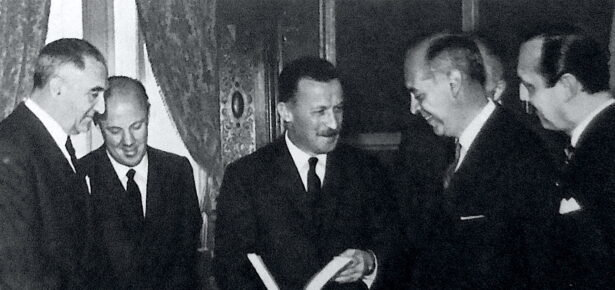
It was the onset of the Spanish Civil War and the Francoist dictatorship that gave Hispanidad its political form, as a crusade against the European Enlightenment based on the moral absolutes of the Catholic dogma. Still, having been supported by Fascist Italy and Nazi Germany, Franco’s regime began as a fascist dictatorship, with a fascist party as its heart (the Falange) and with a conspicuous “national syndicalist” state ideology as its economic engine. It was only in the 1950s that Francoism fully returned to Hispanidad, and linked with its Latin American neo-fascist counterparts, mainly via an international body named the Institute for Hispanic Culture.
How this network of “Hispanic” theorists came to life, and how they put forth a post-fascist Cold War “bloc,” is merely my book’s point of departure. The main theoretical intervention I pose pertains to the way in which a new generation of theorists revised the essence of the fascist corporatist model into a novel format of authoritarianism. A “subsidiary state” based on the principle of works of “intermediary societies,” it was first put into practice in the early 1960s by Franco’s Opus Dei “technocrats.”
The Opus Dei, just like the Argentine Ateneo de la República and Chilean Gremialismo, was an elite spiritual movement that, at a particular point in time, was appointed by the military dictator to reform the nation’s economy and its constitutional framework. All three set out to integrate their economies into the Western financial system while enacting a consumerist society that is ridded from “ideologies” and malicious Western cultural trends. In short, they heralded what they believed was a finite Hispanic modernity.
The book’s purpose is not to argue that Argentines and Chileans mimicked the Francoist change of skin – and the so-called “economic miracle” that came in its wake – but rather to illustrate how they sought to adapt and even transcend it, within their peculiar political circumstances. Along the way, the readers will become privy to the bitter feud between these “technocrats” and the neo-fascists, who still demanded a return to a totalitarian and protectionist revolutionary state. And of course, the book overviews how the Hispanic technocrats’ “subsidiary state” was saddled with paradoxes, and how these led to its demise, often through the reconfiguration of its authoritarian principles within a “protected” parliamentary democracy.
Daniel Gunnar Kressel is a research fellow at the Koch History Centre at the University of Oxford, and specializes in the history of transnational right-wing ideologies and network...
View profile >Keep up with the latest from Cambridge University Press on our social media accounts.


Latest Comments
Have your say!