

Products and services


Catherine Robinson, Murad Khan and I have edited a new book on suicide prevention. Does the world need it when there already loads of books on suicide? We think so.
Many academics in mental health are aware of the ‘basic facts’ of suicide prevention. Reducing access to means of harming oneself works. Male suicide fluctuates with the employment rate. Prompt access to mental health services is crucial. Trying to develop a useful clinical suicide risk instrument has proven impossible. All of these are true, or true in High Income Countries (HICs), but we wanted to bring some different perspectives to academic attention.
Nearly all papers about suicide start with quoting the World Health Organisation statistic on suicide, more than 700,000 deaths per year globally. Fewer quote another WHO statistic, that 73% of those deaths occur in Low and Middle Income countries (LMICs), some of which have a population rate of suicide far in excess of that seen in Western Europe, North America or Australasia. It is a paradox that so much of what is known about suicide comes from countries where the risk is relatively low, that is HICs. Of course, this is no cause for complacency, but we wanted to draw attention to suicide as a global public health problem, with epidemiological and health service implications from the totality of world data that are important for all nations, HICs or LMICs alike. For example, it has been known for a very long time that, in general, suicide is much commoner in males. Nevertheless, this is not an immutable law of nature, applicable everywhere. In India, for example, the gender ratio is equal. What can possibly account for that? It is a meaningful difference affecting large numbers of people. This important but unexplained difference is explored, but not resolved, in this book. Similarly, what is the relationship between violence and suicide, given that rates of the two phenomena fluctuate in tandem? What is the relationship with human rights violations? Of course, some of the learning, for example with regard to the organisation of clinical services, flows from HICs to LMICs. However, we should not assume that the learning, or the solutions, flow in one direction.
We live in a world where nationalism is popular with voters. Nonetheless, we need to implement those lessons from across the world which are available already. Finland had an unusually high rate of suicide within Europe in the 1980s, but has achieved a steady and worthwhile reduction by following a national suicide prevention strategy consistently and with patience over the last 30 years. Very few nations have achieved this, although Finland has shown that it is possible. Similarly, China has seen a major reduction in suicide in the last two decades. The consensus is that this is due to rapid urbanisation, which demonstrates that structural social change can bring about major epidemiological change, and is not simply the dream of public health officials.

The book is entitled “Suicide Prevention: an evidence-based approach”. There is a continuing need for empirical evidence to support suicide prevention measures, and the chapters are carefully referenced. Now, more than ever, we need evidence for what we do. All kinds of mental health measures have been based on belief, not evidence, and well-intended (as well as less well-intended) interventions have turned out to be ineffective or counter-productive. A section of the population may believe that SSRIs are a major cause of suicide, but domestic firearm ownership is a much more likely factor, accounting for the US excess over the UK. Internationally, socioeconomic factors affecting many millions of lives are implicated by empirical evidence. Evidence is more reliable than the opinion of self-appointed experts, and is always subject to revision on empirical grounds.
This book has many thought provoking contributions for experts from around the world. Don’t take my word for it; if this blog has interested you, the book itself is much more detailed and authoritative. Read it!
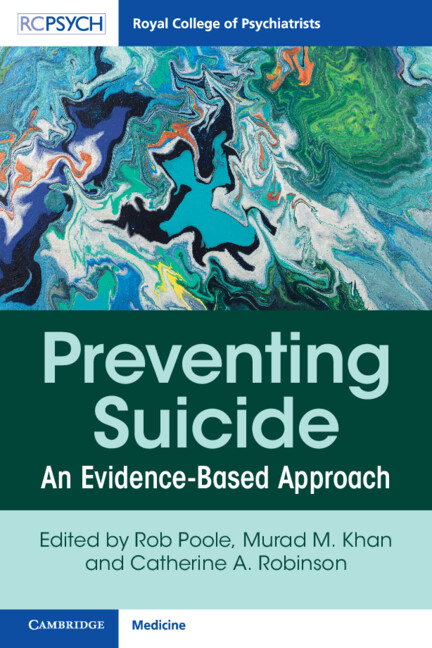
Title: Preventing Suicide
ISBN: 9781108965620
Authors: Rob Poole, Murad M. Khan and Catherine A. Robinson
Keep up with the latest from Cambridge University Press on our social media accounts.





Latest Comments
Have your say!