

Products and services

The law underwent significant developments in eighteenth-century Britain as jurists and legislators adapted older doctrines to fit the needs of an increasingly commercial, industrial, and imperial society. These developments at once shaped and were shaped by the period’s imaginative writing. In an era when disciplinary boundaries had not yet hardened, some men trained for the law or worked in the political arena before turning to literature; others continued to work as magistrates or MPs while pursuing careers as writers. As scholars have noted, the legal and political experiences of authors such as Daniel Defoe, Samuel Richardson, Henry Fielding, and Sir Walter Scott played an important role in the development of prose fiction. But legal questions also permeated the broader culture. Criminal biographies, execution broadsides, and trial narratives received wide dissemination, and parliamentary speeches – themselves highly rhetorical in nature – were routinely reported and discussed in the popular press. The growth of literacy and the expansion of the print public sphere contributed to the diffusion of legal concerns, enabling those without formal training or professional connections to weigh in on legal matters in novels, poems, plays, autobiographies, and essays.
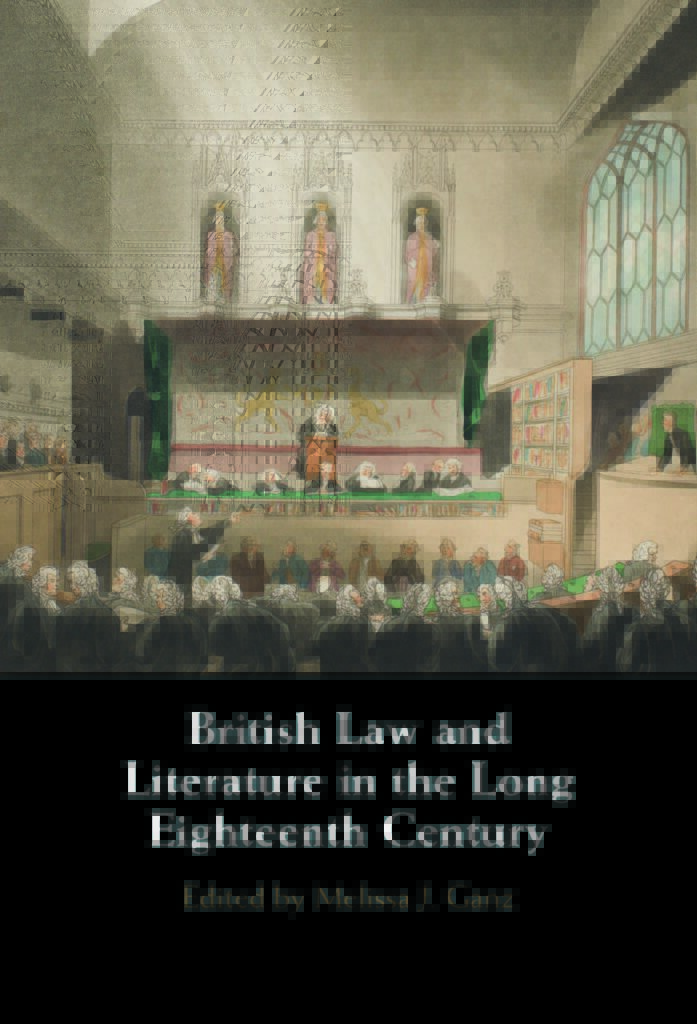
British Law and Literature in the Long Eighteenth Century examines such developments while reflecting on the place of law in eighteenth-century studies. Addressing a range of genres and both familiar and unfamiliar texts, the volume explores literary engagements with libel law, plague law, marriage and property law, naturalization law, the poor laws, the law of slavery and abolition, legal ethics, and the theory and practice of common-law decision-making. The volume considers, too, the language and form of legal treatises and judicial decisions, as well as the role of eighteenth-century literature in the transmission of legal norms today. Through these varied case studies, the volume seeks to expand and deepen our knowledge of law and literature’s mutual entanglements during a formative period of development while showing how eighteenth-century studies has contributed to and been shaped by the law-and-literature enterprise.
Written by scholars with diverse backgrounds and orientations – some based in English departments and others in law schools – the chapters bring new research and insights to bear on a range of works, situating political satire, sentimental and historical fiction, pamphlets, poems, periodical essays, slave narratives, and judicial decisions in the context of developments in common law, statute law, equity, and jurisprudence. Some of the writers under consideration – such as Richardson, Fielding, and Scott – had formal legal training or professional connections in the legal world; others, like Sir Humphrey Mackworth and Mary Prince, found themselves thrust into legal disputes or subjected to legal wrongs. Broadly speaking, the chapters examine the role of literature and rhetoric in the modernization of British law: They trace a shift, though at times uneven and contested, from older forms of legal and political organization to newer ones, from relationships grounded in birth and status to those grounded in individual choice and consent. At the same time, the chapters show how writers and jurists alternately contributed to and challenged inequities that continued to permeate the legal system.
The volume begins with Andrew Benjamin Bricker’s examination of the interplay between satire and libel law in late seventeenth and early eighteenth-century England. Bricker shows that the common-law courts responded to the emergence of new forms of verbally evasive satire by instituting supposedly “reasonable” or “objective” interpretive standards in libel trials. These standards required jurors to reject their subjective understandings of libelous statements in favor of a sociocentric interpretation – the interpretation of a theoretical community of average or typical readers who responded in predictable and normative ways. The chapter examines the emergence and refinement of these standards in two trials for seditious libel and reflects on the implications of these standards for both law and literature.
The second chapter takes up the role of law in Britain’s industrial economy. In the late seventeenth and early eighteenth centuries, Britain saw an unprecedented growth of transport infrastructure. The turnpikes, canals, and railways that appeared throughout the realm frequently crossed one another, prompting discussions about how these different directions of traffic should negotiate the spaces they shared. David Alff examines the conflicts occasioned by one such crossing in the South Wales town of Neath. Combining rhetorical analysis with recent insights from infrastructure studies, Alff shows how Mackworth, a coal magnate, used the language and process of the law to defend his wagonway and define the conditions for public works to exist.
In Chapter 3, Kathryn D. Temple considers another manifestation of the conflict between private interest and public welfare in early eighteenth-century Britain, focusing on Defoe’s account of the law’s failed response to the outbreak of bubonic plague in A Journal of the Plague Year (1722). Defoe’s novel, Temple suggests, points toward what critical-legal scholar Duncan Kennedy has termed the “fundamental contradiction” between our autonomy needs and our reliance upon other people. Building upon scholarship in law and the emotions, Temple argues that feelings of ambivalence are central to both the plot and the form of the novel, and that through his thematic and formal experiments, Defoe illuminates the irreconcilable conflict between individuals’ resistance to and desire for law during periods of crisis.
The next three chapters examine developments in the legal profession and the practice of judging in mid-eighteenth-century England. In Chapter 4, Suzanna Geiser reads Fielding’s Tom Jones (1749) as a meditation on the problems created by the era’s lax standards for legal professionals, arguing that the novel shows the need for a principled and self-regulating body even as it recognizes the role of individual virtue in developing a professional identity committed to the law’s core values of truth and justice. My chapter (Chapter 5) turns to Fielding’s rival novelist, reading scenes of judging and judgment in Richardson’s Sir Charles Grandison (1753–54) in the context of debates about the Court of Chancery’s discretionary mode of decision-making. Through his account of the exemplary consciences of the eponymous hero and Harriet Byron (later, Lady Grandison), as well as his experiments with epistolary form, I argue, Richardson responds to critics’ concerns about the subjective nature of equitable judgment while showing the need to extend the era’s equity jurisprudence to contest the patriarchal underpinning of English marriage and property laws. In Chapter 6, Simon Stern examines the role played by Lord Mansfield, Chief Justice of the Court of King’s Bench from 1756 to 1788, and his law reporter James Burrow in the modernization of the legal decision and the development of precedential reasoning. Through a close analysis of selected decisions and their appearance on the printed page, Stern highlights the formal, rhetorical, and typographical techniques that Mansfield and Burrow used to mark Mansfield’s decisions and the rulings in them as precedents that would govern future disputes.
The next two chapters by Stephanie DeGooyer and Anne Frey, respectively, consider debates about the constitution of the British nation and the nature and reach of British law. In Chapter 7, DeGooyer examines literary contributions to debates about naturalization, showing how imaginative writers like Richardson and Maria Edgeworth used prose fiction as a creative form for imagining the reception, acculturation, and legal protection of foreigners in England. In Chapter 8, by contrast, Frey considers Scott’s interrogation of the fiction that the common law derives its legitimacy from locally shared traditions, arguing that in Ivanhoe (1819) and Chronicles of the Canongate (1827), Scott questions whether the common law can fairly govern multi-ethnic communities.
Chapter 9, by Mark Schoenfield, takes up representations of and responses to the law’s regulation of poverty, exploring the legal discourse that governed metropolitan paupers and that some paupers themselves deployed in the service of self-representation. Schoenfield draws from a wide range of sources, including poems by Thomas Hood and William Wordsworth, periodical essays, legislative reports, legal cases, and popular biographical sketches, considering how writers alternately affirmed and challenged the law’s efforts to strip paupers of agency. In Chapter 10, Sarah Winter examines another site of conflict over freedom and agency in the early nineteenth century, turning to the law and literature of slavery. In Somerset v. Stewart (1772), Lord Mansfield famously held that individuals could not be detained in England against their will or sent out of the country for sale and re-enslavement. In the case of The Slave, Grace (1827), however, Lord Stowell, Chief Justice of the English High Court of Admiralty, emphasized the limits of Mansfield’s decision, holding that the petitioner, Grace James, reverted to her enslaved status when she returned to Antigua. Winter reads legal opinions in the case as well as unpublished correspondence and press reports, before turning to The History of Mary Prince (1831), highlighting the ways in which these texts satirize the contradictions in the law’s conception of English liberty.
In the volume’s final chapter, Nicole Mansfield Wright examines the efforts of right-wing editors and podcasters in the United States to recast struggles for liberty and autonomy in Romantic-era fiction. Specifically, Wright shows how the Ignatius Press’s Ignatius Critical Editions and the National Review’s “Great Books” podcast have polemicized Jane Austen’s Pride and Prejudice (1813) and Mansfield Park (1814) and Mary Shelley’s Frankenstein; or, The Modern Prometheus (1818). Wright shows how these ventures have reinterpreted Austen’s and Shelley’s depictions of freedom and personal autonomy in a manner consistent with the political priorities of today’s Christian right, extolling restrictions on choice – especially for members of subordinate groups – as conducive to contentment and true freedom.
Together, these chapters reveal the complex interplay between British law and literature in the long eighteenth century, the centrality of narrative and rhetoric to the period’s legal discourse, and the continuing relevance of the era’s legal debates to this day. In the wake of the curtailing of legal rights and renewed calls for legal and social justice in the United States, in the United Kingdom, and around the world, the study of law and literature has taken on new urgency. As this volume shows, analyses of the legal dimensions of British literature and the rhetorical features of legal texts in the long eighteenth century can help us understand not only the entanglements of law and literature in the past but also the role of literature, writing, and rhetoric in the pursuit of justice today.

Melissa J. Ganz, Marquette University, Wisconsin. Melissa J. Ganz is Associate Professor of English at Marquette University. She is the author of Public Vows: Fictions of Marria...
View profile >Keep up with the latest from Cambridge University Press on our social media accounts.


Latest Comments
Have your say!