

Products and services


Since the end of World War II, the vow of ‘Never Again’ has been repeated by state leaders, international organisations, diplomats and activists worldwide. The famous phrase appears on genocide memorials in Rwanda, Poland and Bosnia and Herzegovina and many others. It is routinely uttered at annual commemoration events such as the Holocaust Remembrance Day. Beyond mere symbolism, the vow requires action. At the level of international policy, mass atrocities are positioned as a key threat to international security and preventing their occurrence and recurrence seemingly are global imperatives.
In post-conflict contexts, how can mass atrocities be stopped from recurring? Much has changed since World War II, as the world witnessed key developments in international law and policy strands, such as international human rights treaties and international criminal law. New regulatory models have been developed to this end, with one of the most prominent ones being that of transitional justice as a set of tools, mechanisms and practices which states transitioning from conflict and/or authoritarianism are advised or even conditioned to implement to ‘deal’ with their problematic pasts for more sustainable futures and durable peace.
In the past four decades, from Argentina, Rwanda, Bosnia and Herzegovina, Cambodia, to Tunisia, Syria and Sierra Leone, states and societies operating in diverse contexts have embraced a combination of core transitional justice mechanisms claimed to contribute to a long-lasting ‘Never Again’ such as truth and fact-finding commissions, criminal trials, vetting, reparations, and legal and institutional reforms. Looking at ongoing conflicts in places such as Ukraine, where talks about establishing special tribunals are well on the way, it is difficult to think of a transition from conflict to peace without some form of transitional justice. While there is an understanding by both scholars and practitioners that not all measures would work in all contexts, there is still a consensus that some transitional justice is better than none and that, on balance, transitional justice processes positively contribute to conflict non-recurrence.
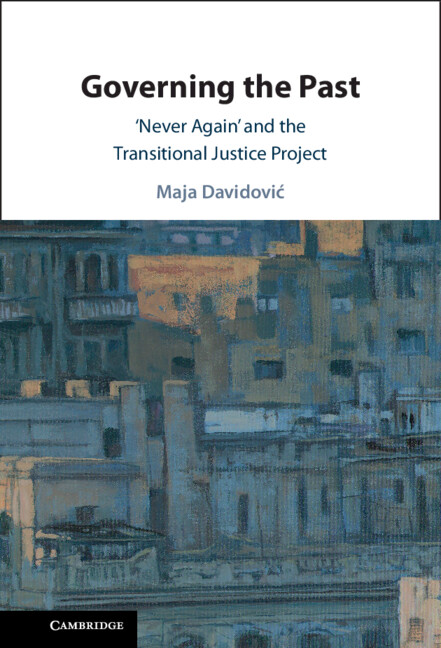
In my new book, Governing the Past, I do not treat transitional justice as an a priori benevolent force of global governance. Instead of looking at individual mechanisms such as tribunals or truth commissions to better understand ‘what works’ for diverse societies in their quest for durable peace, I ponder how we govern ‘dealing with the past’ impacts people’s perceptions of ‘Never Again.’ Ultimately, I propose that the global project of transitional justice can, in fact, exacerbate people’s anxieties around renewed conflict in different political communities. To do this, I observe transitional justice in total as a structure, a neoliberal legalist project with distinct defining characteristics. Such a global project, I propose, has survival, permanence and legitimacy needs. Even though in a given context, for instance, Bosnia and Herzegovina, which I studied for this book, transitional justice is time-limited and all its different mechanisms are expected to eventually cease their operation, as a global project, it needs permanence over time, and to continue to be relevant, it needs to be considered legitimate. Out of these needs emerge specific characteristics visible in the project’s pull towards institutions and hierarchically positioned norms of international law that can neglect lived experiences of (in)security on the ground and attempt to govern people’s past, present, and future in violent and exclusionary ways.
The purpose of transitional justice is to govern uncertainties, as, with its toolkit, it seeks to represent a rupture between the past and the future, the old and the new, ‘the bad’ and ‘the good’ in transitioning societies. All of this brings transitional justice processes into the realm of physical and ontological securities that crave certainty. Trials, commissions, institutional and legal reforms, history education, and memorialisation all impel political communities’ security in their continuous sense of collective self. With its practices, the global transitional justice project places extraneous pressure on communities’ history and memory-making and their collective identities.
The book shifts from the big picture theorising of transitional justice as a concept and its (dis)connections to non-recurrence to what has happened in Bosnia and Herzegovina in the past thirty years since the Dayton Peace Agreement was concluded in 1995. While the likelihood of renewed armed conflict in this country is debated and not a claim my book makes, I show through numerous interviews, observations and life stories how anxieties around the uncertain future of sustainable peace persist. For example, in Chapter 4, I discuss how the normative hierarchies of the global project and positioning of the International Criminal Tribunal for the former Yugoslavia (ICTY) as the key source of historical record about the conflict have left Bosnia and Herzegovina without any state-sponsored, state-wide consensus or even dialogue about the characteristics, dynamics, and consequences of the war 1992-1995. Instead, the ICTY carved a role whereby its records are used to deduce claims about the war much broader than the limits of a criminal case and to educate the public about them at the expense of other forms of fact-finding. These judicial truths are simultaneously a source of security for some and a trigger of ontological insecurity for others. As a result, Bosnia and Herzegovina today is witnessing the production of multiple, competing and often parallel narratives about the war among different political communities, causing commentators to fear that without an openly discussed, negotiated ‘metanarrative’ about the war, future generations might fall into the traps of ethnic-based, victimhood-oriented narratives and resort to fighting.
Nevertheless, structures are not omnipotent, and people can change outcomes. Chapter 7 of the book explores how actors who may experience anxiety about potential renewed conflict or war contribute to its prevention day in and day out, in connection or disconnection with the global project of transitional justice. Some practitioners work with and beyond transitional justice, for example, by engaging in truth recovery practices that appreciate the fact-finding capabilities of international tribunals such as the ICTY and domestic courts but are critical of their claimed values of objectivity, neutrality, civilisation, and completeness. Others work on and for non-recurrence, dcivilizationssibly even against transitional justice, acknowledging the possibility that the transitional justice project does more harm than good, by example, asking what if, instead of seeking to establish our trust towards the state, we sought to re-establish trust among people first and foremost. Looking at what sort of practices people find meaningful for ‘Never Again’ demonstrates that the imperative to prevent renewed conflict is much broader than the scope of the transitional justice project. Non-recurrence is here constructed as a form of work, rather than an actionable goal; an open-ended, fluid process whose completion date is unknown, and which relies on other people joining the workforce. It is not a stress- or contestation-free or necessarily peaceful form of labour. Still, it allows individuals and communities to reclaim ownership of their pasts and remake their world.

Maja Davidović is Senior Lecturer in International Relations in the School of Law and Politics at Cardiff University. She has won the Open Society Foundations Civil Society Schola...
View profile >Keep up with the latest from Cambridge University Press on our social media accounts.




Latest Comments
Have your say!