

Products and services


Supply chain management has often been perceived as the practice of having the right product, at the right time, in the right place, to meet market demand without holding excess inventory. Naturally, such a view makes its ultimate objective the perfect matching of supply and demand. If supply exceeds demand, companies face inventory-holding costs. Conversely, when supply falls short of demand, they incur opportunity costs due to unmet demand. Thus, aligning supply with demand helps reduce these costs and increase profits.
Despite the importance of supply-demand matching, some companies have shown declining sensitivity to it due to digital innovations. For example, “firing customers” has become a popular business concept, deliberately reducing certain demand streams. Likewise, companies such as Starbucks have innovated their business models to generate non-operational profits (e.g., free cash flow from apps used in financial markets). These strategic shifts allow decision makers to reposition supply chains in ways that diverge from the once central objective of perfectly matching supply with demand.
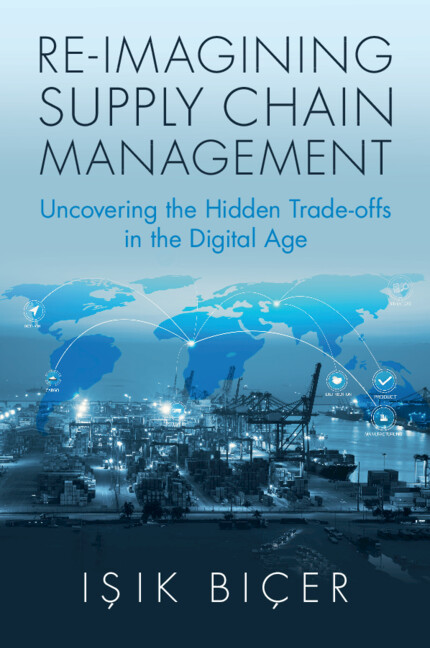
In my book, Re-imagining Supply Chain Management, I explore why this shift is happening. My journey led me to a deeper understanding of the dimensions and fundamental trade-offs of supply chain management.
Supply chain management involves several operations (4), where companies use their own resources (3) or employ other vendors (2) to move products (1) from upstream suppliers to downstream customers.
These four dimensions are interdependent rather than distinct. For instance, product assortment decisions influence vendor selection, while vendor choices affect resource management. For that reason, the four dimensions must be linked to business strategy through revenue analytics. This reveals a fifth trade-off: revenue growth vs. supply-demand mismatches.
In the book, I focus on this fifth trade-off together with the traditional four to develop supply chain strategies tailored to different business models and organizational sensitivities to mismatches. I also explore the digital transformation of supply chains, with particular attention to its design and implementation challenges. My hope is that this work serves as a valuable resource for those interested in supply chain management and the digital transformation of businesses. The structure in the book also has the potential to shape agentic AI developments in supply chains.

Işık Biçer is an Associate Professor of Operations Management and Information Systems in the Schulich School of Business at York University in Toronto, Canada. He is also area d...
View profile >Keep up with the latest from Cambridge University Press on our social media accounts.




Latest Comments
Have your say!