

Products and services

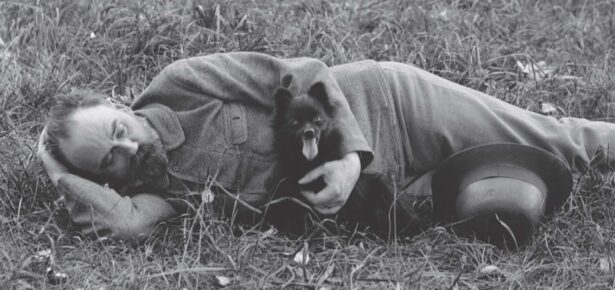
Émile Zola’s Le Rêve—The Dream, in English—appeared in book form in October 1888. It was a strikingly slender novel, by Zola’s standards—the shortest of the twenty volumes that would make up his epic series about the Rougon-Macquart family (1871-93). Yet more curious was its subject: the fantasy life of one foundling Angélique Rougon, whose wayward temper is gradually transformed by her spiritual surroundings and a childhood saturated with medieval iconography and saintly tales. The heroine cultivates two incompatible desires: she aspires, Cinderella-like, to find her prince charming; and she wishes to imitate the paragons of chastity she sees all around her. The novel’s strange resolution, curated around Angélique’s ‘happy death’, culminates in a final gnomic flourish that irked many of Zola’s readers: ‘All is but a dream’.
Hot on the heels of Zola’s scandalous novel of the peasantry, La Terre (Earth; 1887), this apparently innocent fairytale seemed all the more confounding. Was Zola reinventing himself? Was he—at last!—converted to the kind of religious, fantastical, or sentimental writing he had long derided? Or, reading between the lines, was this only a cynical pastiche, or counterfeit? Zola’s readers, generally, sensed a subterfuge, a deliberate kind of duplicity. Keen to settle the matter, once and for all, the critic Jules Lemaître declared: ‘M. Zola must make up his mind: he cannot be at once Zola and something other than Zola.’
Reading, nearly a decade ago now, these heated, and often comical, reactions to Zola’s Le Rêve set me thinking about the naturalist novelist’s flirtation, here and elsewhere, with an apparently rival style of writing, thought, even politics—one which, along with Zola, I have called ‘idealism’. For the naturalist writer who insisted on derisively caricaturing certain of his contemporaries, including George Sand and Victor Hugo, as ‘dreamers’, and often delusional ones at that, the very title of his 1888 novel was clearly intended as a provocation. And it is a provocation that I have taken over in the title of my own book. In many ways, Zola’s Dream is about the supposed impossibility Lemaître describes: of Zola being ‘something other than Zola’. The critic’s attempt to police Zola’s writing only really makes sense when we consider how dogmatic, how polemical, Zola was as a theorist of naturalist literature, how insistently he ‘hammered home’ his ideas about what the novel should and shouldn’t be doing. To ‘be Zola’, in Lemaître’s terms, meant to represent an easily recognisable literary style and mode that the novelist himself had spelt out.
A couple of years later, Lemaître’s take on Le Rêve as a form of writerly schizophrenia found a visual counterpart in Jean-Louis Forain’s caricature, ‘The Two Zolas’. It appeared on the frontpage of Le Courrier français on 16 November 1890. Forain depicted one rotund Zola, with his fictional prostitute Nana by his side; the other Zola decidedly svelte, was adorned with a halo. The caption registers the saintly Zola’s indignation, as he gestures to his alter ego: ‘I wrote Le Rêve! It’s that dirty old man who wrote Nana!’ Over the decade it has taken to write this book, I have often returned to Forain’s caricature as an instant reminder of the questions with which I started out: about the degree of difference the naturalist novel could tolerate in itself; about critics’ categorisation of Zola; and about the nature of the writer’s ‘quarrel’ (Zola’s word) with what he saw to be naturalism’s chief antinomy: idealism.
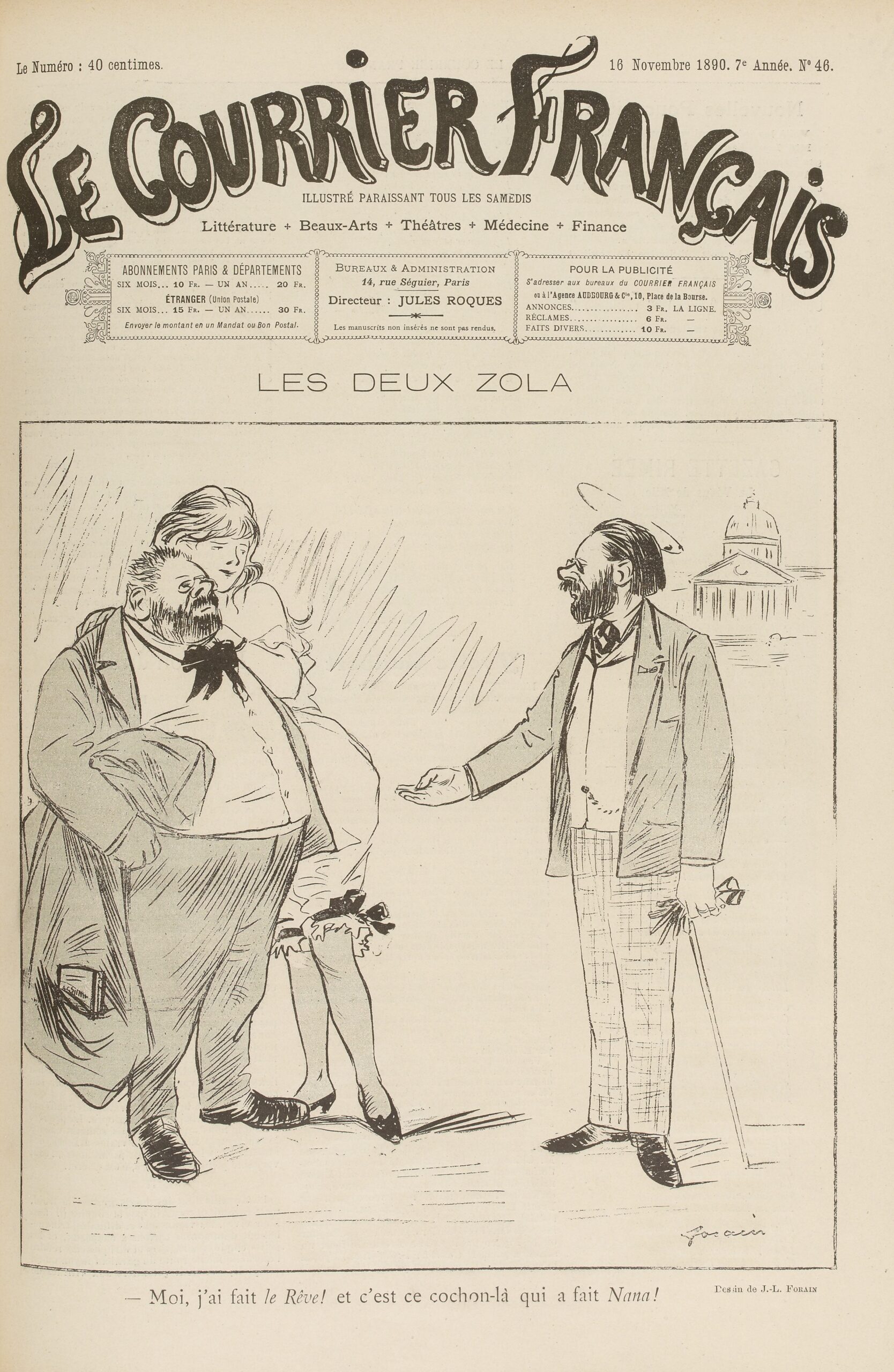
Jean-Louis Forain, ‘Les Deux Zola’. Le Courrier Français, 16 November 1890. Bibliothèque nationale de France.
My book is largely constructed around close readings of four novels—Germinal (1885), Le Rêve, Lourdes (1893), and Vérité (Truth; 1902)—taken from the latter half of Zola’s career, when naturalism faced a backlash and idealism’s star was, once again, on the rise. Germinal aside, I have chosen a set of lesser-read novels with the intention of casting a different light on Zola, of discerning something of a new profile. What I try to tease out is Zola’s ongoing engagement with idealism, not just as an object of straightforward critique, but as a lure, even as a possible solution to the social and political problems that naturalist fiction saw it as its mission to describe. In this sense, I wished to wrestle with another question that has long intrigued me: why does the arch-naturalist novelist end up writing very long works of utopian fiction in the final years of his life? There was, I suspected, surely more to this than Zola’s own (self-parodic) admission, in a letter to fellow writer Octave Mirbeau, that he should like to be allowed to ‘dream a little’ in his ‘old age’.
Vérité, Zola’s last finished novel, appeared in book form five months after Zola’s sudden death from carbon monoxide poisoning-the blocked chimney flue in his bedroom likely connected to his powerful, and deeply controversial, involvement in the Dreyfus Affair. In a sign of mourning, black borders framed the novel, which was itself a fictional transposition of the ongoing Dreyfus saga. One chief difference was that Zola imagined the conclusion of the Affair for his Jewish victim, Simon, in a way that the author would not live to see for Dreyfus. No doubt, as I reflect in my Epilogue, Zola’s defence of Dreyfus changed the way he thought about the novel form, just as it altered, in many cases, the way Zola himself was read. At his funeral on 5 October 1902, some fifty thousand mourners lined the streets as Zola’s casket was borne to Montmartre cemetery. Among those delivering eulogies at the scene was Anatole France, who famously extolled Zola’s fight for justice, on Dreyfus’s behalf, as a ‘great act’. It was an act that seemed to cast a new gilded light, for France, on Zola’s entire personality. ‘This sincere realist’, he declared, ‘was an ardent idealist’. France was by no means the only one to have revised his views on the writer at a moment when political loyalties came to trump aesthetic judgements. Looking back, it seemed to France as though there was an idealism in Zola’s work all along—or, at least, that those two overarching ways of seeing the world were not as incompatible as they had appeared, or indeed, as irreconcilable as Zola himself had often made them out.
My book is about the irresistible draw, as well as the limitations, of a form of binary thinking that was entrenched in the cultural history of the later nineteenth century. This was a time when the very terms ‘idealism’ and ‘naturalism’ reached well beyond literary categories, to connote all manner of political, philosophical, and ideological differences. My book reconstructs some of those meanings, especially as they related to the story of naturalism that Zola wished to tell. When Anatole France stated his vision of Zola as ‘an ardent idealist’, he was not offering up a corrective to the ‘sincere realist’. Rather he was entertaining the important idea that Zola could be two things at once.
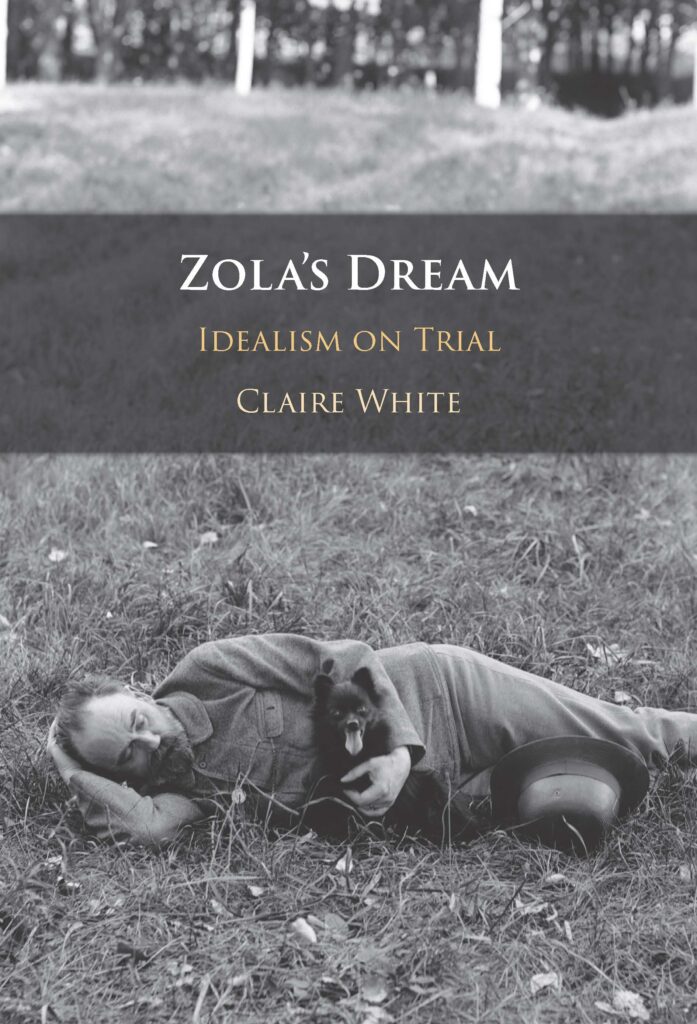
Zola’s Dream by Claire White

Claire White is Associate Professor of French at the University of Cambridge. She is the author of Work and Leisure in Late Nineteenth-Century French Literature and Visual Culture ...
View profile >Keep up with the latest from Cambridge University Press on our social media accounts.


Latest Comments
Have your say!