

Products and services


Copyright: Heide Fest, European University Viadrina
Languages appear to us as self-evident truths in the world. Until recently, the definition of what is a language seemed to be relatively straightforward: a language is what people from the same culture, living in the same territory, use to communicate with each other. We find its rules documented in dictionaries and grammar books.
In an age of globalization and digital communication, we interact across national boundaries and social communities come in many different shapes, not necessarily based on territorial, ethnic or national belonging. Also, speakers use linguistic resources from more than one language and combine linguistic signs with sound, emojis and visual images which hardly fit into the linear representations of grammars and dictionaries. So, what is a language if we are not sure how to define the community who speaks it? What are languages, language boundaries, and language norms if speakers have distinct multilingual repertoires, interact multimodally and only partially or only sometimes share ideas about what is right and wrong in a language? Are languages as orderly systems an imagination from the age of print literacy? These questions have guided the study in my recent book entitled Liquid Languages – Constructing Languages in Late Modern Cultures of Diffusion.
My starting point for studying how languages as categories come into being was to empirically study a setting in which concepts of national monolingualism and literate order never prevailed. Inspired by Le Page’s and Tabouret-Keller’s classic study Acts of Identity: Creole-based Approaches to Language and Ethnicity – an anti-essentialist understanding of how ethnic and linguistic categories dialectically emerge – I conducted an ethnographic field study in Belize, Central America. Belize is an officially English-speaking country that has been described as linguistically ‘diffuse’. That is, language norms are not stable nor nationally shared. Furthermore, ethnolinguistic concepts of belonging are not straightforward as many families are of mixed ethnic origin, do not identify with only one ethnicity and use various linguistic resources on a daily basis, including features from English, Spanish, various Maya languages, Garifuna (an Afro-Carib creole) and languages associated with older and more recent migrations (viz., Chinese, German, Hindi, Arabic, etc.). In addition, the language Kriol is crucial in constructing national belonging. As an English-lexified creole, Kriol is part of the Caribbean cultural space and its boundaries towards the English language are fuzzy. Given its sociolinguistic complexity, Belize offers ideal conditions for approaching the question of how languages and their boundaries come into being.
What I wanted to find out was how people construct languages in settings where neither these nor the groups that speak them can be taken for granted. In empirical terms, I studied multilingual speakers’ language practices and meta-discourses about language and scrutinised what people think about linguistic practices and their links to social affiliation, social attribution, and materialisation. Who uses which linguistic repertoires where and why? How do speakers conceive of the social and linguistic relationships within the community? Which social qualities are languages associated with? How is the mixing or switching of languages conceptualised? What is the role of different linguistic materialisations, from speaking to writing, in this context? And rather than viewing the people I have met during my research as producers of language data, I tried to understand and follow their expert knowledge of complex social and cultural conditions. Their perspectives can help us to critically reflect Western language traditions, which rarely question that languages are orderly systems.
Among the many things I have learned during this journey, I found the most fascinating that speakers of Kriol do not necessarily follow the idea that languages should be stable and fixed in writing. Rather, even very young speakers are aware of and reject normative concepts of linguistic stability but emphasize that each speaker uses language differently. Linguistic prestige is not based on the ability of following rules but on the ability to appropriate linguistic resources creatively. Writing, they argue, fixes language and leads to the emergence of one norm – which they find would destroy Kriol language culture. Embedded in these anti-standard concepts of language are ideals of postcolonial resistance and pride in transnational creole belonging.
What I learned from these perspectives is that the relationships between language categories and social categories are more liquid than imagined in Western modernist national mappings of languages and communities. The metaphor of liquidity is taken from sociologist Zygmunt Bauman and his notion of liquid modernity, who argues that, for social categories in times of modernity, “change is the only permanence, and uncertainty the only certainty” (2012: 90). Like liquids, speaking is an ephemeral sound-based and bodily practice but it is to a certain extent possible to freeze it in space and time as has been the case in European modernity. Writing, national discourse, cultures of printing, territorial concepts of belonging, and traditions of modernist clearcut either-or categorisation have contributed to the perception of languages as stable. This means that stable linguistic systems are outcomes of particular conditions, in ways similar to lakes being outcomes of ensembles of landscapes, weather conditions, characteristics of the soil, or human intervention.
In this light, concepts and practices of national standard languages appear as a culturally specific, non-universal, European provincialism. We therefore should not take Western language concepts as unquestioned, universal norm, as this can reproduce problematic colonial biases. And yet, languages as categories do not necessarily disappear as constructs for establishing social order. This leaves us with new challenges for future sociolinguistics: how are languages produced discursively and materially in post-national cultures of digital capitalism and machine learning, and which social orders will they establish? The study of language as cultural practice continues to be an important area of study to understand human life, politics and culture.
References
Bauman, Zygmunt. 2012. Liquid modernity. Cambridge: Polity Press.
Le Page, R. B., and Andrée Tabouret-Keller. 1985. Acts of identity. Creole-based approaches to language and ethnicity. Cambridge: Cambridge University Press.
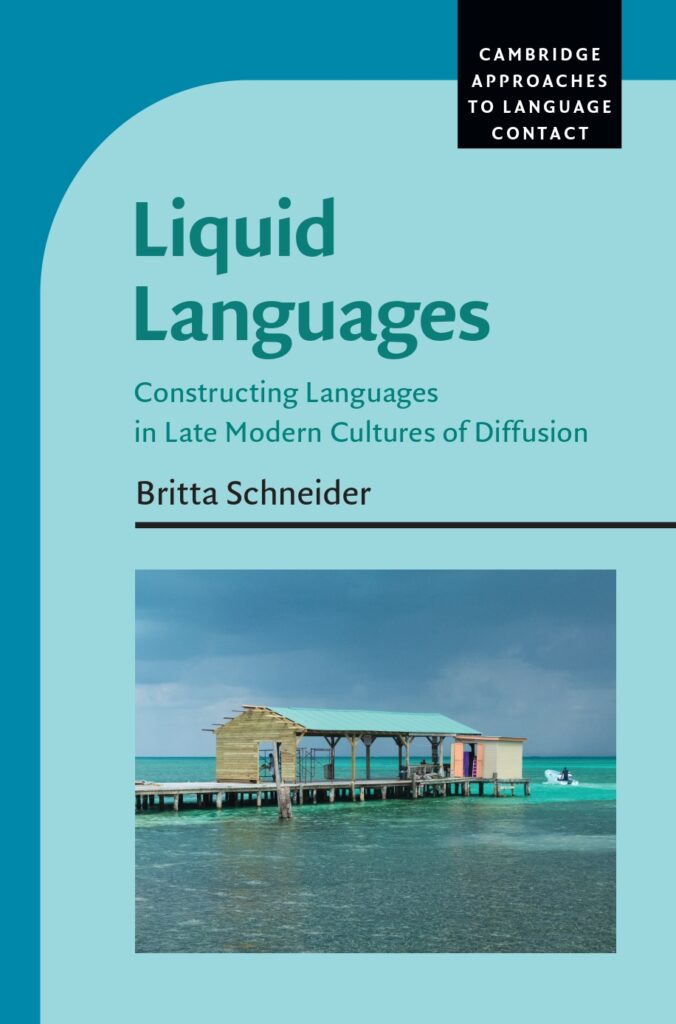
Britta Schneider is a Professor in the Faculty of Social and Cultural Sciences at European University, Viadrina. Her research examines the intersection of language ideology, materi...
View profile >Keep up with the latest from Cambridge University Press on our social media accounts.




Latest Comments
Have your say!