

Products and services

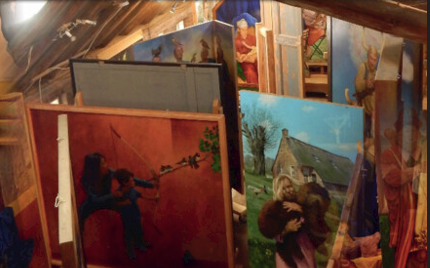
It is Tuesday, April 8, 2025, 10:42 am. Artist A. is mixing magenta and cobalt blue oil paint – produced by the famous Blockx manufacturers of artist materials – with a few drops of alkyd medium, using a #4 Filbert brush, then applying it in broad strokes to a finely woven canvas, picking up some of the wet oil paint underneath. A., who has had a typical concept-oriented contemporary art school education and has taught himself to paint in a style reminiscent of nineteenth-century academic artists, is painting a portrait of a retired professor of mathematics to hang in the university’s portrait gallery, where the oldest portraits date from 1618. A. makes a decent living painting portraits, but A.’s heart is elsewhere. For several years, A. has been working on an installation of partially damaged doors from demolished buildings, to which he has attached failed sketches of earlier portraits. A. wants to present all this in the form of a seemingly random arrangement of freestanding objects through which the viewer can walk and thus be confronted with a superposition of things that were intended to be works of art but failed to be so (failed sketches) and things – doors – that were not intended to be works of art but become art because they are presented in a context that “artifies” them. But unfortunately, A has not yet been able to find a gallery or museum interested in this work, partly because A spends very little time networking on social media with colleagues or gallery owners, partly because he dislikes doing so (a psychologist would say that A scores quite low on the agreeableness dimension of the Big Five Personality Theory), and partly because making money painting portraits takes up virtually all of his professional time.
What we have here is an illustration of how the visual arts are complex dynamic systems.

First, we can look at all of the above from a particular temporal and organizational perspective, e.g., the perspective of a single brushstroke; of painting a picture; of artistic careers from art school (or self-education) to artistic recognition (or not); of psychological processes in artists and viewers (e.g., artists’ personalities and viewers’ movements through museums); of technological systems that produce and distribute materials; of art historical changes in taste and technique, as well as art historical changes in technology; psychological processes in artists and viewers, e.g., artists’ personalities or viewers’ movements through museums; technological systems that produce and distribute artist materials; art historical changes in taste and technique, for instance as reflected in the Portrait Gallery between 1618 and the present moment; spatial and contextual affordances and constraints (as the Portrait Gallery requires portraits and provides no opportunity for performances, installations, video art, etc.); professional and economic networks of artists and viewers (as the Portrait Gallery requires portraits and provides no opportunity for performances, installations or video art); professional and economic networks of artists, viewers, buyers, patrons, museum curators, gallery owners, art historians, etc.; art theory and philosophy that provide justifications and interpretations of artworks that affect artists, viewers, and buyers. Each perspective or level of description has its typical time scale (from seconds to centuries) and its typical form of organization (which components interact and how).
Second, from each of these perspectives we can identify the elements of which they are composed: for example, brush, paint, medium, canvas, … from the perspective of painting activities; or the human, material, and spatial participants in economic and market exchanges from the perspective of the market value of art… These elements or components interact with each other, for instance the paint on the brush with the partially wet paint on the canvas underneath, the buyers with the sellers. These interactions self-organize into typical patterns or properties. That is, they are not governed by a central controller, but result from the myriad influences that govern a particular perspective or level of description. The results of these interactions are emergent properties, i.e. properties that cannot be reduced to the properties of the components. For example, the interactions at the level of brush strokes or written notes and sketches for a proposed installation will result in a particular work of art that is more than the sum of its constituent elements. From the work of artists, in interaction with a public of viewers, buyers, and sellers, an art market will emerge with properties that cannot be reduced to the properties of the participants. A typical example of an emergent property at the level of markets is the extremely skewed distribution of cultural value (fame) and market value (prices), which follows a mathematical rule (basically a power-law distribution) that appears in a wide variety of contexts (prices, size of the social networks involved) and historical periods.
Third, emergent properties exhibit circular causality: an emergent artwork, such as a painting or installation in the process of being made, results from the micro-activities of its creation (bottom-up causality), but the emergent artwork provides so-called adjacent possibilities and constraints for the micro-activities that constitute it (top-down causality). Styles, schools, or approaches emerge from the interactions between works of art, their creators, viewers, and interpreters, and styles or schools provide opportunities for specific new works of art.
Fourth, time scales and their corresponding forms of organization interact to form a network of interwoven influences. What happens on the time scale of the actual creation of a work of art, or on the time scale of the experience of a work of art, is causally related to what happens on the time scale of art market activities or cultural-historical developments. These interactions are reciprocal, they exhibit circular causality.
In this book, I begin with a discussion of the fundamentally processual nature of the visual arts and how this relates to the diversity of definitions of art and the diversity of its functions. After providing a foundation in the form of complex dynamical systems theory, I proceed with a discussion of the entangled and interwoven timescales of the visual arts, beginning with the timescale of the creation of a work of art by an artist and the experience of works of art by members of the public. The next timescale is that of the processes that govern artistic careers, including art school education or processes of self-education, and the lifelong processes of personality and motivation. This leads us to the timescale of the emergence of artistic excellence and celebrity, and the processes that lead to the extremely skewed distributions of cultural and market value, including stardom. This leads to a discussion of the timescales of art history and human evolution. The book discusses the many ways in which these timescales are intertwined, how the relationships are both bottom-up and top-down. The final part of the book applies the method of dynamic modeling, essentially understanding processes through computer simulations, to the dynamics of cultural and market value, the emergence of excellence and stardom, and the dynamics of long-term trends and historical (dis)continuities.
In short, based on the properties of complex dynamical systems, we can begin to apply the concepts, methods, and underlying philosophy of complex dynamical systems theory and conceive of the visual arts as a pluralistic process of interacting, emergent properties that relate to how art is created, how it is experienced, how it acquires cultural and economic values, and how it evolves through cultural history up to the level of human evolution. Applying these concepts, such as attractors, critical states, forms of stability, but also methods such as mathematical and simulation modeling of artistic careers or art historical phenomena, we can come to a deeper understanding of the visual arts as a fluid and pluriform process, rich in complementary, seemingly incompatible properties of taste, style, value, and function, exhibiting both continuity and rapid change, cyclical phenomena and variability.


Paul van Geert is emeritus professor of developmental psychology at the University of Groningen. He is a pioneer in the application of the complex dynamic systems approach to a bro...
View profile >Keep up with the latest from Cambridge University Press on our social media accounts.


Latest Comments
Have your say!