
Products and services


I have worked within the wireless communications R&D industry for close to 20 years now and, in my experience, one consistent ingredient that has often escaped the recipe of so many consumer electronic products is simplicity. This facet alone should be instilled, force-fed and, to be honest, beaten into innovators, developers, manufacturers or whomever decides […]
Read More
Dean Anthony Gratton discusses the implications of our virtual communities and how global connectedness is changing the way we live.
Read More
This week, go Into the Intro of David Wells’ Games and Mathematics for some fun insights on how math elegantly shapes one of our most enduring cultural institutions. If you missed David Wells’ post last Friday about writing the book, be sure to check it out.
Read More
The author of Games and Mathematics discusses how he came to recognize the fascinating relationship between the games we play and the math they're built on.
Read More
The Association for Computing Machinery (ACM) has named Cambridge author Judea Pearl the winner of the 2011 ACM A.M. Turing Award, a prestigious honor widely considered to be computing’s equivalent of the Nobel Prize.
Read More
100 years ago, Cambridge published a book that transformed the study of mathematics and laid the foundations for the computer age. The Principia Mathematica is the most famous work ever published on the foundations of mathematics. Written by British mathematicians and philosophers Alfred North Whitehead and Bertrand Russell, it was published by Cambridge in three volumes […]
Read MoreNPR's Robert Siegel talks to math writer Julie Rehmeyer about Principia Mathematica, a landmark work in mathematical logic written by Alfred North Whitehead and Bertrand Russell and published by Cambridge 100 years ago this month.
Read More
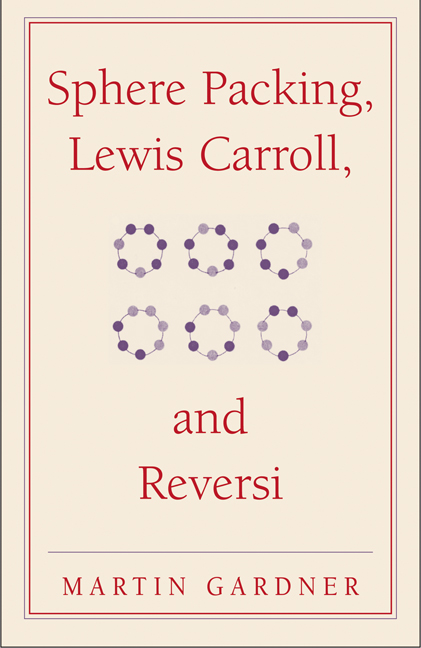
“I’m strictly a journalist.” – Martin Gardner Martin Gardner had no formal mathematical training. A newspaper reporter, publicist, freelancer for Esquire, caseworker, magician, skeptic, Navy sailor, and most famously, "Mathematical Games" columnist for Scientific American, Gardner displayed a boundless energy and enthusiasm for intellectual inquiry. A tireless advocate for science, his popular books and articles painstakingly argue against the dangers of pseudoscience in all forms. On Saturday, Gardner passed away at the age of 95 in Norman, OK. TSoTP takes a look back.
Read MoreKeep up with the latest from Cambridge University Press on our social media accounts.