The ancient Greeks have a reputation for being proudly, purely monolingual: they considered their own language so perfect that they had no need to learn anyone else’s. But was that really true? A new dictionary of Latin words used by ancient Greek speakers suggests that it was not, by documenting over 2,500 words of Latin […]
Read MoreYou do not necessarily have to follow online cats on social media to read the book, but if you do, you might have come across one or the other cat-inspired linguistic process before or have perhaps found a meowlogism not mentioned in the book. Yet, regardless of your online habits, a curiousity for all things […]
Read MoreIt is commonly known that our brain abilities, including reasoning, memory, imagination, and attention, are shaped by the social world. We absorb ways of thinking, behaving, and learning through exposure to life in the home, neighbourhoods, schools, communities, and broader contexts. This knowledge is often cited under the umbrella of Vygotsky’s sociocultural theory, which proposes […]
Read MoreToday many European minority language communities are undergoing profound changes, in part as a result of globalisation, increased mobility and accelerating socio-economic fragmentation within heartland areas. Whereas in the past the family and community network ensured inter-generational language transmission, now it is mainly the statutory education system which provides the skills necessary to communicate effectively […]
Read MoreQ: Let’s start with the title of your book. Why use the term minoritized languages? A: It’s a question of emphasis: there is nothing intrinsically “minor” about the languages (or even the factual question of being a numerical “minority” for many cases, such as Zulu in South Africa), but the fact that the languages in […]
Read MoreAll scientific fields were born from philosophy. And most were born a long time ago. So long ago that conversations between the philosophic ‘parent’ and the scientific ‘child’ are currently non-existent. For example, it’s rare to see collaborative research that involves a physicist and a metaphysician, and you won’t find a philosopher at a chemistry or […]
Read More“Life as a Bilingual” – a highly successful blog and now a new Cambridge book Back in 2016, Cambridge Extra published an interview[1] of François Grosjean[2], a recognized expert on bilingualism, who talked about his Psychology Today blog, “Life as a Bilingual”[3] which he had started back in 2010. He discussed a number of topics […]
Read MoreWho could have imagined this kind of success for a scientific blog on bilingualism? In 2016, François Grosjean was interviewed about his Psychology Today blog, “Life as a bilingual”, by Ewa Haman, Faculty of Psychology, University of Warsaw. The Polish translation appeared under the title, “Nie mógłbym nawet marzyć o takiej liczbie czytelników” on dwujęzyczność.info. […]
Read MoreThe ancient Greeks have a reputation for being proudly, purely monolingual: they considered their own language so perfect that they had no need to learn anyone else’s. But was that really true? A new dictionary of Latin words used by ancient Greek speakers suggests that it was not, by documenting over 2,500 words of Latin […]
Read MoreYou do not necessarily have to follow online cats on social media to read the book, but if you do, you might have come across one or the other cat-inspired linguistic process before or have perhaps found a meowlogism not mentioned in the book. Yet, regardless of your online habits, a curiousity for all things […]
Read MoreIt is commonly known that our brain abilities, including reasoning, memory, imagination, and attention, are shaped by the social world. We absorb ways of thinking, behaving, and learning through exposure to life in the home, neighbourhoods, schools, communities, and broader contexts. This knowledge is often cited under the umbrella of Vygotsky’s sociocultural theory, which proposes […]
Read MoreToday many European minority language communities are undergoing profound changes, in part as a result of globalisation, increased mobility and accelerating socio-economic fragmentation within heartland areas. Whereas in the past the family and community network ensured inter-generational language transmission, now it is mainly the statutory education system which provides the skills necessary to communicate effectively […]
Read MoreQ: Let’s start with the title of your book. Why use the term minoritized languages? A: It’s a question of emphasis: there is nothing intrinsically “minor” about the languages (or even the factual question of being a numerical “minority” for many cases, such as Zulu in South Africa), but the fact that the languages in […]
Read MoreAll scientific fields were born from philosophy. And most were born a long time ago. So long ago that conversations between the philosophic ‘parent’ and the scientific ‘child’ are currently non-existent. For example, it’s rare to see collaborative research that involves a physicist and a metaphysician, and you won’t find a philosopher at a chemistry or […]
Read More“Life as a Bilingual” – a highly successful blog and now a new Cambridge book Back in 2016, Cambridge Extra published an interview[1] of François Grosjean[2], a recognized expert on bilingualism, who talked about his Psychology Today blog, “Life as a Bilingual”[3] which he had started back in 2010. He discussed a number of topics […]
Read MoreWho could have imagined this kind of success for a scientific blog on bilingualism? In 2016, François Grosjean was interviewed about his Psychology Today blog, “Life as a bilingual”, by Ewa Haman, Faculty of Psychology, University of Warsaw. The Polish translation appeared under the title, “Nie mógłbym nawet marzyć o takiej liczbie czytelników” on dwujęzyczność.info. […]
Read MoreKeep up with the latest from Cambridge University Press on our social media accounts.
University of British Columbia, Vancouver
N David Mermin, Author of \\\'Why Quark Rhymes with Pork\\\'
Speaking Shakespeare Today
The Reader\\\\\\\\\\\\\\\'s Brain
Emotive Language in Argumentation
Imagining Medieval English
Language and the Law
David R. Olsen is University Professor Emeritus at the University of Toronto and the author of The Mind on Paper.

News Talk: Investigating the Language of Journalism
Words at Work and Play
Magistracy and the Historiography of the Roman Republic
The Cambridge Handbook of Stylistics
A Reference Grammar of French
Early Social Interaction
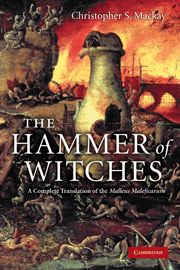
The Hammer of Witches
To receive updates on Language & Linguistics news from Cambridge University Press and Fifteen Eighty Four, please join our email list below. We will not disclose your email address to any third party