
Products and services


Cambridge titles abound in recent FiveBooks interviews over on The Browser! Let’s see if you can match the books Professor James Dunkerly and statistician Andrew Gelman picked as the best in Latin American History and Statistics with what each had to say about them.
Read More
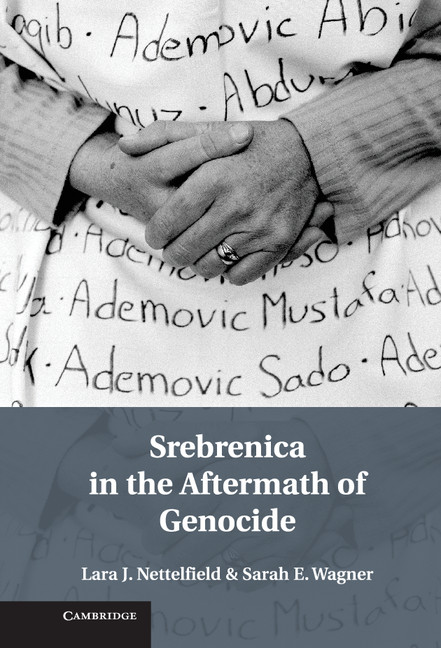
The Fifteenth Anniversary of the Srebrenica Genocide is a series from Lara J. Nettelfield and Sarah E. Wagner, authors of the forthcoming book Srebrenica in the Aftermath of Genocide. The final installment follows the last of the events commemorating the anniversary of the 1995 Srebrenica Genocide.
Read More
The Fifteenth Anniversary of the Srebrenica Genocide is a series from Lara J. Nettelfield and Sarah E. Wagner, authors of the forthcoming book Srebrenica in the Aftermath of Genocide. Part One follows marchers from Bosnia and beyond as they commemorate the anniversary of the Srebrenica Genocide by traversing the 110 kilometer stretch of Eastern Bosnian country trekked by thousands of Bosniak men and boys fifteen years ago.
Read More
The New York Journal of Books looks at the authors of Los Angeles to attempt to define America’s new second city: is it a palm-shaded paradise with great weather or a vapid silicone desert of asphalt?
Read More
Hey all, did you know we have an office in Cape Town, South Africa? And like yours truly, they’re stoked about World Cup. Here’s a blog from our South Africa marketing guru, Ashley Parsraman.
Read More
By Rebecca Yeager, Publicity Intern Extraordinaire The twenty interns for the Cambridge University Press Summer 2010 Internship Program began our first week with an orientation meeting with Benjamin Jeremiah, the Employment Manager. He gave us an overview of Cambridge University Press, such as the structure of the publisher, and an ample amount of information about fire safety. When it came time to filling out forms for contact information, I belatedly realized I should have packed a pen when I was nervously crammed nearly everything else – from tictacs to chapstick – into my bag, and two of my neighbors immediately offered me their pens.
Read More
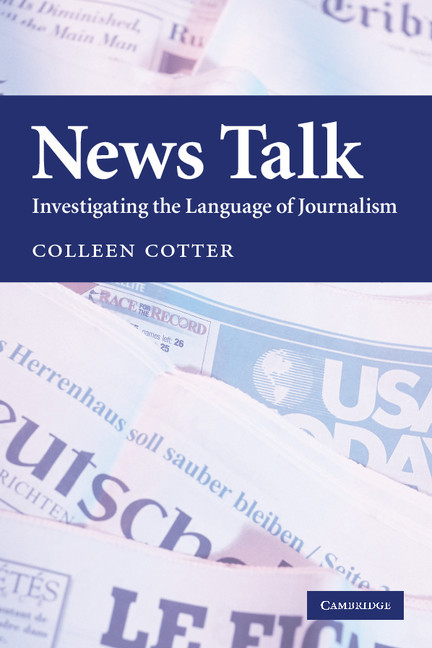
Fair, balanced, unbiased, impartial. Journalism, in theory and by definition, hinges on an ideal of neutrality, an expectation of the direct presentation of facts and findings. Yet the process of news-making is a constant ebb and flow of editorialization. From the selection to the construction of a story, editors and journalists invariably serve as a filter – controlling everything we read, see, and hear. Today, Colleen Cotter, a former news reporter and editor and the author of the forthcoming News Talk: Investigating the Language of Journalism, dissects the inner workings of the media to define the processes and practices that go into crafting our understanding of the day’s events. -------- How to be a language savvy news consumer By Colleen Cotter All professions have them: routines of interacting and communicating that become normalized. That become part of the everyday routine of doing business. A pilot’s FAA-mandated cockpit routine revolves around safety talk. A Disneyland employee uses the specified vocabulary of the Magic Kingdom to enhance the visitor experience. A police officer’s question-asking style leads to “just the facts, ma’am” while the therapist’s are more personal. So it goes with news language. News language isn’t about “correctness” as such, although that’s part of the picture. It can also tell you a lot about what goes on behind the scenes in a newsroom, how reporters and editors think about things, and what the news conventions are. To become a language-savvy news consumer, you have to think both small (words and patterns) and big (culture and concept). Here are some suggestions:
Read More
My Orientation to The Press and BookExpo America By Frances Bajet, Publicity As I’m completely new to both the Press and BookExpo America (aka BEA), I really had no idea what to expect when I found out on my first day that I would be working at Cambridge’s booth. To be honest, the idea of talking to the media and the general public about Cambridge made me want to hide in the supply closet — I had only started work on Monday and was assigned three days later to help run the booth for a full day.
Read MoreKeep up with the latest from Cambridge University Press on our social media accounts.