Products and services

Abdul Qadeer Khan, better known to the world as A. Q. Khan, passed away in October 2021 at the age of 85. Often referred to as the Father of Pakistan’s nuclear bomb, and revered by many Pakistanis for...
International adoption is not a modern invention: it has existed throughout known human history. But then something occurred that had never happened before in such a short period of time and on a such...
As illustrated by the work of the philosopher Thomas Kuhn, our conceptual models, our paradigms, frame our interpretation of data. Today, it is critically important that we share an “energy convergence”...
Why do the humanities matter? As Dean of a school of Arts and Sciences at a research university, I care deeply about the disciplines that fall under the rubric of the Arts and Sciences, which also include...
Deep cultural features can be subtle, influential and very resistant to change, so it is important to create space for each people to find their own ways to respond to environmental threats.
“A lot of guys say, ‘I almost feel like I’m coming home”, said Bill E., a former Marine from his home in Da Nang. Bill had deployed to Vietnam in 1969, serving a year as a machine gunner along...
One of the last frontiers of science remains the human mind – but not for much longer. Scientists can already manipulate memories and emotions such as fear or anger, at the switch of a nanolaser, using...
I have been thinking and writing about religion and culture since the 1990s. However, I did not think about writing a book. I was more preoccupied with questions pertaining to media ethics and medical...
A consortium of over 160 firms, with net assets of more than USD70 trillion, are now members of the Glasgow Financial Alliance for Net Zero (GFANZ), a COP26 initiative set up under the leadership of former...
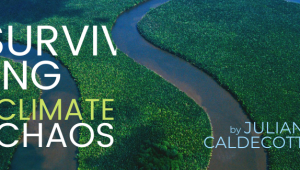
Surviving Climate Chaos is being published into a new world of lethal fires, floods and record-breaking temperatures, while the IPCC warns us that we are in the last decade before Arctic, oceanic and...
With a large number of Britons “staycationing” in the UK due to the ongoing COVID-19 pandemic, there is a greater emphasis on the recreational value of England’s rivers. From canoeing to fishing,...
Whose work, in your field, has inspired you most? Though much of my scholarship is historically grounded, I was not trained as a historian. I admire historians who can put archival texts into conversation...
Keep up with the latest from Cambridge University Press on our social media accounts.