
Products and services

What is an animal? Silly question, surely? Everybody knows what an animal is – don’t they? If you look at the two creatures in the image to the left, you’ll see one that’s an animal and one that’s...
Moshe Milevsky, author of King William's Tontine (2015), looks back to 17th Century finance for 21st Century economic solutions.
Today is ‘May The Fourth’ – a day that excites millions of fans of the Star Wars franchise worldwide, and plays on the film’s famous ‘May the force be with you’ line....
Author Ron Batchelor explores French language and the tricky topic of word order.
Cambridge Companions to Management is an essential resource for academics, graduate students and reflective business practitioners seeking cutting-edge perspectives on managing people in organizations. In...
Sven-Oliver Proksch and Jonathan B. Slapin, the authors of The Politics of Parliamentary Debate, compare the systems of debate that keep governments from the US to Germany to New Zealand considering different points of view.
At the American Philosophical Association’s Pacific Division Meeting this month, we got to sit down with six Cambridge authors to discuss their latest studies in philosophy. You can hear about everything...
I found the panchayat, or Indian village council, by accident and by luck. Trained as a historian of Britain, I had been working on a study of British trade unions and arbitration during the nineteenth...
This opens up a whole new world of opportunities for subtle cross-technology flirting. But cyberbullying is real, people… Though when that ends badly at least you can spend your 21st century...
With Earth Day almost upon us, Prasenjit Duara, the author of The Crisis of Global Modernity, explains why we need a new vision of the world to prevent ourselves from destroying it.
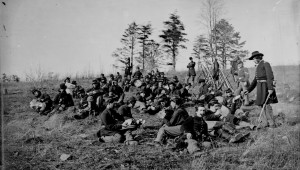
On April 9, 1865, Confederate General Robert E. Lee surrendered to Union forces at Appomattox, putting an end to the bloodiest war in American history. Now, 150 years after Lee's surrender, five historians and authors lead the conversation about the Civil War's enduring legacy.
I would like to loudly applaud Nevada and Georgia for declining to drink the RFRA Kool-Aid this year. Smart. All RFRAs are a bundle of negative unintended consequences and bad public policy, as I explain...
Keep up with the latest from Cambridge University Press on our social media accounts.