
Products and services

Take a look at the life and achievements of Supreme Court justice Ruth Bader Ginsburg. To learn more about Ginsburg’s accomplishments and her lasting impact on American law, check out The Legacy...
Deana A. Rohlinger, the author of Abortion Politics, Mass Media, and Social Movements in America, examines the recent national news to demonstrate why the debate on abortion is changing, but certainly isn't gone for good.
Last Friday, Douglas Walton and Fabrizio Macagno, wrote about arguing with language in their book Emotive Language in Argumentation. This week, they delve into the way definitions raise the argumentative stakes--particularly at trial.
If you've been enjoying our recent posts on Chopsticks, you'll remember that the rise of those ubiquitous utensils owes a lot to the prominence of rice. The new book Rice: Global Networks and New Histories has more insights to offer about the popular grain that shaped ancient and modern cuisine.
The Nazi era stands as an exceptionally horrific period of global history. But in recent years the perception of Hitler and the Third Reich has changed. In Internet culture, where irony rules supreme,...
Alissa M. Ardito, the author of Machiavelli and the Modern State, compares two famous politicians who could not have been more different--but whose commitment to modernizing their republican governments grants them more in common than we thought.
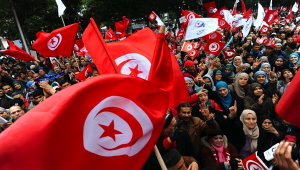
Sarah Bush, the author of The Taming of Democracy Assistance, discusses the complexities of Tunisia's transition to democracy and what role democracy assistance can play.
In the first of a series of three posts, Douglas Walton and Fabrizio Macagno, the authors of Emotive Language in Argumentation, discuss how language can have a specific effect by influencing emotions in an argument.
Did you know that we have wheat to thank for the rise of chopsticks? Q. Edward Wang, the author of Chopsticks, takes you on a global culinary journey.
Hendrik W. Day, the author of The Afterlife of the Roman City, takes readers through the maze of Roman cities to explore how the way a state is ruled shapes its architecture: from ancient Constantinople to today's Pyongyang.
Andreas Dür and Manfred Elsig, the co-editors of Trade Cooperation, break down the preferential trade agreements that have become nearly ubiquitous since the end of WWII.
Stephen Offutt, the author of New Centers of Global Evangelicalism in Latin America and Africa, explores how the Christian evangelical movement has influenced communities from Beijing to Cape Town to Mexico City.
Keep up with the latest from Cambridge University Press on our social media accounts.