Products and services

All this week on fifteeneightyfour we are reconstructing the lives of eighteenth century Londoners who feature in, London Lives a new book which examines the daily lives of the poor and criminal in eighteenth century London, including thieves, paupers, prostitutes and highwaymen, and shows how their actions influenced the pace and direction of change in social policy.
Jane Vobe, b. 1775 The fifth of six children of a pauper family, Jane Vobe was cared for by her parish for six years, until she ran away from her apprenticeship. Family and Early Life Jane Vobe, the daughter...
All this month fifteeneightyfour is celebrating Black History Month with a series of articles exploring the lives of some of the most important people in African-American history.
Throughout the week we will feature a ‘life in a day’, beginning with Charlotte Walker, a recidivist pickpocket who was rarely punished Charlotte Walker, c. 1754-1806 Charlotte Walker was...
John Quigley, author of The International Diplomacy of Israel’s Founders: Deception at the United Nations in the Quest for Palestine (2016), examines how history has shaped Palestine.
James Thurber, co-author of American Gridlock: The Sources, Character, and Impact of Political Polarization (2016), examines the future of polarization and governing in the face of the 2016 US election.
We go Into the Intro of Christine A Hemingway's Corporate Social Entrepreneurship: Integrity Within (2014).
Ron Vannelli, author of The Evolution of Human Sociability: Desires, Fears, Sex and Society (2015), examines the origins of human behaviour.
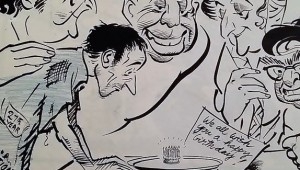
Ritu Gairola Khanduri, author of Caricaturing Culture in India (2014), explores the power of cartoons, and the legacy of R. K. Laxman.
As a result of the recent financial crisis, a number of measures have been undertaken to make a repeat less likely and to facilitate recovery and resolution of failing banks should a (systemic) financial...
John Suler, author of Psychology of the Digital Age: Humans Become Electric (2016), examines what is meant by 'Digital Dualism'.
Ritu Gairola Khanduri, author of Caricaturing Culture in India (2014), examines the work of R. K. Laxman in the first of three posts.
Keep up with the latest from Cambridge University Press on our social media accounts.