
Products and services

In the century preceding the French Revolution advanced mathematics began to play a role in ordinary affairs. If you wanted to find the position of a ship at sea, design fortifications or price annuities,...
Why should one mind performances at court in Shakespeare’s time? Do we really need a book on the subject? So much has been written about the Elizabethan theatre industry’s connection with the public...
The fundamental concern of Romanticism, which brought about its inception, determined its development, and set its end, was the need to create a new language for religion. One of the main motivations behind...
In October 2015 Ireland’s National Theatre announced its commemorative ‘Waking the Nation’ programme. The intention was to ‘interrogate rather than celebrate’ the 1916 Easter Rising, yet women...
Thomas Hardy fully understood, from early on in his career, that the production of a novel, or short story, took place both in the realm of artistic creation and in the literary marketplace. He eventually...
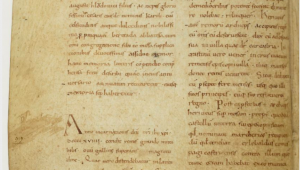
The decades following the demise of the Carolingian Empire in 888 were traditionally seen as a downward spiral of political fragmentation and cultural stagnation: a ‘mind-the-gap’ period between the...
Shakespeare on Screen: King Lear is the most recent volume in the Cambridge University Press Shakespeare on Screen series, which provides in-depth analyses of how Shakespeare’s work has been adapted...
‘Why do you want to study India’s State-run Media?’ This question was frequently posed to me by my friends and fellow academics. For some broadcasting if not passé, is quite a mouthful, and hard...
Since the end of authoritarian rule under Suharto in 1998 Indonesia has experience two decades of law reform, which has had a huge effect on the courts. Melissa Crouch investigates these reforms below.
In our book Universal Semantic Syntax we provide an introduction into a unique theory of syntax, which is based on the idea that syntax is part of semantics. This theory takes a radical different approach...
A History of Intellectual Property in 50 Objects is available now. This episode is also available on Apple Podcasts, Google Play, Stitcher and Spotify. Read More ?
“Will Bolivia and Peru become Indian republics through communist instigation?” So asked a conservative Bolivian newspaper in 1949. Two years prior, large portions of the countryside had witnessed indigenous...
Keep up with the latest from Cambridge University Press on our social media accounts.